Jesus declares: You ARE the salt of the earth! You ARE the light of the world!
In Matthew 5:13-16, Jesus does not say that we should become salt and light, or that we should be salt and light. No! Instead, he declares that we ARE salt and light. This message unpacks what this means for us.
Apologies that the sound is quite soft, and you may also not hear what the parishioners are saying in response to my questions. Try turning up the volume.
Love is central to the being of God, so it is little wonder that Love infuses Jesus’ post-resurrection, post-crucifixion appearances, and also his post-ascension appearances. This message unpacks the details of Jesus’ infinite and irresistible love for his people in John 21, and also his demanding and liberating love for those who are not his people in Acts 9. Watch the 24-minute video message or read my notes below that.
Let us consider John chapter 21
v3. The disciples go fishing. So ordinary – living life, even in the absence of their Lord.
v5. Jesus appears on the seashore and asks if they have caught no fish. He is concerned for them, for their well-being, for their everyday life.
v6. He tells them to cast their nets to the other side of the boat and the catch a massive haul! Jesus acts on behalf of the disciples, with their ordinary, everyday needs. Like he did at the wedding in Cana (Jn 2), where he rescued a couple’s wedding by making water into wine. He is concerned for our everyday lives.
v9. Next thing, he’s cooking food for them! This is the Son of God, raised from the dead! This is the one we read out in Rev 5, “Many angels, ten thousand times ten thousand, encircling the throne, saying in a loud voice: Worthy is the Lamb, who was slain, to receive power and wealth and wisdom and strength and honour and glory and praise!” This is the one cooking breakfast for them!
v9. Jesus provides the fish for the meal. They bring their catch only after he has already caught and cooked fish for them. He cares, he’s thoughtful.
v12. Jesus invites them, “Come and have breakfast.” So ordinary, so thoughtful. He breaks bread and fish, like he did when he fed the 5000 in Jn 6.
v12. This meal reminds us of the Last supper just a week or so previously in Jn 13. From supper to breakfast; from night to dawn; from death to life. This is a transformative meal – more than just brekky.
v15-17. Three times Jesus asks Peter, “Do you love me?” Three times Peter protests, “Of course I love you!” Here Jesus gives Peter a chance to undo the three denials on Good Friday. In so doing, Jesus resets Peter’s standing – his slate is wiped clean. This is grace.
v15-17. Each time, Jesus says, “Feed my lambs, take care of my sheep, feed my sheep.” This is good shepherding. This is what we want in our new bishop. We remember Jesus in Jn 10, “I am the good shepherd. I know my sheep and my sheep know me. I lay down my life for my sheep.” This is good shepherding.
v19. Finally, Jesus says, “Follow me!” His example is the one we are called to follow – his example, his footwashing in Jn 13. “Now that I, your Lord, have washed your feet, you should wash one another’s feet. I have set you an example.” An example of humility, of care, of love.
Let us also consider Acts 9
v1. “Saul is breathing out murderous threats against the Lord’s disciples”. He is a bad, bad man, full of perverse religious self-righteousness.
v4-5. On the road, Saul encounters the risen Jesus, who says, “Saul, Saul, why do you persecute me? I am Jesus, whom you are persecuting.”
Here Jesus demonstrates his “option for the poor”. He identifies with those whom Saul is persecuting – ‘you are persecuting me’, he says, because he is one with those who are persecuted.
Like then, still today, Jesus stands with those who suffer. He is always to be found in the midst of conflict and suffering. He stands in Gaza, he stands in Ukraine, he stands in the DRC, in Ethiopia, in Myanmar. He stands today even among minority groups in the USA who are being persecuted by their new government.
v6. But despite all of Saul’s repugnant hatred and self-righteousness, Jesus calls and uses Saul, who becomes Paul.
God’s choices are radical and loving.
He can transform anything and anyone. Nothing we do can block God’s purposes.
Jesus’ love and intentions are irrepressible.
Best we just surrender to him, because we cannot overcome God’s love.
To wrap up, let’s read Psalm 30
I will exalt you, O LORD, for you lifted me out of the depths and did not let my enemies gloat over me. O LORD my God, I called to you for help and you healed me. O LORD, you brought me up from the grave; you spared me from going down into the pit. Sing to the LORD, you saints of his; praise his holy name. For his anger lasts only a moment, but his favor lasts a lifetime; weeping may remain for a night, but rejoicing comes in the morning. When I felt secure, I said, “I will never be shaken.” O LORD, when you favored me, you made my mountain stand firm; but when you hid your face, I was dismayed. To you, O LORD, I called; to the Lord I cried for mercy: “What gain is there in my destruction, in my going down into the pit? Will the dust praise you? Will it proclaim your faithfulness? Hear, O LORD, and be merciful to me; O LORD, be my help.” You turned my wailing into dancing; you removed my sackcloth and clothed me with joy, that my heart may sing to you and not be silent. O LORD my God, I will give you thanks forever.
Watch the video below of this 42-minute message. Yes, much longer than usual! I’m sorry about that, but it is – I think – worth the time, as a close reading of John 20:19-29 sheds to much light on Jesus’ character, his relationship with the disciples and his work as the Son of God. My notes are available below the video
Verses 19, 26 Both times Jesus “stood right in the middle of them”
Christ is the centre – not the priest, Bible, APB – only the person Christ
Christ-centred church
1, 19, 26 Easter Sunday morning – Jesus appears to Mary
Easter Sunday evening – Jesus appears in the upper room
Following Sunday (today) – Jesus appears again, to Thomas
19, 21, 26 Peace be with you – Shalom alechem x3
Easter Sunday – Christ made peace between us and God
Forgiveness of sins – done, paid for, wiped clean, forgotten, cast the deep
Everything is good. It’s all okay
Easter is the Great Forgiveness!
20 He showed them his hands and side
Emphasis on bodily resurrection, reconnected to his people
Not just some spiritual, esoteric thing
He is fully embodied, albeit with some unusual capacities
20 He could have come back healed, but doesn’t. Why?
His identification with us, solidarity with our pain & suffering
He remains the suffering servant of Isaiah 53 (4-5):
He took up our pain and bore our suffering. He was pierced for our transgressions, he was crushed for our iniquities, the punishment that brought us peace was on him, and by his wounds we are healed.
20 The disciples were overjoyed – full of joy
Joy (chara) & grace/gift (charis) – joy is a gift of God – because Jesus is back
21 “As the father has sent me, I am sending you”
We are to continue God’s work. We are sent, just as Christ was sent
Jn 3:16/7 “God so loved the world that he gave [sent] his one and only Son … For God did not send his Son to condemn the world, but to save it”
Every Christian is sent – not just clergy or evangelists
22 He breathed on them, “Receive the Holy Spirit”
Hebrew for spirit & breath are both? Ruach
Gen 1:2: Spirit of God hovering
22 Gen 2:7: “Then the Lord God formed a man from the dust of the ground and breathed into his nostrils the breath of life, and the man became a living being”
To receive Jesus’ breath & Holy Spirit is to be made a new living being
22 To receive Jesus’ breath & Holy Spirit is a grace/gift (charis)
As the Spirit/breath was active in the creation of earth and humanity
2 Cor 5:17: “If anyone is in Christ, they are a new creation. The old has passed away, the new has come.”
22 Holy Spirit poured out on Pentecost: Easter Season is from Easter Sunday to Pentecost
23Forgive anyone’s sin
The gift of HS is not so much miraculous signs, etc.
Instead the central commission – sending – is to forgive
And to warn that to not repent = no forgiveness
The Great Forgiveness!
24Thomas was not with the disciples when Jesus came.
Where was he? He should have been in church! We should be in church!
27 Touch, see
V20. Jesus showed them his hands and side.
Thomas wants what the others got – to see. But also to touch
Our Eucharist is a see and touch moment
– receive the body of Christ broken for you (not receive this bread)
– receive the blood of Christ (not receive this wine)
Not clear if Thomas did actually touch: “Thomas answered and said…”
Perhaps seeing and the invitation to touch was enough for him
27 Stop doubting and believe. Be a believer!!
Accept the small and periodic signs of God and believe into him
28My Lord and my God!
Hebrew: Yahweh & Elohim – names for God
Greek: Kyrie & Theos – names for God
The only place in the Gospels where Jesus is referred to as God – A profound statement of faith – perhaps the most
Click below to watch the video of this message on Jesus’ style of leadership, preached on Maundy Thursday, 17 April 2025, drawing on the reading from John 13:1-17. Jesus’ leadership is all about partnerships, delegation, setting an example, serving, and humility. All this, terribly out of sync with most modern leadership styles.
Watch the video recording of today’s 16-minute message here at YouTube.
We focus a lot on Jesus’ love, generosity, healing, and forgiveness – and so we should. But emphasising these gentle qualities of Jesus can sometimes lead us to diminish him – gentle Jesus, meek and mild. The transfiguration, in Luke 9, reminds the disciples and us that Jesus is the Son of God, a divine being, creator of all that is, and our God. It is a sober reminder that we are accountable to God, who is both demanding of holiness and generous with forgiveness. We must live in that space between these two qualities of Jesus Christ.
Today we celebrate St Stephen, after whom our church is named. It is our church’s patronal festival, our birthday.
Stephen was a young man, appointed a deacon in the early church. He appears only in Acts 6 and 7, but in those few pages, he makes a remarkable impression and impact. He is the first Christian martyr – stoned to death because he challenged the Jew people’s lack of faith in Jesus Christ.
While we walk primarily in the footsteps of Jesus Christ – he is God incarnate, our teacher and our Lord and saviour – we give heed also to the example of Stephen, and seek to continue his legacy in our parish community today.
Our readings centre on Acts, omitting Stephen’s long, but very impressive and persuasive sermon. This are supported by a reading from 2 Chronicles, where Zechariah (an earlier Zechariah – not the father of John the Baptist) is stoned to death for speaking God’s Word. Psalm 31, which includes the words that both Jesus and Stephen speak as they died. And John 6, which is the ordinary reading for today, from Jesus’ long sermon on the Bread of Life. I have tabulated these three people, because there are significant and meaningful similarities between them, that speak to all Christians, and especially those who are members of a church named after St Stephen:
Topic
Zechariah
Jesus
Stephen
Reading
2 Chronicles 24:17-22
John 6:24-35
Acts 6:8-10 & 7:54-60
Holy Spirit
Spirit of God came on him
Baptised by John and the Holy Spirit descended on him
Full of Holy Spirit, faith, grace and power
Care for the poor
–
Fed 5000 men (plus women and children) with bread and fish
Oversaw the daily distribution of food
Challenges with the people
They were chasing after other Gods
They just wanted food and miracles
Wanted quiet conformity with the past
Challenging the people
Why do you disobey the Lord’s commands?
Do not work for food that spoils
You stiff necked people! Your hearts are uncircumcised! You always resist the Holy Spirit! Was there ever a prophet your ancestors did not persecute?
Consequences for God’s messengers
Stoned to death
Crucified
Stoned to death
Their final words
May the Lord see this and call you to account.
Father, forgive them, for they know not what they are doing.
Lord, do not hold this sin against them.
Final prayer
–
Father, into your hands I commit my Spirit (in Luke)
Lord Jesus, receive my spirit (Psalm 31:5)
So, what do we take from this, and particularly from Stephen, into our daily lives?
We must take our faith seriously – it is costly, important and even worth dying for.
We must care for the poor, hungry and marginalised.
We must seek the infilling of Holy Spirit, who equips us for life and ministry.
We must seek after the things of God, and not after the things of this world.
We must forgive those who hurt even, even to death.
Jesus crosses the Sea of Galilee and then ascends the mountainside (v. 3) and sits down – it is on mountains that God often appears to people. Think of Moses and the burning bush, Moses receiving the Ten Commandments, Jesus transfigured before Peter, James and John. His ascent cues us that something important is going to happen – some revelation of the being or character of God.
John then tells us (v. 4) – seemingly for no reason – that the Jewish Passover Festival was near. Another translation (Bruner) has, “Now, the Passover, the festival of the Jewish people, was coming up.” The Passover, which takes place when the Jews are slaves in Egypt, includes the passing over of the Jewish households and their fleeing Egypt across the Red Sea. It is THE central narrative of the Jewish religion, in the same way that Christ’s death and resurrection are THE central narrative of the Christian religion. It speaks of deliverance, freedom, salvation, relief and hope. It speaks of God coming near to God’s people and answering the deep cries. So John mentions this to raise up in us a hopeful expectation of what God might do for us.
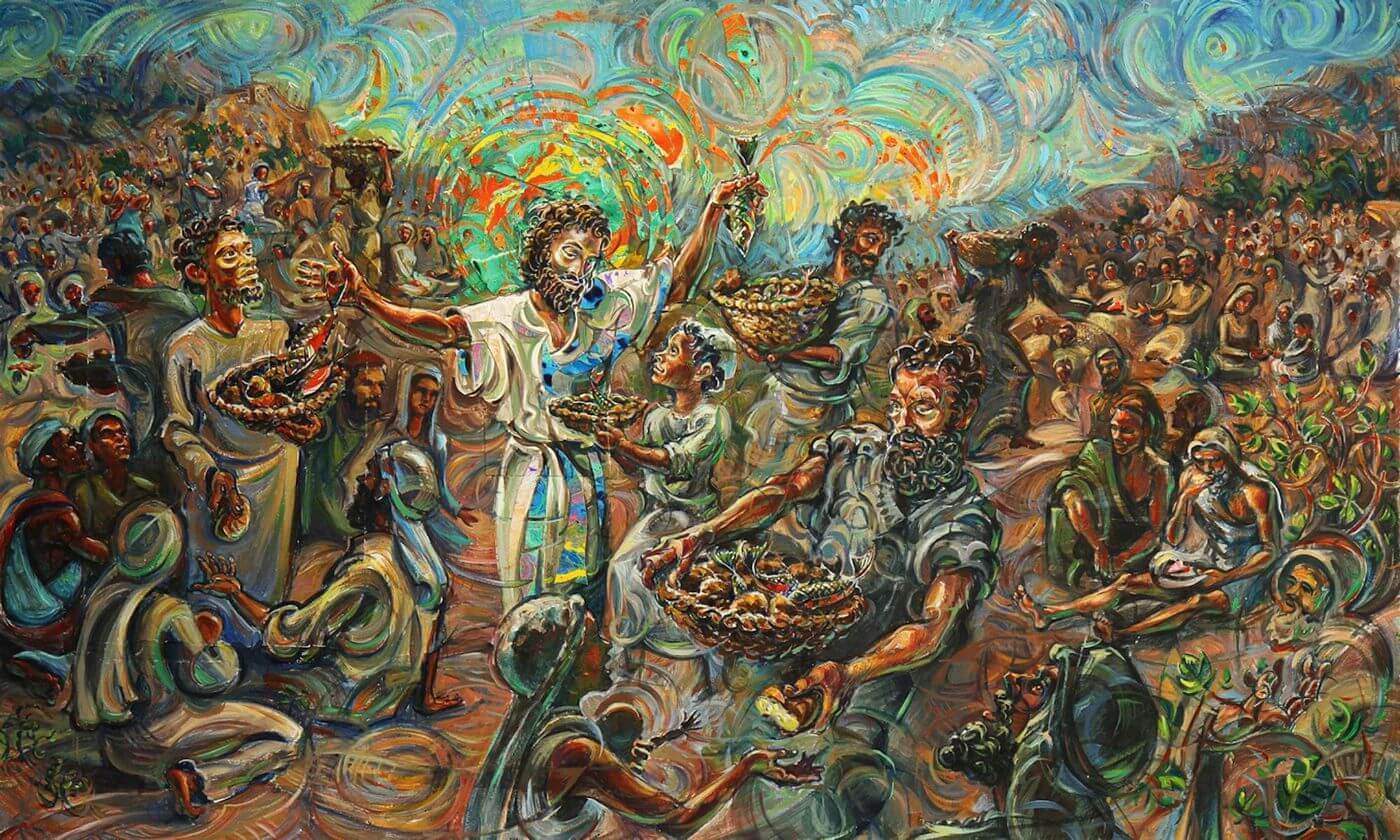
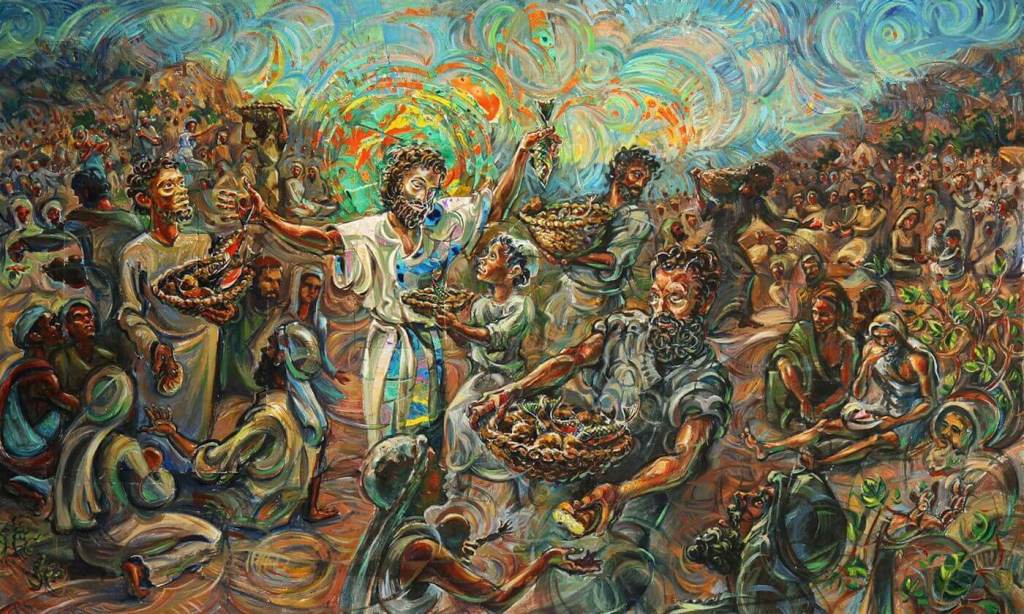
There are two layers to this story of the feeding of the five thousand: food and faith
First, there is a practical layer – food. There are 5000 men there, presumably together with women and children. They are hungry and there is no place to get food. So Jesus creates enough food out of five small barley loaves and two small fish to feed them all, and to have 12 baskets of leftovers. This miracle, which may remind us of Jesus turning water into excellent wine at a wedding, a few chapters earlier, speaks to God’s concern for the basic needs of humanity. God desires us to have what we need to live. Basic needs for shelter, food, warmth, healthcare, education and safety are important to God. And Jesus provides for them. This is the first part of God’s revelation of himself in this story – God is concerned for your everyday needs and is willing and able to help you meet those needs, just as he helped free the Jews in slavery in Egypt.
Second, there is a spiritual layer – faith. Looking at the large crowds, the disciples are overwhelmed, and their mustard seeds of faith flee. Jesus knows that their faith is feeble, and so he asks Philip, “Where shall we buy bread for these people to eat?” His question leaves no wriggle room for Philip to say they must sort themselves out – it is clear that bread must be provided. The only question is where they will buy it. Philip’s faith collapses, as he says, “It would take more than half a year’s wages to buy enough bread for each one to have a bite!” Philip is unable to imagine that Jesus can do more than what is humanly possible. His feet are deeply embedded in the ground.
But then Andrew brings along a little boy who has five small barley loaves and two small fish and presents him to Jesus. It feels as if Andrew has some spark of faith that maybe something could be done with this little bit of padkos. But almost immediately, his faith also collapses, as he says, “but how far will they go among so many?”
Jesus takes control of the situation and issues instructions. The disciples trust and obey, and everyone ate as much as they wanted. Although Jesus will come to criticize the people for chasing after food, in this moment, they recognise him: “Surely this the Prophet who is to come into the world!” They want him to be king, but he just wants to reveal God to them.
And today’s reading ends with Jesus walking across the surface of the lake in a storm, several kilometers from the shore, and reminding them of who he is: “It is I. I am. Don’t be afraid.”
Today, I’d like us to reflect on giving – financial giving. Before you run for the doors, give me a chance to put giving into context.
Our Old Testament reading today (2 Samuel 1:17-27) tells of the great love between David and Jonathan. It is a very tender reading, reminding us of our loving relationships with others, with family and with God. This theme of relationship runs through all our readings today.
Psalm 130 is an intimate song of love for and trust in God. “Out of the depths I cry to you, Lord” and “I wait for the Lord, my whole being waits, and in his word I put my hope” and “with the Lord is unfailing love”. This beautiful Psalm emphasises the deep loving relationship between us and God.
And Mark 5:21-43 tells of the woman who suffered from bleeding and had all but given up hope of healing. But she hears that Jesus is in the area and so she comes towards him, hiding from the people who would judge her, trusting and having faith that he can heal her, even if she touches just the hem of his robe. And as she is healed, Jesus lifts her up and honours her.
And Jesus does the same later in the same passage with the little girl who had died, “Little girl, I say to you, get up!” And she is brought back to health and life.
All of these readings emphasise the relationship of love, faith and trust between us and God and between us and each other.
It is in this context or relationship and faith that we come to 2 Corinthians 8:7-15, where Paul speaks about giving financially:
v7 – Paul writes about the “grace of giving” – grace meaning a gift (charis in the Greek, from which we get charismatic – spiritual gifts)
v8 – He emphasises that this is not a command to give – rather it is a grace to give
v8 – He uses words like sincerity and earnestness in relation to giving, to emphasise how personal giving is
v9 – Paul compares this with Jesus’ giving of himself for us – though he was rich, for our sake he became poor, so that through his poverty we might become rich – such a great act of generosity from Christ
v10 – He affirms the Corinthians not just for being the first to give, but particularly for being the first to have the desire to give – this desire or willingness or wanting to give is more important to him than the actual giving
v11 – He emphasises that we should give “according to our means” – the quantity of giving de-emphasised in favour of the “eager willingness” with which we give
v12 – Again, Paul emphasises our “willingness” to give – and again he emphasises giving “according to what one has, not according to what one does not have”
vv13-15 – And in the following passage he speaks at length about equality. He is interested in a redistribution of wealth – that those have more give to those who have less, so that everyone has enough. “The goal is equality” he says. Perhaps the modern word ‘equity’ is more appropriate – that each person has enough according to their needs, rather than that each person has the same. This is a foundation of Christian socialism, which brings us back to the focus on relationships – we live in fellowship with each other, connected to each other, and so if we have more than we need and someone else has less than they need, our inclination should be give some of what we have to them.
And Paul concludes, “The one who gathered much did not have too much, and the one who gathered little did not have too little”, quoting from the Israelites gathering manna in the desert in Exodus 16:18, which also says, “Everyone had gathered just as much as they needed”.
Giving financially may not come naturally to most of us – we want to hold on to, protect, save or spend what money we have. But the scriptures call us to be both sensible and generous, based on our relationships with God, the church and each other – relationships of love, faith and trust. I encourage you to reflect on this and consider whether you should revise your giving to God’s work.
John the Baptist is arguably the second most important person in the New Testament – second only to Jesus. He was the last of the First Covenant prophets – prophesying about the coming Messiah. Once Jesus arrived, John’s ministry, and that of all the prophets in the First Testament, had reached fulfillment.
Curiously, in John 1:6-35, John the Baptist (or the writer of the Gospel according to the John) repeatedly speaks to who John is NOT, rather than to who John IS. In total, there are five negative declarations in this passage, suggesting a humility on the part of John and a clear understanding of his role, as the forerunner and preparer for the Messiah. John is not the light (8), not the Messiah (20), not Elijah (21), not the Prophet (21) (even though that is really what he is), and not worthy to untie the sandals of the Messiah (27). Strong negative statements about who he is NOT.
Alongside these are three affirmations of who John IS, only one of which he voices himself: he is a witness to testify concerning the light (7), he is a witness to the light (8) and he is the voice of one calling in the wilderness, ‘Make straight the way for the Lord’ (23), even though this last is John quoting Isaiah. John makes not independent statements of himself in his own words.
John’s negations and lack of affirmations about his pivotal role and place in the Christian story suggest great humility and that the focus of all his efforts is on Jesus, the Messiah, the promised Son of God. His life purpose is to point to Christ.
This is confirmed in John’s testimony about Jesus, which includes him sharing that he himself did not recognise Jesus (31), but that he saw the Spirit of God descend upon him and remain on him (33).
And so John points us to Jesus: “Look, the Lamb of God, who takes away the sin of the world! This is the one I meant…” (29) and the next day, “Look, the Lamb of God!” (35). This is the role of the Prophet – to witness to his experience of Jesus and to point us to Jesus. He is the pointer.
Our role, as Christians today, at the end of 2023, is to take up John’s prophetic role, by pointing to Jesus, as John did. Through our lives, our actions, our words and our values, we are (for better or worse) God’s prophets, pointing the way to Christ.
How do we do this? Our readings provide suggestions:
Isaiah 61 suggests we do so by sharing good news to the poor, binding up the broken hearted, proclaiming freedom to captives, comforting those who mourn, providing for those who grieve, restoring places long devastated, standing up for justice, and standing against robbery and wrong doing. All of these prophetic actions are located in the world – they all speak to the social justice that characterises the Kingdom of God.
Mary’s song in Luke 1:46-55 echoes some of Isaiah’s sentiments: extending mercy, lifting up the humble, and filling the hungry with good things. But Mary’s vision of her son, the Messiah, also includes some strong prophetic words: scattering the proud and sending the rich away empty.
And 1 Thessalonians 5:16-22 focuses on more obviously ‘spiritual’ actions: to rejoice always, pray continually, give thanks in all circumstances, hold to the good and reject evil.
It is all of these actions – standing up for social justice, speaking out against injustice and evil, and ensuring a robust spiritual life – that serve as a prophetic voice in the world today. This is perhaps the most important thing for us as Christians to be doing in the world – pointing the way to the Messiah.
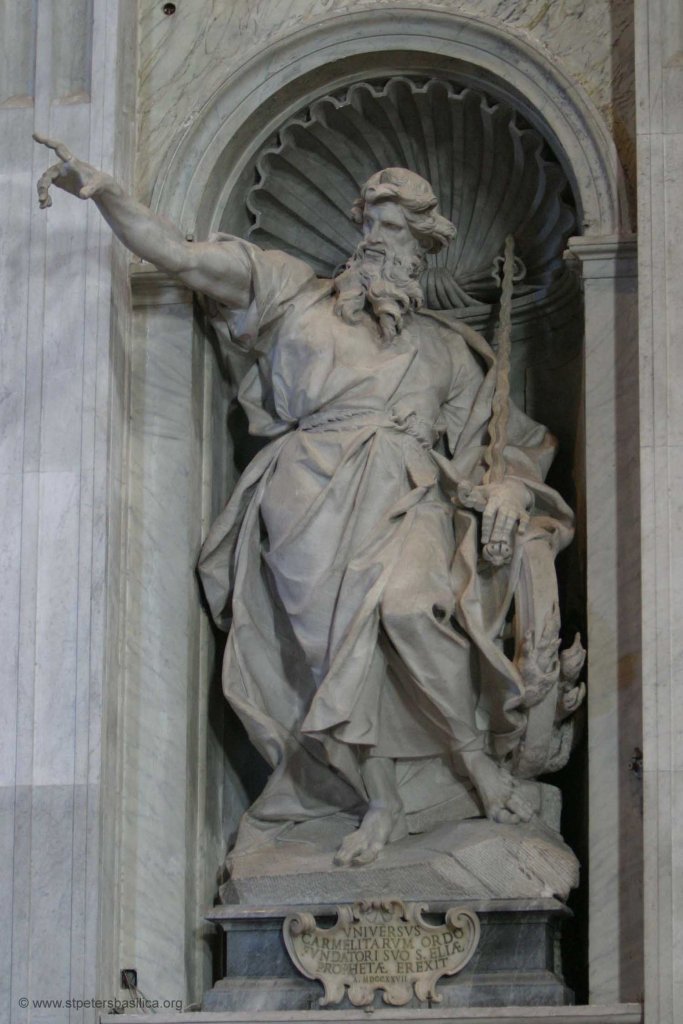
Statue of Elijah pointing, by Agostino Cornacchini (1727) at St Peter’s Basilica, Vatican City
Psalm 119:105 is a key text for Christian living: “Your word is a lamp for my feet, and a light on my path.” Not only does this verse point us to Scripture – the Word of God – as the source of light in life, but it also tells us something important about how God reveals Godself to us: in small increments.
We think of a lamp or light as a torch, providing a beam of light to shine up a path to see ahead to where we’re going. But the lamp the Psalmist writes about creates just a puddle of light around us – enough to see only the next step. To translate this verse into contemporary times, think of pointing your flashlight down at your feet rather than beaming ahead several meters.
Today’s world is premised on knowing the future and planning strategically and systematically. This is not bad – I do this all the time. But it is not the way God engages with humanity. God points us to a destination but typically does not provide us with the steps.
Let’s look, for example, at the story of Abraham and his descendants. In Genesis 12, God promises that he will make Abraham into a great nation and a blessing to all people. This promise is renewed several times over Abraham’s life. But he has his first child, Isaac, only around the age of 100 years! That’s a long time to wait for the most critical next step to becoming a great nation.
Then Isaac married only at age 40 and had his first son, Esau, at 60. And after Esau sold his birthright to Jacob, Jacob only had his first son, Reuben, at around 80 years. (Making up for lost time, Jacob had his other 11 sons within about half as many years!)
The point here is that there was little sign of God’s promise fulfilled across three generations from God’s promise to Abraham, covering perhaps 200 years. Where are the descents as many as stars in the sky and sand on the seashores? Abraham was given a destination, but he saw only a few steps of this over a very long time. Yet, throughout this time, Abraham was renowned for his deep faith that God was working out God’s purposes in him.
My journey to ordination is not as dramatic as Abraham’s, but it too was long in coming. I became a Christian at age 16, in 1984. Soon after, I began to feel a calling to become a minister. Though it persisted, I ignored it for nearly 20 years. In 2004, the call appeared again with an irresistible insistence. The following year, I started my BTh at TEEC and was licensed to preach. 12 years later, after much adversity, I was ordained deacon and the next year priest. Three years later, in 2021, I was appointed Rector at St Stephen’s. In total, the journey took around 35 years. That’s quite a long time to be journeying towards the fulfilment of a call to pastor a congregation. I knew the destination, but God took God’s good time to make it happen.
Jesus’ parable in Matthew 13 about the seeds sown in different soils tells a similar story. The fruitful crop emerged from seeds scattered on good earth. These seeds had to grow deep roots in healthy, nutritious soil to produce an abundant harvest. It takes time. Plant radishes if you want something quick, though most of us don’t like how they taste! Those who grow fruit trees or olives will know that farming is a long-term investment.
The lesson from these three readings (Genesis, Psalms and Matthew) seems to be that while we may have insight into God’s will for us, for our destination, the path from here to there is often long and opaque. We have to trust God – to trust his Word – that he will do what he says. But we should not expect quick answers.
Romans 8 reminds us that our minds must be governed by the Spirit and that we live in the realm of the Spirit. We do not live on the internet superhighway. We live our lives in the eternal life space of God. And that means being patient and faithful while God takes God’s good time to work out God’s purpose in our lives.
And so, dear ones, as we surrender the whole of ourselves to God, I encourage you to be patient with God and to have faith in God. Give God the space to do what God does best. Remember that the Lord says, “I know the plans I have for you, plans to prosper you and not to harm you, plans to give you hope and a future” (Jeremiah 29:11).







 Reflections of God's Love