Healthy church

Click here to listen to the audio recording of this 30-minute message (yes, again a bit longer than usual). Or watch the video here on Facebook (the message starts 24 minutes into the recording). Or read the text summary below.

This sermon (preached a week ago on 4 February 2024) is about a healthy parish – what makes for healthy parish life. It emerges, in part, in light of various churches failing to uphold core values around clergy integrity and sexual relations. A model for a healthy church is presented, based on the readings that were set for today in the Revised Common Lectionary, viz. Isaiah 40:21-31, Psalm 147:1-11, 1 Corinthians 9:6-23 and Mark 1:29-39.

Jesus is always our model for everything to do with Christian living, including corporate or collective Christian living – the church. This model is influenced by the readings above and also by how Jesus lived his life, related to God and people, and exercised his ministry.

1. Personal relationship with God

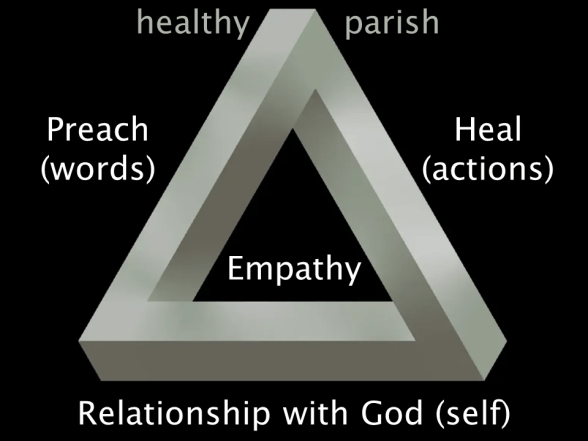
The foundation of a healthy church – and the foundation the triangle above – is each member’s personal relationship with God. Our collective well-being rests on the aggregate of each individual person’s health relationship with God. In Mark 1:35, Jesus leaves his ministry to spend time in his personal relationship with God – he does so repeatedly, even though there are so many people waiting for his healing ministry and teaching. If a personal relationship with God is important to Jesus – who is God, the second person of the Holy Trinity – how much more important should it be to each of us.

When you fly on an airplane, you will be told that, in the event of cabin decompression, oxygen masks will drop down from above your seat. And you will be told to put your OWN mask on FIRST, before helping others (including your children). This is an apt illustration of the need for each of us to see to our personal relationship with God. I, as priest, must ensure the robustness and depth of my relationship with God.

2. Preach words

In 1 Cor 9:16-18, Paul refers to his preaching as central and as God-given. In Mark 1:38-39, Jesus says he needs to go to other villages to “preach there also”. He goes on to say, “That is why I have come”. Preaching words is important to build people’s faith.

But for a health church, I suggest we translate preaching as our words. Too often our words are harsh, judgmental, critical and gossipy. Such words break down, alienate, diminish and harm. There is no place for such words in a healthy church.

Our words should heal and create. Psalm 147:4 says, God “determines the number of stars and calls them each by name”, while Isaiah 40:26 reiterates, “Lift up your eyes and look to the heavens: who created all these? He who brings out the starry host one by one and calls forth each of them by name. … not one of them is missing”. These verses indicate how the words of God bring stars into being, as he names and calls them. Similarly, our words – whether good or bad – can call things into being.

Therefore, our words should be deliberately encouraging, edifying, building up, loving. Last year, we spent the whole of Lent reflecting on Jesus’ command to “love one another”, where we teased this out in detail.

3. Heal through actions

Mark 1:29-34 and 39 say, “…[Jesus] went to her, took her hand and helped her us. The fever left her … Jesus healed many who had various diseases. He also drove out many demons … So he travelled throughout Galilee … driving out demons.” Isaiah 40:29-31 says, “He gives strength to the weary and increases the power of the weak. Even youths grow tired and weary, and young men stumble and fall, but those who hope in the Lord will renew their strength. They will soar on wings like eagles; they will run and not grow weary, they will walk and not be faint.” Psalm 147: 2-3, 8-9, says, “The Lord builds up Jerusalem; the gathers the exiles of Israel. He heals the broken-hearted and binds up their wounds. … He covers the sky with clouds; he supplies the earth with rain and makes grass grow on the hills. He provides food for the cattle and for the young ravens when they call.”

These words are all of healing actions. How we behave impacts the health of a church. When we exclude, abandon or just do nothing, we harm the church. We break it down and weaken it. Rather, we should engage in actions that build up a health community. We can do this by simply showing up, instead of being absent. And through simple acts, like cooking a family a meal when they’re going through a hard time, giving someone a call or sending them a message, helping to clean up. In our tradition, we share the peace during the service – we can make sure we greet all the people around us, instead of rushing off to chat with our friends and ignoring a visitor.

4. Empathy

I have placed ’empathy’ at the centre of the graphic of a healthy church, even though the word ’empathy’ does not appear in the Bible. But the concept is there, for example in 1 Corinthians 9:19-23, Paul writes:

19 Though I am free and belong to no one, I have made myself a slave to everyone, to win as many as possible. 20 To the Jews I became like a Jew, to win the Jews. To those under the law I became like one under the law (though I myself am not under the law), so as to win those under the law. 21 To those not having the law I became like one not having the law (though I am not free from God’s law but am under Christ’s law), so as to win those not having the law. 22 To the weak I became weak, to win the weak. I have become all things to all people so that by all possible means I might save some. 23 I do all this for the sake of the gospel, that I may share in its blessings.

Here Paul steps into the shoes of others, in order to understand them from inside, in order to share the Gospel in a way that makes sense to them. This effort to feel with others is core to empathy.

We see this profoundly in Jesus. Until Jesus was conceived, God had no first-hand understanding of what being human was like. God was not a man, and didn’t have personal experience of being human. But when Jesus incarnated in Mary’s womb and was born like any other human, God got a first-hand experience of being human – God discovered empathy for the human condition.

Too often, however, we jump to negative conclusions, without first exercising empathy. We assume the worst of people, rather than considering other less judgmental reasons for their behaviour. For example, if we don’t see someone for a few weeks we assume they have lost their faith or reneged on their responsibilities, when in fact they might be ill. Instead, let us rather assume the best – if we’re going to make an factless assumption, let’s make a positive one rather than a negative one, until the facts suggest otherwise.

A church that is grounded in personal relationships with God, that speak and act in ways that build up and encourage, and that chooses to empathise with each other, is likely to be a healthy community. This is the kind of community or body that God desires for us. It takes some effort on each person’s part. Working together, we can build a healthy church centred on God.

Mary’s example (Advent 4)

Click here to listen to the audio recording of this 18-minute message. Or watch the video here on Facebook (the message starts about 28 minutes into the recording). Or read the text summary below.

Mary, the mother of Jesus, had a difficult start to her pregnancy – she was young (probably about 13) and unmarried (only betrothed). Many of us may have become parents in less than ideal circumstances, and so we can feel with her the challenges she faced, when the angel Gabriel comes and informs her that she will become the mother of Son of God (Luke 1:26-38).

In reflecting on this well-known passage, three things stand out for me afresh:

First, Mary had a community of people around her, who loved and supported her. First, Joseph, the man (probably a boy, really, aged perhaps 14 or 15) who she was engaged to. He could so easily have spurned her, but instead, he remains steadfast at her side and protects her from judgmental neighbours. He was accepting, loving and faithful in ways that are quite extraordinary. Although we know little about Joseph, he sounds like a great father.

In addition, Mary’s aunt, Elizabeth, and her husband Zechariah. They were very old and Elizabeth had not borne a child. They too were vital sources of support for Mary, and in the following passage we read about Mary’s visit to Elizabeth.

This human community of support is important for all of us. We all need people in our orbit who care, love, accept, cherish, nourish, empower, advocate, challenge and enable. We need this at home, and we need it in the church.

Second, Mary did not go from ‘zero to hero’ in one leap. She was ‘greatly troubled’ by Gabriel’s message, so much so that the angel had to reassure her: Do not be afraid, Mary. And after Gabriel’s pitch to her, Mary asks questions of Gabriel, “How will this be since I am a virgin?” Gabriel is fully willing to engage her uncertainty, her fear, her incredulity and her questions.

This is in contrast to Gabriel’s response to Zechariah, who in v18 says something similar to Gabriel: “How can I be sure of this? I am an old man and my white is well on in years.” Zechariah’s words are not unlike Mary’s, but Gabriel responds strongly, asserting his authority, and silencing Zechariah until after John’s birth.

After some discussion with Gabriel, Mary come to a place of acceptance, or rather of acquiescence, “I am the Lord’s servant. May your word to me be fulfilled.” I have selected the word ‘acquiescence’ because I think it best captures Mary’s initial response. Acquiescence can be defined as “the reluctant acceptance of something without protest.” It is almost a resignation, similar to the Arabic “Inshallah”, which means “if God wills”, and implies that if God wills, it will happen whether we want it to or not. We surrender to God’s will.

We need also to learn to hear God’s voice speaking into our lives, to engage with God about God’s will, and to make decisions to acquiesce to God’s will. In other words, to trust in God.

Third, this passage shows forth a long-held principle (dating back to Genesis 1) of God choosing to partner with humans. Almost always there is a co-working between God and people to accomplish God’s aims. In this passage (v31), we get a series of things Mary will do: You will conceive. You will give birth to a son. You are to call him Jesus. And (v32-33), we get a series of things God will do: Jesus will be great, Jesus will be called the Son of the Most High, God will give him the throne of his father David, Jesus will reign over Jacob’s descendants for ever, Jesus’ kingdom will never end.

This plan that Gabriel brings to Mary involves a partnership between Mary and God. Without the partnership, the plan is impossible. And so it is with much of God’s work in the world – God chooses to limit God’s self by working with imperfect and limited human beings. This is God’s modus operandi.

In conclusion, let us follow Mary’s example, and that of Joseph, Elizabeth and Zechariah, and partnering with each other and with God, to accomplish those things that God desires in this world.

The Annunciation, fresco by Fra Angelico, 1438–45, San Marco, Florence

Repentance & Restoration (Advent 2)

Click here to listen to the audio recording of this 21-minute message. Or watch the video here on Facebook (the message starts about 35 minutes into the recording). Or read the text summary below.

Today (Sunday 10 December) is the Second Sunday in Advent, a season in which we remember and celebrate Christ’s first coming into the work and prepare ourselves for his second coming into the world.

Two key themes emerge from our readings: repentance and redemption.

Central to our preparation for Christ’s coming is repentance of sin:

  • Mark 1 speaks of John’s ministry of a call to prepare for Christ’s coming, to a baptism of repentance of sin, and to confession,
  • Isaiah 40 speaks of the sins of the people of Israel,
  • Psalm 85 refers to our iniquity and sin, and warns us of God’s wrath and anger, and
  • 2 Peter 3 calls us to repentance and warns of the possibility of us perishing.

Repentance is an important part of our lives as followers of Christ. The Greek word for repentance means to turn around – a 180 degree about turn. In repentance, we turn away from sin and towards God. It is a reorientation of ourselves in relation to God and sin. This is the most important work we can do during Advent, as we prepare for Christ.

Repentance leads to restoration. Through repentance, we are stored into our fellowship with God and experience the blessings of God in our lives:

  • Mark 1 speaks of John’s baptism of repentance leading to God’s forgiveness of our sins,
  • Isaiah 40 uses the most wonderful language, starting with “comfort, comfort my people”, tenderly, our hard service is complete, sin is paid for, valleys will be raised up and mountains made low, rough ground becomes levels and rugged places a plain, we all (humans) will see God’s glory and restoration, and God will tenderly gather, carry and lead us,
  • Psalm 85 says that God will restore us again and revive is again, That we will be together in righteousness and peace, that righteousness and peace will kiss, that faithfulness will spring up while righteousness will look down, and that God will give us what is good, and
  • 2 Peter 3 speaks of God’s patience with us, of a new heaven and earth, of us becoming spotless, blameless and at peace with God, and that God’s patience means our salvation.

These wonderful words of restoration are the fruit of repentance. As we turn 180 degrees away from sin and towards God, something most of us have to do daily (even hourly or minutely!), God forgives and restores. This is the great gift of God’s son – Jesus comes into our world to forgive and restore.

God, the Bible, the Church and Sexuality

Click here to listen to the audio recording of this 34-minute message. Or watch the video of the message here on Facebook (the message starts about 23 minutes into the recording). Or download my fairly detailed sermon notes (not a full-text transcript) in MS Word.

Today’s set of compelling readings from Micah 6:8, Psalm 15:1-3, Matthew 5:3-10 and 1 Corinthians 1:27-28, point us to the heart of a God who is concerned for those who are marginalised, vilified and outcast. They also emphasise that our responsibility as Christians is to be merciful, kind, humble, inclusive and generous.

In light of these readings, today’s message addresses the complex and controversial topic of sexuality in the church, particularly homosexuality. This is a topic that has been long ignored and more recent has lead to deep divisions within the the church between those who are against and those who are for (or at least tolerant of) gay relationships. Many gay Christians feel deeply rejected by the church – not just for what they do sexually, but for who they are – for their very being, their humanity, which is experienced to be under attack by Christians and the church.

In today’s message, I endeavour to the following, which I encourage you to watch, listen to or read, using the links provided at the top of today’s blog.

  • Some clarification of terminologies, particularly the difference between gender identity (who I see myself as being in terms of gender – traditionally male or female) and sexuality (who I have sexually or romantically attracted to – traditionally heterosexual or homosexual). Both of these terms have become increasingly diverse and nuanced in recent years.
  • Developing an understanding of how the Scriptures were authored within particular historical and cultural contexts that differ vastly from contemporary society.
  • I address five broad points of discussion in this message:
    • The belief of many Christians that heterosexuality is God’s only legitimate sexual orientation. I’ll show that this is not true.
    • The belief of many Christians that the Bible does not anywhere say that gay relationships are okay. I’ll show that this is not entirely true.
    • The belief of many Christians that the Bible condemns homosexual relationships as an abomination. I’ll show that this is not true.
    • The point that among the numerous laws in the Bible, some Christians draw on preconceived cultural beliefs to justify their condemnation of homosexual relationships.
    • And the primary of love that is presented in Jesus Christ’s teachings and his example of radical inclusivity.
  • Based on the above discussion points, I draw 4 key conclusions:
    • In human relationships, God is most interested in the quality of our love.
    • God is not interested in the sex or gender of the person we love.
    • Marriage is sacred, a divine joining together, and must be protected.
    • Marriage (defined as a sacred joining together or union) is not restricted to a man and a woman.
  • And in light of this I hope that my parish and your church community would aspire to:
    • emulate Jesus’ example of radical inclusivity, diversity and love
    • create a church space where people of various sexual orientations feel welcome, accepted and loved
    • focus on and champion the quality of love in human relationships.

I do appreciate that the views of Christians on the subject of homosexuality vary widely, and that there are many that will view my understandings and interpretations of the Scriptures as false and heretical. Our views on this subject can be deeply divisive. Nevertheless, I take Jesus’ lived life (how he behaved with people he encountered) and Jesus’ spoken teachings about what is most important to God as the central guides to make sense of the rest of Scripture. He is God incarnate – he is the perfect reflection of who God is. He himself says, “Whoever has seen me has seen the Father” (John 14:9). I follow him.

God’s self-revelation

Click here to listen to the audio recording of this 12-minute message. Or watch the video on Facebook here (the message starts at about 25 minutes).

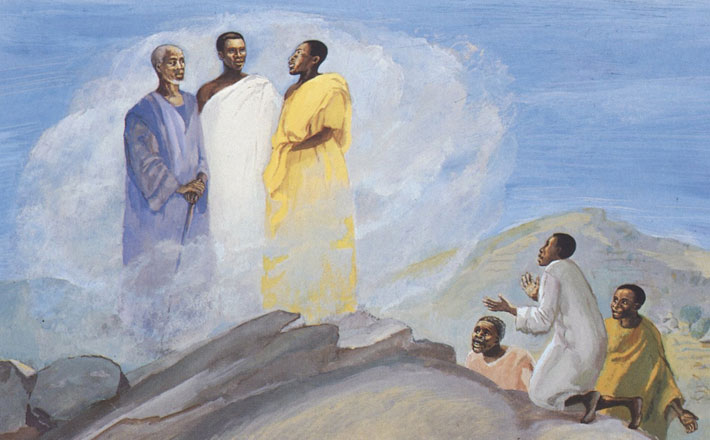
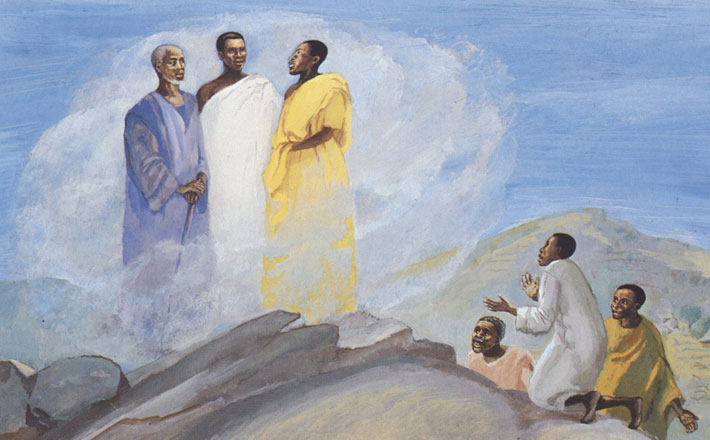
Today we celebrate the transfiguration (Luke 9:28-36), where Jesus reveals his divine nature to three of his disciples. This event, which in our church we celebrate with the colour white, falls after a period of ‘ordinary time’ in the church calendar, which we celebrate with green, and Lent, which we observe with purple. This celebration is thus well placed as a link between a period of ordinary growth in the church and period of intensive penitence and critical self-reflection.

Furthermore, the transfiguration is located in our church calendar almost exactly at the midpoint between Christmas (two months and two days ago) and Easter Sunday (10 days less than two months from now). Each of these events – the birth of Christ, the transfiguration of Christ and the resurrection of Christ – are moments of God’s self-reflection, or epiphanies. God shows God’s self for who God is, in these key moments in the life of Christ.

Christmas focuses on the incarnation of God the Son in the form of the human Jesus. It is God’s emptying of God’s self – the kenosis – in which God immerses God’s self into human life and comes to live among us as one of us. It is also a story of the birth of a child – of hope, of new life, of a baby. The Christmas self-revelation emphasises the light and life of God in our midst.

The transfiguration shows us that Jesus is more than ‘just’ a teacher, more than ‘just’ a healer or miracle worker. He is revealed in all his divine splendour, as the Son of God, even more, as God the Son. All the fullness of the Godhead dwells in Jesus. Most of the time it is hidden from sight. But in the transfiguration, Jesus kind-of drops his human skin and reveals his divine nature to Peter, James and John. The transfiguration self-revelation emphasises the power and divine majesty of God in our midst.

Easter focuses on the discipline and love of Jesus for his Father, and for humanity, leading him to walk a path that he knows will lead to his humiliation, suffering and ultimately, his death. He knows this is a path of suffering, but he also knows that it is a path towards the salvation of all of humanity. Jesus’ Easter resurrection is God’s self-revelation of profound and reckless love for humanity.

These revelations of God’s self – of who the triune God truly is – as our focus as we enter Lent. God is the child that brings life and light. God is the divine being, filled with power and majesty. And God is our saviour, filled with love and compassion. It is into this God, this Christ, that we immerse ourselves during the coming period of Lent.

Featured image: JESUS MAFA. Transfiguration, from Art in the Christian Tradition, a project of the Vanderbilt Divinity Library, Nashville, Tenn. https://www.workingpreacher.org/wp-content/uploads/2020/06/Mafa_Transfiguration_710.jpg

Advent: Hope

Click here to listen to the audio recording of this 15-minute message. Or watch the video on Facebook here (the message starts at 42 minutes).

Last week we learned some Advent yoga – reaching back and seizing hold of the promises God made and fulfilled in Christ, which God has fulfilled, which feeds our faith; and reaching forward and grasping at the promises God has made that still will be fulfilled in Christ, which gives us hope. Today we focus forwards towards the hope of things yet to come. Central among this is Jesus’ second coming.

Our readings today (Malachi 3:1-4; Luke 1:68-79; Philippians 1:3-11 and Luke 3:1-6) all speak about the anticipation of Christ’s coming, including his second coming. Malachi (and Jesus) speaks about the second coming as being sudden, unexpected, which gives us a fright. We don’t know when to expect him. Malachi also says, when the Lord comes, the messenger we long for, the Son of Man, who will be able to stand? It will be daunting. (Though Jesus prays in Luke 21:36 that at the end times “you may be able to stand before the Son of Man”.)

Malachi, John the Baptist, Jesus and Paul all tell us we need to prepare for the coming of Christ. We must be ready. We must repent of our sins and receive God’s forgiveness, then we are made right God, and ready to receive Christ. Malachi speaks about purification – metal purified by fire and clothing cleansed with launderer’s soap.

There will be a sifting, a separation. Malachi calls it a sifting – of flour from chaff and sand and stones. Jesus speaks about it as a separation of sheep and goats, of pruning away and discarding unproductive branches off a fruit tree.

But it is not all challenge and judgement. It is also about hope. HOPE! The hope that comes through Jesus Christ and the great work he has done for us. Zechariah, praying over his new-born son, John (the Baptist), uses words of hope like: salvation, mercy, rescue, forgiveness, peace, covenant, righteousness, tender mercy, sunshine, rising sun. And Paul, writing to the Philippians, speaks of love that may abound more and more in knowledge and depth of insight.

Let us prepare for Christ’s return. And let us hope for what he will accomplish in and around us. Let us articulate and pray for what we hope for – our lives, our world as a better place, as redeemed and sanctified. Let us pray with hope for the world we desire God to make real for us.

Amen

I really love this song!
Featured image from https://revivalfellowship.nz/wp-content/uploads/2016/07/12_LUMO_Ascension_1920.jpg

Advent: Between times

Click here to listen to the audio recording of this 9-minute message. Or watch the video of the message on Facebook here (the message starts at 32 minutes). Today’s message is really visual and action oriented, so watching the video is strongly encouraged – you need to see what’s going on really understand what I’m saying.

Advent is a between-times season – between Christ’s first coming (with all the prophecies before that in the First Testament) and Christ’s second coming (with all the prophecies for that in both First and Second Testaments). In Advent, we look forward to celebrating Christ’s first coming and also anticipate his second coming – which could be today or in a thousand years.

One part of us looks back in time and grabs hold of all the prophesies that were given about Jesus’ first coming, knowing that these were fulfilled. These fulfilled prophesies strengthen our faith to know that God is good on God’s word – what God says will be, will indeed be. And that nourishes and vitalises our faith. So, we have to read back into the past and clasp those promises made and fulfilled by God, because they nourish and enrich our faith in God.

And another part of us looks forward in time and reaches out to the fulfilment of the prophesies concerning Jesus’ second coming, with the hope that they will be fulfilled. Our hope is not blind, nor futile. Because we have the evidence of previously fulfilled prophesies. Thus our faith flames our hopes.

During this between-times, we are encouraged by Christ to “stand up and lift up your heads” (Luke 21:28). And so, in this very short homily, I act out (in a kind of ‘Advent yoga’) this reaching back and grasping the fulfilled promises of God, and stepping forward and reaching out towards the yet-to-be-fulfilled promises of God. And I get the congregation to stand up and join me in this.

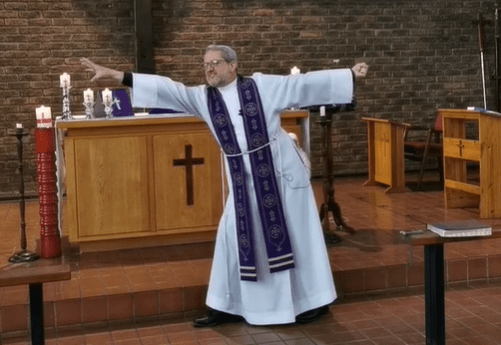
Adrian demonstrating what Advent looks like

Desperate times

Click here to listen to the audio recording of this 25-minute message. Or watch the video on Facebook here (the message starts at about 35 minutes – unfortunately the volume on the video is very soft).

There are times in our life when things are desperate. These two years of Covid, and the losses, restrictions and challenges it has brought us, have given us additional reasons to feel desperate. There are times when life is exceptionally hard and we feel that the world is pitted against us – that even God is pitted against us.

Psalm 22 knows something about this:

1 My God, my God, why have you forsaken me? Why are you so far from saving me, so far from my cries of anguish? 2 My God, I cry out by day, but you do not answer, by night, but I find no rest. 6 But I am a worm and not a man, scorned by everyone, despised by the people. 7 All who see me mock me; they hurl insults, shaking their heads. 8 “He trusts in the Lord,” they say, “let the Lord rescue him. Let him deliver him, since he delights in him.” 14 I am poured out like water, and all my bones are out of joint. My heart has turned to wax; it has melted within me. 15 My mouth is dried up like a potsherd, and my tongue sticks to the roof of my mouth; you lay me in the dust of death.

Jesus uses this Psalm to express his desperation and despair as he hangs dying on the cross. He feels God-forsaken, utterly desolate. Where is God in all of this? Why am I abandoned?

The Psalmist shows a flicker of faith – just a flicker, though:

9 Yet you brought me out of the womb; you made me trust in you, even at my mother’s breast. 10 From birth I was cast on you; from my mother’s womb you have been my God.

And he cries out with a desperate, but muted plea:

11 Do not be far from me, for trouble is near and there is no one to help.

Job knows something about desperate times, having lost everything, despite being a righteous man of deep faith. He loses everything – everything – and grapples to make sense of what feels like God’s abandonment of him. Instead of imploding in despair like the Psalmist above, Job explodes outwards in anger and wants to confront God (Job 23):

2 “Even today my complaint is bitter; his hand is heavy in spite of my groaning. 3 If only I knew where to find him; if only I could go to his dwelling! 4 I would state my case before him and fill my mouth with arguments. 5 I would find out what he would answer me, and consider what he would say to me.

Job pushes towards God, seeking confrontation, to put his case to God, to demand to know why God would let him struggle like this. Job is desperate, and his desperation evokes anger and outrage at God.

Yet God makes himself unfindable:

8 “But if I go to the east, he is not there; if I go to the west, I do not find him. 9 When he is at work in the north, I do not see him; when he turns to the south, I catch no glimpse of him.

How frustrating it is when the person we want to confront is unavailable, inaccessible. God disappears and Job is left both desperate and angry, with nowhere to vent his anger. And yet, Job is also afraid of God – God is dangerous, and a confrontation with God could be a disaster for Job:

13 “But he stands alone, and who can oppose him? He does whatever he pleases. 14 He carries out his decree against me, and many such plans he still has in store. 15 That is why I am terrified before him; when I think of all this, I fear him. 16 God has made my heart faint; the Almighty has terrified me.

In the end, Job does not offer up a muted plea like the Psalmist. Instead, he shakes his fist at God:

17 Yet I am not silenced by the darkness, by the thick darkness that covers my face.

23 “How hard it is for the rich to enter the kingdom of God! 24 … Children, how hard it is to enter the kingdom of God! 25 It is easier for a camel to go through the eye of a needle than for someone who is rich to enter the kingdom of God.”

The disciples also experience similar desperate times with Jesus. While we think and teach about Jesus as always available, receptive and loving, sometimes he is not. We know the story in Mark 10 of a young man who rushes up to Jesus, falling on his knees and asking what he must do to inherit eternal life. Jesus seems, from the get-go, to treat him harshly, eventually telling him to give away everything he has, and the young man is crestfallen and “went away sad”. Jesus then turns to the disciples and says:

The disciples are amazed and shocked – presumably at both Jesus’ response to the earnest young man and Jesus’ words about how impossible it is to saved. Peter cries out in desperation:

26 Who then can be saved? [and] 28 But we have left everything to follow you!

You can hear Peter’s despair. He has left everything – family, work, home, community, his place in society, everything – to follow Jesus, and now Jesus says that it is impossible for man to be saved and how hard it will be for anyone to be saved. It seems to Peter and the disciples that everything they have sacrificed is for nothing.

This is a low point for Peter. He hits rock bottom as it seems to him that he has lost everything. His sense of purpose is fracturing.

Sometimes, we find ourselves in similar places to the Psalmist, to Job and to Peter. Our world seems to be falling apart, the challenges of life pile up and seem unduly heavy, God seems to have abandoned us, where is he to be found?, we feel alone and desperate. It as this lowest point that transformation can come.

Peter missed something that Mark noticed. In Mark 10:21a, Mark writes, “Jesus looked at him [the rich young man] and love him.” Jesus looked at him and he loved him. Jesus looked at her and he loved her. Jesus looked at me and he loved me. Jesus looks at you and he loves you.

The writer of Hebrews helps us understand that a fundamental change occurs in the life of God, through Christ’s experience here on earth. Before the incarnation, God could see what human life was like, but could not feel what it was like. But with Jesus’ coming into this world in human form, God now knew first hard what human desperation feels like. Hebrews 4

14 Therefore, since we have a great high priest who has ascended into heaven, Jesus the Son of God, let us hold firmly to the faith we profess. 15 For we do not have a high priest who is unable to empathize with our weaknesses, but we have one who has been tempted in every way, just as we are—yet he did not sin.

And because Jesus understands fully what it is like to be human, and because he truly understands what it is like to be desperate, and because he loves us utterly and to the very end, the writer to the Hebrews invites us to come to God:

16 Let us then approach God’s throne of grace with confidence, so that we may receive mercy and find grace to help us in our time of need.

We can come to the throne of God, not with a muted plea, not with anger, not in desperation, but in confidence, knowing that at that throne we will find grace and mercy to help us in our time of need. We can be confident to wrestle with God, to plead with God, to challenge God, to lean into God. Because he love us and because he knows first hand how hard this life can be. Jesus (in Mark 10:29-31) does not promise an easy life – he promises both reward and persecution.

But he does promise that we can always have direct access to the throne of grace and mercy. Such is the love the Father has for us. God is always accessible, always nearby, always connected, always empathic, always in the midst of adversity with us.

Featured image from https://www.cdc.gov/nceh/features/hurricanepreparedness/index.html

Bread of Heaven (Part 5)

Click here to listen to the audio recording of this 25-minute message. Or watch the video on Facebook here (the message starts at 30 minutes). Or read the text summary below.

We complete our five-part series on the Bread of Heaven, this week focusing on John 6:56-69. Over the past four weeks, Jesus has been consistently redirecting us to himself and presenting himself to us as the source of life. Among other things, he has show that:

  • He cares about us.
  • He feeds us, meets our physical needs, abundantly.
  • He redirects us from earthly things to heavenly spiritual things.
  • He directs us towards himself.
  • He invites us repeatedly into a relationship with him.
  • He says he is the bread of life, come down from heaven
  • He invites us to feast on him.
  • He offers us and the world eternal life.

Now the question is: How will you respond to all this?

There are two sets of responses in our reading: the response of the larger group of Jesus’ disciples and then the response of the 12 disciples, voiced by Peter.

The response of Jesus’ disciples

Today’s reading indicates that Jesus’ teachings are hard – who can accept them? What is it about Jesus’ teaching in John 6 that is hard to accept, offensive? In part, it is his claim that he came down from heaven (John 6:42) and in part that he invites us to eat his flesh and drink his blood (John 6:52). On the one hand, he is too heavenly and on the other hand he is too earthly and fleshy. He is too high and too low!

Jesus responds to the first point by asking how they will feel when they see him ascending back into heaven (John 6:61-62). If his claim to have come down from heaven is hard to accept, how much more witnessing him ascending back into heaven! And he respond to the second point by saying they should forget about earthly flesh and concentrate on spiritual flesh and words, which are full of Spirit and life (John 6:63).

But, recognising that his teachings are hard to understand, Jesus acknowledges that some do not believe and some who believe will fall away. It is our choice whether or not we believe in him. Yet, it is important for us also to know that God the Father enables our faith, enables us to believe and even to accept hard, difficult teachings. Indeed, three times in this chapter, Jesus emphasises that it is the Father who inspires and enables our belief:

  • The Father gives us to Christ (John 6:37).
  • The Father draws us to Christ (John 6:44).
  • The Father enables us to come to Christ (John 6:65).

God is sovereign. God does the drawing of our hearts towards Jesus. We rely and depend on God to enable and inspire our faith. And so we pray to him when our faith frays.

Nevertheless, many of Jesus disciples turn away and leave him. God does not force them to stay or force them to believe. We have free well to listen to God’s call and to follow him. God may give, draw and enable our faith, but he does not coerce – we still choose.

The response of Peter

Finally, Jesus turns to the 12 disciples – they are not among those who turned away and left. He asks them, “You do not want to leave too, do you?” (John 6:67). The phrasing of the Greek implies a ‘no’ answer. Jesus is hoping that they will not join the others who have turned away.

Peter’s reply is wonderful:

“Lord, to whom shall we go? You have the words of eternal life!” (John 6:68) Peter knows the options out there, and concludes that they are all wanting. Even if Jesus’ teaching is hard to fathom, he can think of no better options. And besides, despite the difficult of Jesus’ teachings, he recognises that these are words of eternal life. Not words about eternal life, but the words of eternal life! Jesus very words are Life itself! As Jesus said earlier (v63), “the words I have spoken are full of the Spirit and of life.”

“We have come to believe to know that you are the Holy One of God.” (John 6:69) Here Peter describes a process – the same process that we have been following these past five weeks: there is a process (“we have come”) of learning to trust Jesus and to entrust ourselves into Jesus (“to believe”) that leads to knowledge about who Jesus is and what he means to us (“and to know that you are the Holy One of God”). There is a process of trusting Jesus that leads to us knowing him.

All of this (this entire chapter 6 in John’s Gospel) has been about drawing us closer into a trusting relationship with Jesus, redirecting us from the things of the world to himself, and learning to trust that he himself, as the bread that has come down from heaven, is the source of all the nourishment that we need, of life, of Spirit.

Again, the question is: How will you respond to all this?

Featured image of sourdough bread from https://www.independent.com/events/how-to-make-sourdough-bread/

Suffering God

Watch the video of today’s Good Friday service here. The Gospel reading and sermon start at about 25 minutes and continue for a total of about 25 minutes. If you want to hear me sing, you can also skip to about 1 hour and 18 minutes, as I lead the singing of “Sing, my tongue, the glorious battle”.

Today is Good Friday on which we commemorate the suffering and death of Christ, the Son of God. Part of what is so remarkable, even shocking, is that it is not just Jesus the man who suffers and dies, but God the Son who suffers and dies.

From the moment of his incarnation, separating out the second person of the Trinity into human form, God began to experience life as a human. This reaches a climax on the cross, when the evil and darkness of this world crashes into the Son of God. It is the whole person of Jesus – with both his human and his divine natures – who suffers and dies on the cross – not just the human Jesus.

  1. Christ experiences the sins of all the world – past, present and future – falling upon him, leaving him feeling dirty, tainted, defiled. No wonder he says, “I thirst”.
  2. Christ experiences sin’s separation from God – an ocean of sin distancing him from the Father with whom he had already existed for eternity. No wonder he says, “My God, my God, why have you forsaken me”.
  3. Christ experiences the surprise of human love, and the ways in which compassion between people brings God into our midst. Thus he says to his mother, “Woman, here is your son” and to his beloved disciple, “Here is your mother”.
  4. Christ experiences the grace of God, able to transform the darkest and most painful into a moment of salvation and glory. Thus he is able to say, “It is finished!”
  5. Christ experiences death – the loss of life, the loss of this world, the loss of self. John writes poetically, “He bowed his head and gave up his spirit”.

As much as we might want to end today’s story with a ‘Happy Easter’, scripture does not permit this. We have to end with the darkness that covers that earth as the Son of God’s light and life is snuffed out. And we wait in silence and hope for his resurrection.

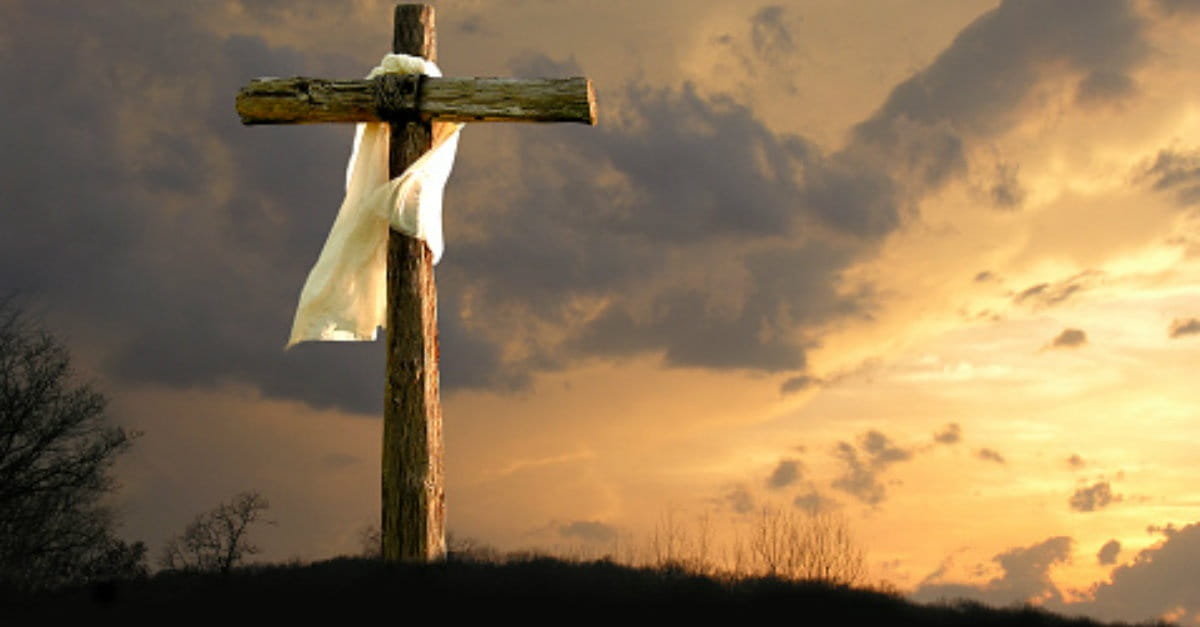
Featured image from: https://media.swncdn.com/cms/CW/30914-cross-5-facebook.jpg