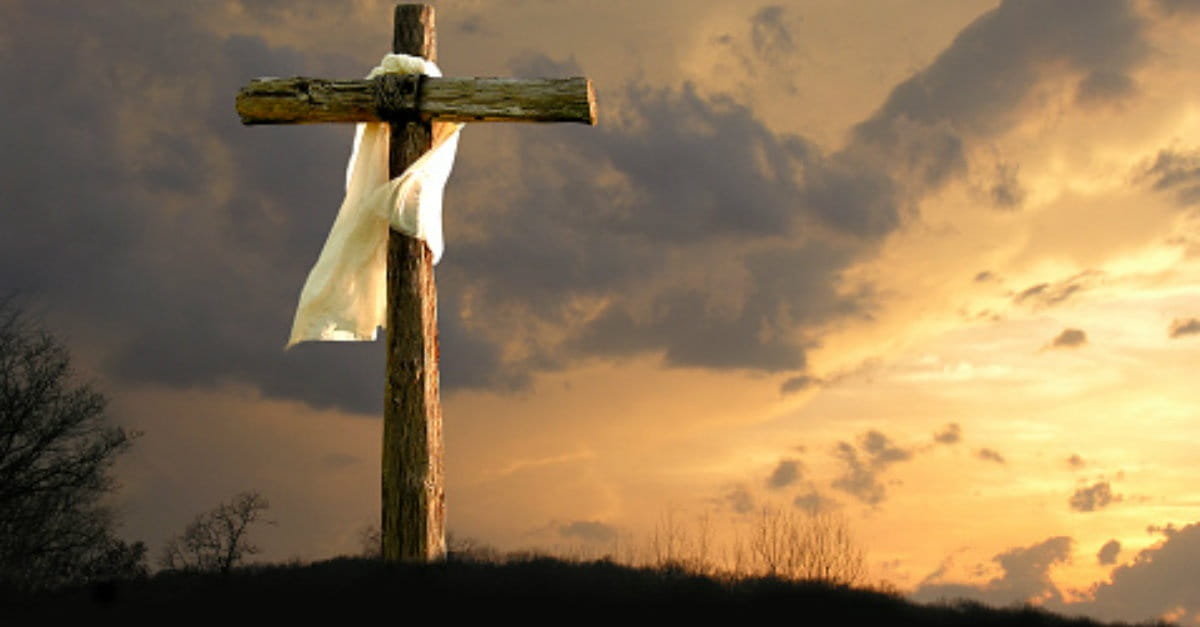
Riding the storm (part 2)

Click here to listen to the audio recording of this 18-minute messages. Or watch the video on Facebook here (the message starts at about 30 minutes into the video). Or read the short summary below.

Last week, we read and reflected on the story from Mark 4:35-41 about Jesus calming the storm (see last week’s message – Riding the storm – here). It’s worth watching or listening to if you missed it. I emphasised three key points:

  1. Jesus is in the boat with us in the midst of the storm. He is not sitting far off watching, dispassionate. No! He is right in the storm with us, in the boat with us.
  2. Jesus controls the storm that buffets and scares us. He is more than capable to put the storm in its place.
  3. Jesus reminds us of the many times before that he has been faithful and capable, so that we can have faith in him, confidence in him, even during the storm.

Today, I want to add two additional stories to this one, so that we can build up our faith muscles when we are weathering a storm. This is particularly important, given that we are in the midst of the third wave of the COVID-19 pandemic, and given that our churches have, once again, closed their doors and moved online for services.

The first story is an echo of the one above and comes from Mark 6:45-51. The disciples are again in a boat on the Sea of Galilee, but this time Jesus is up on the hillside praying. He can see that the disciples have encountered a storm and are struggling. So he walks down the hill and across the top of the water towards the disciples’ boat. They are terrified, thinking he’s a ghost, but he calms them, saying, “Take courage! It is I. Don’t be afraid.” Then he climbs into the boat with them, and the storm calms down. Mark does not say Jesus calmed the storm, but it seems an unlikely coincidence that the storm just happened to subside when Jesus arrived. We learn three important lessons about Jesus when we are in a storm:

  1. Jesus sees the disciples plight and comes to them and speaks words of comfort to them: ‘I am here, it is I, don’t be afraid.’
  2. Jesus climbs into the boat. In the previous story Jesus was already in the boat when the storm arrived. In this story, Jesus climbs into the boat with the disciples in the midst of the strong winds. He chooses to enter the difficult place where they are.
  3. Jesus calms the waves, demonstrating (again) that he is more than capable.

The second story is a healing story, that is located within a larger healing story. The larger story is about Jairus’ daughter who is mortally ill and (it seems) dies before Jesus gets there, because Jesus is delayed by the inner story, which is recounted in Mark 5:24-34. The story is set in a large crowd – many people, all jostling around and up against Jesus, as he walks the streets.

The crowd feels like a storm – buffeting, noisy, knocking up against, pushing, threatening. (Hence the picture for today’s message.)

This is the story of the woman who had been bleeding for 12 years and all her efforts to find a cure were futile. He hears about Jesus and believes that even if she can just touch just the hem of his outer clothing, she will be healed. Even though she is unclean due to her persistent bleeding, she enters the crowd and manages to just touch Jesus’ clothes. And she is fully healed! Jesus can feel that power has gone out of him and wants to see who was healed. We learn three important lessons about Jesus when we are struggling in life’s storms:

  1. Jesus cures her. She merely needed faith, and without him even knowing or intending it, without even actually touching her, she is healed. It is as if Jesus’ natural instinct is to heal and make whole, so it just pours out of him when someone has faith in him.
  2. Jesus knows her. He initially doesn’t know who touched him, but he knows someone did, and when she owns up, he fully engages with her as if the crowd is not even there – like the still centre of a tornado.
  3. Jesus restores her. Her healing is primarily physical. But the result of that physical healing is that she becomes clean again, and thus able to touch other people, able to engage in the life of her family and community, able to participate in her faith.

There are many storms raging around us. Covid is the most public and universal. But there are others: financial concerns, loss of work, mental health issues, substance abuse, marital problems, divorce, illness, death, loneliness, addictions, and so on and so on. The list is almost endless.

But there are three important take-home messages for you today:

  1. Jesus sees you. He sees and knows you right where you are. He knows everything about you and your circumstances, no matter how private you are and no matter how alone you might feel. He sees you.
  2. Jesus joins you. He does not remain remote. He does not watch from a distance. He climbs into your boat, into your life, into your shoes. He is right there with you – so close, there is no gap between you and him.
  3. Jesus acts for you. Jesus calms storms, he banishes fear, he heals disease. He is more than capable and he is more than willing. We just have to reach out to him, to touch the hem of his robe.
Featured image from: https://www.popsci.com/what-to-do-crowd-crush-panic/

Riding the storm

Click here to listen to the audio recording of this week’s 12-minute message (followed by some singing). Or watch the video here on Facebook (the message starts at about 35 minutes).

The disciples find themselves in a boat in the midst of a ferocious storm (Mark 4:35-41). They cry out to Jesus: “Don’t you care?” We sometimes find ourselves in a similar situation. The world seems to swirl around us, exploding, destabilising. We wish for a granite foundation, but instead we are in a boat in the storm; at sea. But the disciples learn three things in this experience:

  1. Jesus is in the boat with them. He is not standing at a distance, watching. He is right with them in the boat, in the midst of the storm.
  2. Jesus demonstrates that he has the power to subdue nature. He is more than able to overcome any adversity we may experience, to calm any storm we may experience.
  3. Jesus reminds his disciples that they have experienced his capability in the past; and so should remember it in the present. “Do you still have so little faith?” he asks them.

When we are in the midst of the storm – as we are now with the third wave of Covid threatening to overwhelm us – we need to keep turning back to Jesus. He is the source of strength, healing and wholeness.

Featured image by Bernard Allen at https://twitter.com/bernardallenart/status/900703185479897090
I appreciate how we see Jesus both sleeping (in the lower left) and calming the storm (in the upper right), with the sea reflecting the storm and calm in the two sections.

Christ in the world

Listen to the audio recording of this 12-minute message here. Or watch the message on YouTube here. Or read the text summary that follows.

Towards the end of John’s Gospel, Jesus prays for his disciples, “My prayer is not that you take them out of the world but that you protect them from the evil one” (John 17:15). It seems that Jesus wants his disciples to be immersed in the world. Indeed, he reinforces this in verse 18, when he prays, “As you sent me into the world, I have sent them into the world”, with his double use of “into the world”. Christians, therefore, cannot stand apart from the world. We need to be invested in and participate in the world.

But in his prayer, Jesus also prays that we may be protected “from the evil one”. I suggest that he is praying that we don’t get co-opted into the ways and values of the world, whose master is the evil one. Jesus wants us in the world, but not of the world; active in the world, but not colluding with the values of the world, that is, the values of Satan.

It reminds us of the Lord’s Prayer, where Jesus prays both “thy kingdom come on earth as in heaven” and “deliver us from evil”.

John 8:2-11 provides us with an example of how Jesus implements this. A woman who was caught in the act of adultery is brought to Jesus by a group of men (teachers of the law and Pharisees). We don’t hear about the man who was engaged in adultery with her, which already tells us something is not right. They want Jesus’ opinion on what should be done. Jesus doodles in the dust – we’re not sure what he is writing. Perhaps he is weighing up the sins of the woman and the sins of each of the men.

When he stands up it is clear from his responses to the men (“Let any one of you who is without sin be the first to throw a stone at her”) and the woman (“Go now and leave your life of sin”) that both the men and the women were sinful. Jesus then appears to lift up and suspend their sin – it is something they have in common – all are sinners. And what is left once their sin is lifted away?

A massive power differential. The men, as a group, as leaders and as men in a patriarchal society, have far greater power than the woman, as an individual and as a woman in a patriarchal society. The degrees of power between them are enormously disparate.

In light of that, Jesus opts to stand with the woman. He stands in solidarity with the one who is less powerful, more marginalised, more poor. This is Jesus’ pattern throughout his ministry. Scholars have come to call this Jesus’ “option for the poor“, because he repeatedly opts to stand with the poor. Not because they are less sinful than anyone else, but because they are less powerful, more vulnerable.

In the world right now, we are deeply disturbed by the escalating violence in the Middle East, between Palestine and Israel. This is a fraught situation, with a long history going back decades and even centuries. There are no easy answers. And whatever one says, one may be judged to be wrong. Nevertheless, let us attempt to apply Jesus’ method to this situation.

Both Israel and Palestine (and Hamas) have used and are currently using violence against each other. Each side blames the other for their use of violence, making it hard or even impossible to say who started it. Let us, then, like Jesus recognise that both sides use violence and lift or suspend that, for now. Not for ever, just for now. What is left once violence is lifted away?

A massive power differential. Israel, compared to Palestine, is wealthy, has powerful allies, has large amounts of land, has tremendous resources to protect itself. Palestine is impoverished, lacking in infrastructure, with very little access to the world, with few powerful allies and with increasingly little land and freedom. The degrees of power between them are enormously disparate.

In light of that, where would Jesus stand? He would stand in solidarity with the one who is less powerful, more marginalised, more poor. He would stand with Palestine. Not because Palestine is less sinful than Israel, but because they are less powerful, more vulnerable. This is Jesus’ option for the poor. He opts to stand with the poor.

And so we too should stand with the poor and not collude with the evil one who would prefer us to stand with the powerful. While it is good to pray for peace in that region of the world, it is better to pray for justice. Once the violence stops, the problems that fuel the violence will still not be resolved. These problems have existed for decades. They are fundamentally about justice for Palestine. Let us pray for justice for Palestine that leads to peace with Israel.

Featured image from https://unjppi.org/index.html

Suffering God

Watch the video of today’s Good Friday service here. The Gospel reading and sermon start at about 25 minutes and continue for a total of about 25 minutes. If you want to hear me sing, you can also skip to about 1 hour and 18 minutes, as I lead the singing of “Sing, my tongue, the glorious battle”.

Today is Good Friday on which we commemorate the suffering and death of Christ, the Son of God. Part of what is so remarkable, even shocking, is that it is not just Jesus the man who suffers and dies, but God the Son who suffers and dies.

From the moment of his incarnation, separating out the second person of the Trinity into human form, God began to experience life as a human. This reaches a climax on the cross, when the evil and darkness of this world crashes into the Son of God. It is the whole person of Jesus – with both his human and his divine natures – who suffers and dies on the cross – not just the human Jesus.

  1. Christ experiences the sins of all the world – past, present and future – falling upon him, leaving him feeling dirty, tainted, defiled. No wonder he says, “I thirst”.
  2. Christ experiences sin’s separation from God – an ocean of sin distancing him from the Father with whom he had already existed for eternity. No wonder he says, “My God, my God, why have you forsaken me”.
  3. Christ experiences the surprise of human love, and the ways in which compassion between people brings God into our midst. Thus he says to his mother, “Woman, here is your son” and to his beloved disciple, “Here is your mother”.
  4. Christ experiences the grace of God, able to transform the darkest and most painful into a moment of salvation and glory. Thus he is able to say, “It is finished!”
  5. Christ experiences death – the loss of life, the loss of this world, the loss of self. John writes poetically, “He bowed his head and gave up his spirit”.

As much as we might want to end today’s story with a ‘Happy Easter’, scripture does not permit this. We have to end with the darkness that covers that earth as the Son of God’s light and life is snuffed out. And we wait in silence and hope for his resurrection.

Featured image from: https://media.swncdn.com/cms/CW/30914-cross-5-facebook.jpg

Into the light

Click here to watch the video of this sermon. It is a visually driven message so good to watch if you can. The Gospel reading starts at about 17 minutes, and the sermon starts at about 35 minutes and lasts 22 minutes.

https://fb.watch/4zbbA1Fosv/

Today is the Tuesday of Holy Week. We continue with John 12, focusing today on vv 20-36. I preached on this just a few days ago – a message titled Following Jesus, which you can access here. Tonight I want to focus on just the last two verses of this passage:

Then Jesus told them, “You are going to have the light just a little while longer. Walk while you have the light, before darkness overtakes you. Whoever walks in the dark does not know where they are going. Believe in the light while you have the light, so that you may become children of light.” When he had finished speaking, Jesus left and hid himself from them.

In these two verses, Jesus uses the word ‘light’ five times in reference to himself. This reinforces yesterday’s sermon, Light in the centre, where I emphasized in a drawing that Jesus is the light at the centre of all of life’s complications, and that the centre light is where we most want and need to be.

Jesus stresses in tonight’s passage that the light is surrounded by darkness and at risk of being overtaken by darkness and that the light will not be with us for long – just a little while. We get the sense that the Light of Christ is precious and to be embraced. Light is something beautiful, wonderful, fragile, exceptional and desirable. We want the light!

And then Jesus gives us three instructions:

  • Believe in the light. Jesus is himself the light (John 1:4-9 and John 14:6), so to believe in the light is to believe in Christ.
  • Walk in the light. Jesus says he is the way and the light (John 14:6). We want to walk in the light, not in the dark. In the dark we get hurt and lost, but in the light, we cannot put a foot wrong.
  • Become children of light. Paul writes, “Now if we are children, then we are heirs—heirs of God and co-heirs with Christ” (Romans 8:17). This adoption as children of God, children of light, is an incarnation of the Spirit of God into us, as God makes our bodies a temple for Holy Spirit.

As we journey out of church into the darkness, and we journey through the various darknesses in the world around us (rape, abuse, racism, social exclusion, poverty, Covid, xenophobia, and so the list goes), let us believe in the light, walk in the light and become children of light. When we do that, we become God’s light-filled presence in a world that is much in need of light.

Light in the centre

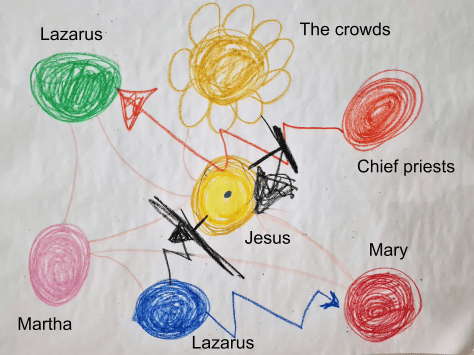
Today is the Monday of Holy Week. We read the story (John 12:1-11) of a dinner party hosted by Lazarus (whom Jesus had raised from the dead) and his sisters, Mary and Martha. During the dinner, Mary anoints Jesus’ feet with extremely expensive perfume and is reprimanded by Judas, who wants the money for himself. Meanwhile, crowds gather around the house, not only to see Jesus, but also to see Lazarus – the man back from the dead. And the chief priests plot to kill Lazarus, because his resurrection was adding to Jesus’ popularity.

In the midst of all this turmoil, Jesus is a quiet, strong, protective, light-filled centre. It is towards and into this centre that we should move when life’s challenges build up around us.

I invite you to watch the reading of the Gospel from John 12:1-11, which starts at about 14 minutes into the service. And the sermon starts at about 22 minutes and runs for about 23 minutes. This is a visual sermon, mapped out on a flipchart, so you really do need to watch it and not just listen to it. May you place yourself in the centre of Christ, in his light and peace – the best place to be!

Watch the video by clicking here: https://fb.watch/4xReFll03A/

A life of love

Click here to listen to the audio recording of this 12-minute message. Or watch the YouTube video. Or read the text summary below.

Today is surely a watershed moment for the world: 20 January 2021, the end of Donald Trump’s administration. Whether or not one is an American, this change of administration will surely impact the world in one way or another.

This is not a sermon about America or American politics, however. Rather it is a sermon about what defines a Christian. When we look at the American right and left, who are so profoundly divided at this time, and yet who both comprise large numbers of Christians who believe that their politics is aligned with their Christian faith, we must ask, What does it mean to be a Christian? How can Christians, who follow the same book of teachings, be so polarised when it comes to their beliefs, practices and policies?

Perhaps one of the reasons is the weight that different groups of Christians give to different parts of the Bible. While we (are exhorted to) believe that “all Scripture [that is, the whole of the Bible] is God-breathed and is useful for teaching, rebuking, correcting and training in righteousness” (2 Timothy 3:16), if we base our Christian beliefs, practices and policies on the first Testament (the Old Testament) more than on the Gospels, or even on the rest of the second Testament more than on the Gospels, then something is wrong.

The Gospels present to us the very life, ministry and teaching of God the Son. These are not subsequent interpretations of Christ’s ministry, but Christ’s ministry itself. If we want to see God, we must look at his Son; and we get his Son in the Gospels. Jesus Christ’s life, as recorded in the Gospels, must be the template for Christian belief, practice and policy. And all the rest of the Bible must be interpreted through the Gospels.

Ironically, our reading today is not from the Gospels, but from Paul’s letter, where he writes about the central message we get from the Gospels: live a life of love.

Be kind and compassionate to one another, forgiving each other, just as in Christ God forgave you. Follow God’s example, therefore, as dearly loved children and live a life of love, just as Christ loved us and gave himself up for us as a fragrant offering and sacrifice to God. (Ephesians 4:32-5:2)

The life of a Christian must be rooted in love. This passage is not about love for other Christians, but love for all humanity. Paul emphasises the love that God had for us before we were saved – the love that led to God’s forgiveness of us and of Christ’s offering of himself as a sacrifice to God – these are about God’s love for us before we were saved, and thus the example is for how we love the whole world.

Love is the foundation of Christian life. Indeed, these verses are part of a larger passage which opens as follows:

So I tell you this, and insist on it in the Lord, that you must no longer live as the Gentiles do, in the futility of their thinking. They are darkened in their understanding and separated from the life of God because of the ignorance that is in them due to the hardening of their hearts. (Ephesians 4:17-18)

In other words, Paul sees this ‘life of love’ as constituting a fundamental difference between Christian life and non-Christian life. Our love for others is what is supposed to define us as Christians and differentiate us from everyone else. Indeed, Christ himself gives us this great command:

A new command I give you: Love one another. As I have loved you, so you must love one another. By this everyone will know that you are my disciples, if you love one another. (John 13:34-35)

This love for other people (and indeed for the whole of creation) is fundamental to what it means to be Christian. It is only after all this, that Paul then says, “But among you there must not be even a hint of sexual immorality” (Ephesians 5:3) and then goes on to talk about morality. Morality is important, but the life of love is even more important. When we place morality above love, we are out of step with Christ, who consistently placed love above everything else. If you are placing morality above love, you must go back to the Gospels and see how Jesus lived, what he said and how he related to people.

What is most important and definitive in the life of Christ is the life of love, which is a love that is radical and inclusive. It is this kind of love that is supposed to inform our beliefs (how we understand God, ourselves and the world), our practices (how we life our life moment by moment) and our policies (or politics).

We pray for the people of America and their new president. We pray for a drawing closer together of the American people, a reduction in polarisation and anger, and a greater rooting of life in the Gospel message of love for one another. And we pray also for ourselves and our nation, which has its own challenges.

Featured image from https://www.pinterest.co.uk/pin/17240411047269719/

The battle

Click here to listen to the audio recording of this 13-minute message. Or watch the YouTube video below. Or read the text summary after that.

Covid-19 has been spreading at an alarming rate in recent weeks. We have more new cases and more deaths than we had at the height of the first wave back in July and August 2020. And we hear of whole families infected with Covid and even dying of Covid. We ought to be greatly concerned about Covid. Let us think of Covid as the enemy of humanity and an agent of the devil. Covid does everything that is the antithesis of God and works against God’s vision for humanity.

We draw on Exodus 17:8-13 for today’s message:

The Amalekites came and attacked the Israelites at Rephidim. Moses said to Joshua, “Choose some of our men and go out to fight the Amalekites. Tomorrow I will stand on top of the hill with the staff of God in my hands.” So Joshua fought the Amalekites as Moses had ordered, and Moses, Aaron and Hur went to the top of the hill. As long as Moses held up his hands, the Israelites were winning, but whenever he lowered his hands, the Amalekites were winning. When Moses’ hands grew tired, they took a stone and put it under him and he sat on it. Aaron and Hur held his hands up—one on one side, one on the other—so that his hands remained steady till sunset. So Joshua overcame the Amalekite army with the sword.

Let us think of the Amalekites as Covid – our common enemy. Everyone is working to fight off this enemy:

Joshua and his soldiers are like those who are fighting Covid directly – frontline health workers, those developing vaccines and the President and his team.

Moses, together with Aaron and Hur, are up on the hilltop praying for Joshua and his team as they battle the enemy. Let us imagine that we are Moses, Aaron and Hur.

We can and ought to be praying against Covid. Prayer is not just a psychological thing that we do. It is real engagement with God and has a real impact on the real world. Prayer is hard – Moses struggles to keep his hands above his head holding the staff of God. We have to persist, to persevere in prayer.

And as Moses struggles, Aaron and Hur come alongside him. They help him to sit and then each help him hold up his arms, so that Moses can continue his work of prayer. Aaron and Hur work together to support Moses, who prays on behalf of Joshua.

In a similar way, we need each to do our part in supporting our collective efforts against Covid. These are quite simple: wear a mask, maintain physical distancing and avoid large gatherings. When we each do our part, we make a collective difference and contribute to the common good of all humanity.

And finally, let us take heart that God is present also in this collaborative effort: Aaron and Hur work to support Moses as he prays to God to enable Joshua and his team to fight off the enemy. There is no ‘let go and let God’ in this narrative. Each member of Israel had a role to play – each did their part. Together, working collaboratively, working in partnership with God, they were able to win the battle.

Dear friends, let us pray for God’s salvation and let us each do our part to support and protect each other, so that we win the battle against Covid.

Featured image from https://i.pinimg.com/originals/af/a1/53/afa153c86da28cdfcf52e0091fc0035e.jpg

The world

Click here to listen to the audio recording of this 21-minute message. Or watch the YouTube video below. Or read the text summary that follows.

1 John 2:15-17 presents us with a challenging text:

Do not love the world or anything in the world. If anyone loves the world, love for the Father is not in them. For everything in the world—the lust of the flesh, the lust of the eyes, and the pride of life—comes not from the Father but from the world. The world and its desires pass away, but whoever does the will of God lives forever.

How is it that John tells us not to love the world? Must we hate the world? Or distance ourselves from it? And from the people who live in it? These questions are made yet more challenging because John uses the Greek word agape for ‘love’, which is the kind of self-sacrificial love we use for Jesus’ love for us. How then do we make sense of this passage?

When presented with difficult passages, we should always look at the text in context. The immediate context is the letter that John is writing. And a broader context that I often find useful is the life and teaching of Christ – what we learn in the Gospels. From Jesus, we learn much of value about loving the world, for example, in John 3:16-17, Jesus says to Nicodemus:

For God so loved the world that he gave his one and only Son, that whoever believes in him shall not perish but have eternal life. For God did not send his Son into the world to condemn the world, but to save the world through him.

Clearly, from this passage, God loves the world extravagantly, so much so, that he sent his Son, Christ, into the world. Not to condemn or judge the world, but rather to save it, to heal it, to reconcile it to God. Indeed, this teaching comes across in numerous places throughout the Second Testament. John, as the author of both the Gospel and the letter, cannot be meaning that we must hate the world or even not love it. His meaning must be more nuanced than that.

Let’s look at another passage, from Luke 10:25-37. Here Jesus is asked by an expert in the Law what he must do to inherit eternal life. Jesus answers with the Great Commandment – to love God and to love one’s neighbour. Because ‘neighbour’ could easily be interpreted to mean just those close to me, people who are like me, the expert rightly asks Jesus, “And who is my neighbour?” Jesus then tells the parable of the Good Samaritan – the Samaritan is the neighbour – a person who was not part of the Jewish community or faith. In effect, Jesus says, ‘Everyone is your neighbour’. Or even, ‘The world is your neighbour’. Again, John can certainly not be implying that we love only other Christians and not love ‘the world’ – this would be against Christ’s own teachings.

When we look more closely at John’s letter, we read:

For everything in the world—the lust of the flesh, the lust of the eyes, and the pride of life—comes not from the Father but from the world.

Here John gives a more nuanced explanation of what he means by ‘the world’. It is not actually the world itself or its people, but rather worldly values, which are often at odds with the values of Christ.

All too often, Christians assimilate the values of the world and turn them into pseudo-Christian values. As wise Christians, we need to be critical about what we hear and what we accept. We need to look at the values of our church, the values that our pastors/ministers/priests preach about, and how our church behaves, and critically evaluate whether they are aligned with the values and behaviour of Christ. This is John’s message.

Let me give three examples:

  1. Materialism. The world has become increasingly materialistic, and this passion for money and things, for wealth and possessions, has come into the church in the form of prosperity teachings – that God wants you to be rich and that being rich is a sign of God’s favour. But this worldly value “comes not from the Father but from the world” (1 John 2:16). Rather, Jesus’ life was characterised by simplicity, contentment and generosity. Material things, that Christians so often chase after, will “pass away” – they are but dust.
  2. Me first. There is a growing self-centredness in the world’s values. We see this at the individual level, but also at national levels, with the rise of nationalism (e.g., my country first) and the withdrawal of countries from regional or global collectives. But this is a worldly value, not seen in the life and teachings of Jesus. Jesus’ life is characterised by other-centredness, not self-centredness and by an attitude and practice of service or servanthood. His ministry and the life of the early church was rooted in collectivism – things held in common and shared, so that everyone had enough. The self becomes one part of the Body of Christ, which is his Church, each one playing their part for the greater good.
  3. Entitlement. Emanating from the previous two is a sense of entitlement – that I am owed and deserve everything good, and that everything bad is an unfair imposition. This intolerance for difficulty in life is a worldly value, not Christian. Instead, Jesus embodies the path of suffering. While, as God the Son, he was entitled to power and authority, he poured himself out and became nothing, taking the form of a servant. He teaches that we should not expect rewards here on earth, but rather that we should build up treasures in heaven, as those are the ones that will last, that count. And he sacrifices himself for the good of the world. There is no entitlement in the life of Christ, and no place for it in the lives of Christ’s followers.

Dear friend, let us heed John’s warning to not become entangled in the values of this world – the lust of the flesh, the lust of the eyes, and the pride of life – and in particular to not allow these values to be assimilated into Christian teaching in our church. As John says, “The world and its desires pass away, but whoever does the will of God lives forever.” Let us hold firm, then, to the life pattern and teaching of our Lord Jesus Christ.

Featured image from here

I would like, at the end of this year, to pay tribute to the people in (I think) the Democratic Republic of the Congo who wove the Kuba cloth that has been my backdrop for all my sermons during 2020. I purchased this cloth in Zambia several years ago and have treasured it as a work of great skill among African artists. I have been pleased to have it as my backdrop this year.

Next year, I’ll be using another beautiful African fabric called mud cloth (bogolanfini), probably handmade in Mali. Click here for the history of mud cloth.

Reconciliation

Click here to listen to the audio recording of this 15-minute message. Or watch the YouTube video below. Or read the text summary that follows.

Today (16 December) in South Africa we celebrate Reconciliation Day, a day on which we remind ourselves of the great need for us to reconcile with each other, after generations and generations of racial oppression and exclusion. We still have a long way to go with this!

In 2 Corinthians 5:16-20, Paul writes at length about reconciliation. He explains that God has reconciled us to Godself; that God has been working all along to reconcile the whole of humanity – indeed, the whole of creation – to Godself; and that God has now entrusted this ministry of reconciliation to us:

So from now on we regard no one from a worldly point of view. Though we once regarded Christ in this way, we do so no longer. Therefore, if anyone is in Christ, the new creation has come: The old has gone, the new is here! All this is from God, who reconciled us to himself through Christ and gave us the ministry of reconciliation: that God was reconciling the world to himself in Christ, not counting people’s sins against them. And he has committed to us the message of reconciliation. We are therefore Christ’s ambassadors, as though God were making his appeal through us. We implore you on Christ’s behalf: Be reconciled to God.

Given that God has done so much to reconcile us to God’s self and given that we are given this great commission to carry out in Christ’s footsteps, how sad it is that there is still so much division among Christians! I do not refer only to divisions between denominations, but also divisions within a local parish, between members of the same local church. Such divisions are completely out of step with everything that God has been doing with humanity since the Fall. We are called to work for relational reconciliation among ourselves in the church.

Paul then goes on in Galatians 3:26-29 to emphasise that the work of Christ has been not only to towards relational reconciliation, but also towards structural or systemic reconciliation:

So in Christ Jesus you are all children of God through faith, for all of you who were baptized into Christ have clothed yourselves with Christ. There is neither Jew nor Gentile, neither slave nor free, nor is there male and female, for you are all one in Christ Jesus. If you belong to Christ, then you are Abraham’s seed, and heirs according to the promise.

These categories that Paul writes about – Jew/Gentile, slave/free, male/female – are the classic sociological topics of race, class and gender. These are the systemic and structural lines according to which most societies are still divided. Employment, poverty, inequality, social exclusion, crime, agency, violence, salaries and so on all run along the lines of race, class and gender – those very things that Paul says should have disappeared in Christ. Yet in the so-called ‘Christian world’, these lines run deep into the earth.

As followers of Christ, we are called to work to undermine and subvert and dismantle these lines. To stand up against racism, classism and sexism or patriarchy. Not to perpetuate them!

And Paul then goes still further in Ephesians 5:21 to emphasise that this reconciliation should be not only in church and the world, but also in our intimate relationships. Within our households, we need to work towards domestic reconciliation and harmony:

Submit to one another out of reverence for Christ.

Such a simple verse! Christians tend to emphasise the next line (wives submit to your husbands), but Paul’s headline for this passage is that we all must submit to each other: husbands to their wives, wives to their husbands, children to their parents and parents to their children. When we are all submitting to each other, out of reverence for Christ, who has reconciled us to God, we will be united and harmonious. Mutual submission to one another builds reconciliation, dismantles inequality and fosters unity.

Let us reflect deeply on the reconciliation that God has already worked for us between us and God, and in grateful response to that, work for relational, structural and domestic reconciliation.

Featured image from: https://www.thesouthafrican.com/news/day-of-reconciliation-24-years-democracy-south-africa-reconciled/

Click here to listen to a previous sermon, from 2016, on this same theme, but from a different angle.