Mary’s example (Advent 4)

Click here to listen to the audio recording of this 18-minute message. Or watch the video here on Facebook (the message starts about 28 minutes into the recording). Or read the text summary below.

Mary, the mother of Jesus, had a difficult start to her pregnancy – she was young (probably about 13) and unmarried (only betrothed). Many of us may have become parents in less than ideal circumstances, and so we can feel with her the challenges she faced, when the angel Gabriel comes and informs her that she will become the mother of Son of God (Luke 1:26-38).

In reflecting on this well-known passage, three things stand out for me afresh:

First, Mary had a community of people around her, who loved and supported her. First, Joseph, the man (probably a boy, really, aged perhaps 14 or 15) who she was engaged to. He could so easily have spurned her, but instead, he remains steadfast at her side and protects her from judgmental neighbours. He was accepting, loving and faithful in ways that are quite extraordinary. Although we know little about Joseph, he sounds like a great father.

In addition, Mary’s aunt, Elizabeth, and her husband Zechariah. They were very old and Elizabeth had not borne a child. They too were vital sources of support for Mary, and in the following passage we read about Mary’s visit to Elizabeth.

This human community of support is important for all of us. We all need people in our orbit who care, love, accept, cherish, nourish, empower, advocate, challenge and enable. We need this at home, and we need it in the church.

Second, Mary did not go from ‘zero to hero’ in one leap. She was ‘greatly troubled’ by Gabriel’s message, so much so that the angel had to reassure her: Do not be afraid, Mary. And after Gabriel’s pitch to her, Mary asks questions of Gabriel, “How will this be since I am a virgin?” Gabriel is fully willing to engage her uncertainty, her fear, her incredulity and her questions.

This is in contrast to Gabriel’s response to Zechariah, who in v18 says something similar to Gabriel: “How can I be sure of this? I am an old man and my white is well on in years.” Zechariah’s words are not unlike Mary’s, but Gabriel responds strongly, asserting his authority, and silencing Zechariah until after John’s birth.

After some discussion with Gabriel, Mary come to a place of acceptance, or rather of acquiescence, “I am the Lord’s servant. May your word to me be fulfilled.” I have selected the word ‘acquiescence’ because I think it best captures Mary’s initial response. Acquiescence can be defined as “the reluctant acceptance of something without protest.” It is almost a resignation, similar to the Arabic “Inshallah”, which means “if God wills”, and implies that if God wills, it will happen whether we want it to or not. We surrender to God’s will.

We need also to learn to hear God’s voice speaking into our lives, to engage with God about God’s will, and to make decisions to acquiesce to God’s will. In other words, to trust in God.

Third, this passage shows forth a long-held principle (dating back to Genesis 1) of God choosing to partner with humans. Almost always there is a co-working between God and people to accomplish God’s aims. In this passage (v31), we get a series of things Mary will do: You will conceive. You will give birth to a son. You are to call him Jesus. And (v32-33), we get a series of things God will do: Jesus will be great, Jesus will be called the Son of the Most High, God will give him the throne of his father David, Jesus will reign over Jacob’s descendants for ever, Jesus’ kingdom will never end.

This plan that Gabriel brings to Mary involves a partnership between Mary and God. Without the partnership, the plan is impossible. And so it is with much of God’s work in the world – God chooses to limit God’s self by working with imperfect and limited human beings. This is God’s modus operandi.

In conclusion, let us follow Mary’s example, and that of Joseph, Elizabeth and Zechariah, and partnering with each other and with God, to accomplish those things that God desires in this world.

The Annunciation, fresco by Fra Angelico, 1438–45, San Marco, Florence

Grace amazing

Today’s reading is Matthew 20:1-16. It is the story about a landowner who hires people to work in his field, starting from early in the morning (perhaps 5am) until 5pm in the evening. He promises the first a denarius – a generous day’s wage; and he promises the later workers a ‘fair’ wage. He comes out himself even late in the day and asks people why they are standing around doing nothing, and they say, because no-one has hired them, and so he hires them, knowing that humans were created to work – God’s first commands to Adam and Eve are to work in the garden and take care of the earth. This is the first grace: we are invited to work with God.

Evening comes and the landowner calls the workers together and pays everyone the same – a denarius. The workers who started early are understandably unhappy. But this is not a story about labour and economics. It is a story about grace. God’s grace is abundantly given to all of us, whether we start early or late, whether we do much or little. Think of the thief on the cross beside Jesus in Luke 23 – he could do nothing on that cross, yet he entered into Christ’s paradise. The landowner asks the disgruntled workers if they are envious that he is generous – do you envy my grace? Grace if fundamentally unfair. This is the second grace: we ALL get what we do NOT deserve.

Fix your eyes on Jesus. Be amazed by grace.

Just last night, my wife Trina shared with me this video of ‘Amazing Grace’ sung differently by Dan Vasc. It fits so perfectly, I cannot help but conclude it was God’s prompting.

God’s timing

Click here to listen to the audio recording of this 16-minute message. Or watch the video here on Facebook (the message starts about 25 minutes into the recording). Or read the text summary below.

Psalm 119:105 is a key text for Christian living: “Your word is a lamp for my feet, and a light on my path.” Not only does this verse point us to Scripture – the Word of God – as the source of light in life, but it also tells us something important about how God reveals Godself to us: in small increments.

We think of a lamp or light as a torch, providing a beam of light to shine up a path to see ahead to where we’re going. But the lamp the Psalmist writes about creates just a puddle of light around us – enough to see only the next step. To translate this verse into contemporary times, think of pointing your flashlight down at your feet rather than beaming ahead several meters.

Today’s world is premised on knowing the future and planning strategically and systematically. This is not bad – I do this all the time. But it is not the way God engages with humanity. God points us to a destination but typically does not provide us with the steps.

Let’s look, for example, at the story of Abraham and his descendants. In Genesis 12, God promises that he will make Abraham into a great nation and a blessing to all people. This promise is renewed several times over Abraham’s life. But he has his first child, Isaac, only around the age of 100 years! That’s a long time to wait for the most critical next step to becoming a great nation.

Then Isaac married only at age 40 and had his first son, Esau, at 60. And after Esau sold his birthright to Jacob, Jacob only had his first son, Reuben, at around 80 years. (Making up for lost time, Jacob had his other 11 sons within about half as many years!)

The point here is that there was little sign of God’s promise fulfilled across three generations from God’s promise to Abraham, covering perhaps 200 years. Where are the descents as many as stars in the sky and sand on the seashores? Abraham was given a destination, but he saw only a few steps of this over a very long time. Yet, throughout this time, Abraham was renowned for his deep faith that God was working out God’s purposes in him.

My journey to ordination is not as dramatic as Abraham’s, but it too was long in coming. I became a Christian at age 16, in 1984. Soon after, I began to feel a calling to become a minister. Though it persisted, I ignored it for nearly 20 years. In 2004, the call appeared again with an irresistible insistence. The following year, I started my BTh at TEEC and was licensed to preach. 12 years later, after much adversity, I was ordained deacon and the next year priest. Three years later, in 2021, I was appointed Rector at St Stephen’s. In total, the journey took around 35 years. That’s quite a long time to be journeying towards the fulfilment of a call to pastor a congregation. I knew the destination, but God took God’s good time to make it happen.

Jesus’ parable in Matthew 13 about the seeds sown in different soils tells a similar story. The fruitful crop emerged from seeds scattered on good earth. These seeds had to grow deep roots in healthy, nutritious soil to produce an abundant harvest. It takes time. Plant radishes if you want something quick, though most of us don’t like how they taste! Those who grow fruit trees or olives will know that farming is a long-term investment.

The lesson from these three readings (Genesis, Psalms and Matthew) seems to be that while we may have insight into God’s will for us, for our destination, the path from here to there is often long and opaque. We have to trust God – to trust his Word – that he will do what he says. But we should not expect quick answers.

Romans 8 reminds us that our minds must be governed by the Spirit and that we live in the realm of the Spirit. We do not live on the internet superhighway. We live our lives in the eternal life space of God. And that means being patient and faithful while God takes God’s good time to work out God’s purpose in our lives.

And so, dear ones, as we surrender the whole of ourselves to God, I encourage you to be patient with God and to have faith in God. Give God the space to do what God does best. Remember that the Lord says, “I know the plans I have for you, plans to prosper you and not to harm you, plans to give you hope and a future” (Jeremiah 29:11).

Featured image from https://antiquesknowhow.com/wp-content/uploads/2022/11/Branded-Antique-Pocket-Watches-1024×864.jpg

Light in the darkness

Click here to listen to the audio recording of this 18-minute message. Or watch the video on Facebook here (the message starts about 23 minutes into the video).

The story of Jesus’ transfiguration on the mountain top, in front of Peter, James and John, is well known to most Christians – in our church we celebrate this event at least once a year just before Lent starts (Matthew 17:1-9).

But this year I noticed for the first time the narratives about Jesus’ death on either side of the transfiguration story. In Matthew 16:21-23, Jesus tells his disciples that he will shortly be killed. Peter challenges him for this negative comment, and Jesus in turn rebukes Peter with strong words, “Get behind me, Satan!” How devastated Peter must have felt, both hearing about Jesus’ fate and hearing Jesus’ stinging rebuke.

And shortly after the transfiguration, in Matthew 17:22-23, Jesus repeats this statement, “The Son of Man is going to be delivered into the hands of men. And they will kill him.” The disciples were filled with grief at these words. What dark encounters to have immediately before and after the transfiguration.

In addition to hearing these words, the disciples hear other difficult-to-swallow messages. In Matthew 16:24-28, Jesus tells his disciples that if they want to follow him, they must deny themselves and take up their cross and lose their life. A hard teaching – they thought they were going to journey with their saviour towards the Eternal Life that Jesus so often spoken about. But instead, they hear these hard words.

And after the transfiguration, they go out to heal people and cast out demons (Matthew 17:14-20). But there is one child they cannot save. Jesus comes and heals the body immediately. They ask Jesus why they couldn’t drive out the demon, and Jesus responds “Because you have so little faith.” Ouch! Tough, harsh words from their Lord.

It is like there are these tall walls on their left and their right, before and after the transfiguration, that block out the sun and that undermine and disrupt the disciples’ faith. Almost like they are at the bottom of a chimney tower, with walls all around that reach up into the sky, so that no light gets down.

And yet is it is in this very space – in this dark place – that the transfiguration takes place. It is here, in this darkness, that the light of Christ, his dazzling divine nature, is revealed to Peter, James and John.

Here is an important lesson: It is often in the darkest spiritual times that we we have the brightest encounters with God.

It is clear from Matthew 17 that Jesus goes immediately into the transfiguration – he wastes no time. It is as if this is exactly why he brought them up the mountain – so that in the midst of their darkness, they could encounter his light. And they hear the voice of God speaking, “This is my son, whom I love; with him I am well pleased. Listen to him!”

Here are hope and courage and spiritual resources to sustain the disciples, in the midst of spiritual testing.

Have a look back at Exodus 24:12, where Moses is invited to go up the mountain to meet with the Lord and to receive the Ten Commandments. God says to him, “Come up to me on the mountain and stay here.” What a remarkable invitation! To be not only invited up the mountain to meet with God, but also to stay there with God. And Moses stayed there 40 days and 40 nights. All around the mountain, the Israelites saw a storm, thunder and lightning, dark clouds – it was terrifying. But Moses was safe in the light of God within the darkness of the cloud, just staying with God.

During the period of Lent, which kicks off on Wednesday this week, many of us will experience an intensification of spiritual attack. We will be working to deepen our faith, to nurture our spiritual life, to strip down the outer layers of excess, to step away from sin and get down to a more fundamental and authentic relationship with God. But in this very time, when we are trying so hard to grow spiritually, Satan attacks us the most. We experience increased difficulties, challenges, disruptions, criticisms, failures, hardships, losses. These are the dark walls of the chimney tower rising up around us.

It is in these times that we are most in need of the light of Christ. Peter, having recounted his experience on the mountain top, provides us with some helpful advice (2 Peter 1:19):

We also have the prophetic message as something completely reliable, and you will do well to pay attention to it, as to a light shining in a dark place, until the day dawns and the morning star rises in your hearts.

‘The light shining in the dark place’ and the ‘morning star rising in our hearts’. This is the transfiguration of Christ taking place within us as we seek to follow Christ, even when the world is dark around us, even when our faith seems weakest, even when we feel besieged by evil. This is where we encounter the transfigured Christ.

“Transfiguration” by Lewis Bowman, from https://fineartamerica.com/featured/transfiguration-lewis-bowman.html

What happens to souls

Click here to listen to the audio recording of this 23-minute message. Or watch the video here on Facebook (the message starts at about 26 minutes into the video).

Today we celebrated All Souls, also known as the Commemoration of the Faithful Departed. In fact, it should be celebrated on 2 November, but we moved it today, since it’s Sunday. It is the day on which remember all those whom we have loved and lost – parent, family, friends, and others who have died. Later in the service we came up to light candles to remember and appreciate them.

Strictly, the ‘faithful departed’ mean those who died in the faith. But what about those who died outside the faith? What happens to them? And, indeed, what happens to the faithful departed? In this message, I try to explain the main teachings in the scriptures about what happens to us after we die. The truth is that the Bible presents rather mixed and even contradictory accounts of this, which can leave us a bit confused. Perhaps because no-one who has died, has come back to explain what happens. But what we can rely on in all this, is the grace and love of God, whose heart is open to humanity.

Psalm 130: 3-4 says, “If you, Lord, kept a record of sins, Lord, who could stand? But with you there is forgiveness , so that we can, with reverence, serve you.” And late, the same Psalm encourages us to “put your hope in the Lord, for with the lord is unfailing love and with him is full redemption”.

So, what happens to those die in the faith?

  • There are some verses that say our spirit goes immediately into the presence of God. Luke 23 tells of Jesus hanging on cross and saying to the one criminal hanging next to him, “Truly I tell you, today you will be with me in paradise.” Today means today – not sometime in the future, but this very day. 2 Corinthians 5:8 is also thought to say that we transition immediately into the presence of God.
  • But other passages suggest we go to sleep for a period, until the last day. 1 Thessalonians 4:13-15 speaks three times about believers who were asleep – all those who died before Christ’s second coming would remain asleep, until he returned and woke them up with a the trumpet call of God.
  • Either way, it seems that our bodies will be resurrected only on the last day, when Christ returns – the second coming. Whether you’ve been cremated, or long buried and decomposed, or recently buried, God seems able to raise up our bodies. 1 Thessalonians 4:16 speaks about this, as well as several other passages about the resurrection, e.g., 1 Corinthians 15:12-58.
  • And will the faithful departed then be judged? John 5:24 and 29 say ‘no’: “Very truly I tell you, whoever hears my word and believes him who sent me has eternal life and will not be judged, but has crossed from death to life … Those who have what is good will rise to live”. But 2 Corinthians 5:9-10 say ‘yes’: “So we make it our goal to please [God], whether we are home in the body or away from it. For we must all appear before the judgement seat of Christ, so that each of us may receive what is due to us for the things done while in the body, whether good or bad.”

It’s all a bit confusing! Although we may not know the specifics of the mechanisms of what happens after we die, we can surely rest assured that we will experience the love, grace and forgiveness of God.

And what, then, about those who die without faith in Christ? What happens to them?

  • In John 3:36, Jesus is pretty blunt: “Whoever rejects the Son will not see life, for God’s wrath remains on them.”
  • And John 5:29 reinforces this: “Those who have done what is evil will rise to be condemned.”
  • Again, in Luke 13:27, Jesus speaks about the narrow gate through which few will get, and the door closing and the owner saying, “I don’t know you! Away from me!”

It seems then that there is no hope for the ‘unfaithful’ departed. But, we must remember the repeated messages through the entire Bible about God’s great, extravagant and all-embracing love. This gives us hope, that maybe somehow God will find a way to win over the hearts of all or at least many people who died outside of faith.

  • For example, Lamentation 3:31-33 says, “For no-one is cast off by the Lord for ever. Though he brings grief, he will show compassion, so great is his unfailing love. For he does not willingly bring affliction or grief to anyone.” This points us to the heart of God, which seeks good for every person.
  • Col 1:17-20 also speaks of God’s desire to save every person: “He is before all things, and in him all things hold together. And he is the head of the body, the church; he is the beginning and the firstborn from among the dead, so that in everything he might have the supremacy. For God was pleased to have all his fullness dwell in him, and through him to reconcile to himself all things, whether things on earth or things in heaven, by making peace through his blood, shed on the cross.”
  • And similarly in Ephesians 1:9-10 tells us that the mystery of God’s will is “to bring unity to all things iun heave and on earth under Christ”.

Since Christ died for the sins of the whole world, and not just for the sins of the faithful, universal salvation is at least a possibility. God’s love is radically inclusive, not exclusionary, and so there is the possibility that all could be saved. But God does not force himself on people – we have the right reject God. But it is perhaps hard to imagine unbelievers encountering the God of love face to face and denying his existence or rejecting his offer of a relationship. His love is almost irresitable.

And so, we try to win over those who do not believe, through our witness, our words and our prayers. And we continue to pray for those who have died outside the faith, that God will make a way for them to find salvation. We don’t have to understand how – that’s God’s business. But we can pray and hope and trust in the expansive and extravagant love of God.

Featured image from https://live.staticflickr.com/5046/5642983250_95071a5ca8_b.jpg

Continuous God

Click here to listen to the audio recording of this 15-minute message. Or watch the video on Facebook here (the message starts at about 22 minutes into the video).

We live in a world that is fraught with challenges and unpredictabilities. We think of Russia’s war on Ukraine, the continued challenges of the people of Palestine and the various conflicts in Africa. We think in South Africa of increasing unemployment, rising inflation, the upcoming petrol price hike. We think of loadshedding and the ongoing challenges of Covid. We think of the water crisis in Nelson Mandela Bay and the devastation of the floods in KwaZulu-Natal. The world is unpredictable. Our lives are often unpredictable. Sometimes, we may feel disoriented and anxious because of the many challenges that we face at personal, national and global levels.

In these times, it is reassuring to recognise that while life may be unpredictable, God is consistent. God persists. God has always, continues to and will always engage with us. When life feels chaotic, we have a God we can rely on.

Today’s reading from John 14:23-27 is particularly strong in reassuring us of God’s continuity. Jesus starts in v23 with himself: “Anyone who loves me will obey my teaching.” And then he immediately continues, “My Father will love them.” Here is the first affirmation of consistency – between God the Son and God the Father. Jesus draws the immediate and strong link between himself, his Father and us – rooted in love – our love for Christ and the Father’s love for us. And he continues with these amazing words, “and we will come to them and make our home with them”. I love this use of ‘we’ and ‘our’ – here Jesus is referring to himself and his Father as operating together, as a partnership, and of coming dwell with us as a partnership. What a great reassurance of the continuity between the Father and the Son. And Jesus continues further, “These words you hear are not my own; they belong to the Father who sent me” – yet further reassurance of continuity and consistency between God the Father and God the Son.

Jesus then continues, introducing the Holy Spirit as “the Advocate, the Holy Spirit, whom the Father will send in my name”. In this short phrase we have Father, Son and Holy Spirit, collaborating together – the Father sends the Holy Spirit in the Son’s name. And the role of the Holy Spirit will be to “teach you all things and [to] remind you of everything I have said to you”. Here again, we have continuity and consistency – Holy Spirit does not start a new work in us, but rather continues the work of the Son, by reinforcing his teachings in us.

The result of all of this continuity from the Father of the Old Testament, the Son of the Gospels and the Spirit of the New Testament church is peace. Peace! Jesus says, “Peace I leave with you; my peace I give you. Do not let your hearts be troubled and do not be afraid.” We can breathe out, we can rest in God, we can trust that God has been consistently and persistently at work throughout history, from the creation until now and into the future. Do not be troubled. Do not be afraid. Be at peace.

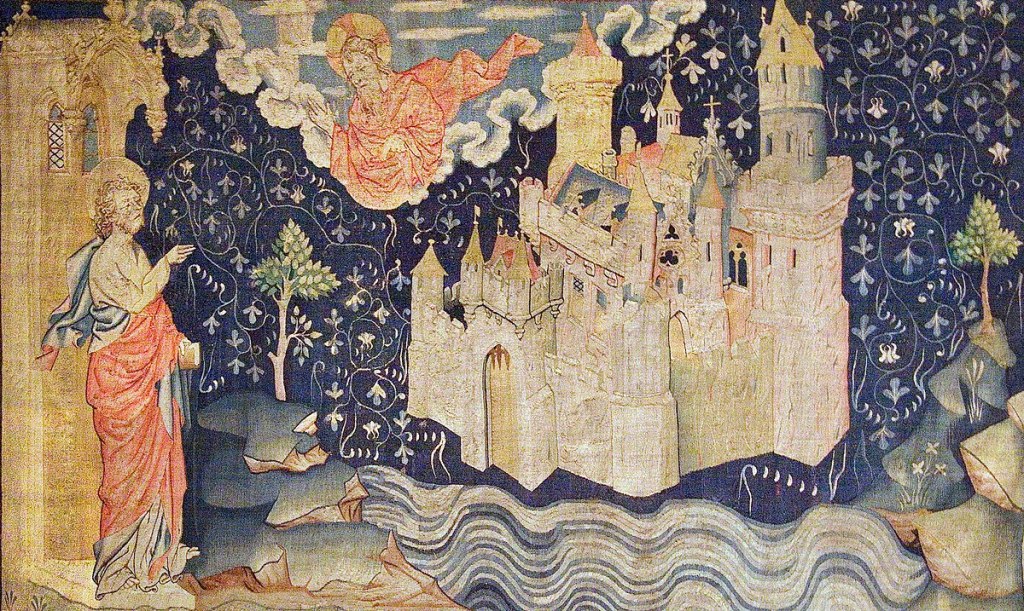
And these reassurances of God’s continuity extend into the future. Revelation 21:10 and 21:22-22:5 paint a compelling image of the heaven. John is taken by the Spirit – the same Spirit Jesus has spoken about in John’s Gospel – and sees the new Jerusalem, the Holy City coming down out of heaven from God. It is a glorious sight! There is no temple there, because God (the Father) and the Lamb (the Son) are its temple. God’s light shines out brilliantly. The gates of the city are always open. There is a river running through the city, with the water of life, and the tree of life, with leaves for the healing of the nations. We can see God’s face.

John’s vision is a deep reassurance of God’s continuity – what have seen in the Father throughout the first Testament, what we have seen confirmed in the life of the Son in the Gospels, and what we have been promised and experienced in the coming of Holy Spirit in the early Church and continuing until today, will continue into the future, until the day Christ returns.

We can rest deeply into the continuity of God, into God’s steadfast faithfulness and persistence. We can hold onto a God who is faithful, even when our own faith is frail or when life’s burdens overwhelm or depress us. We can hold fast to God’s continuity.

Featured image: John of Patmos watches the descent of New Jerusalem from God in a 14th-century tapestry (https://en.wikipedia.org/wiki/New_Jerusalem)

Desperate times

Click here to listen to the audio recording of this 25-minute message. Or watch the video on Facebook here (the message starts at about 35 minutes – unfortunately the volume on the video is very soft).

There are times in our life when things are desperate. These two years of Covid, and the losses, restrictions and challenges it has brought us, have given us additional reasons to feel desperate. There are times when life is exceptionally hard and we feel that the world is pitted against us – that even God is pitted against us.

Psalm 22 knows something about this:

1 My God, my God, why have you forsaken me? Why are you so far from saving me, so far from my cries of anguish? 2 My God, I cry out by day, but you do not answer, by night, but I find no rest. 6 But I am a worm and not a man, scorned by everyone, despised by the people. 7 All who see me mock me; they hurl insults, shaking their heads. 8 “He trusts in the Lord,” they say, “let the Lord rescue him. Let him deliver him, since he delights in him.” 14 I am poured out like water, and all my bones are out of joint. My heart has turned to wax; it has melted within me. 15 My mouth is dried up like a potsherd, and my tongue sticks to the roof of my mouth; you lay me in the dust of death.

Jesus uses this Psalm to express his desperation and despair as he hangs dying on the cross. He feels God-forsaken, utterly desolate. Where is God in all of this? Why am I abandoned?

The Psalmist shows a flicker of faith – just a flicker, though:

9 Yet you brought me out of the womb; you made me trust in you, even at my mother’s breast. 10 From birth I was cast on you; from my mother’s womb you have been my God.

And he cries out with a desperate, but muted plea:

11 Do not be far from me, for trouble is near and there is no one to help.

Job knows something about desperate times, having lost everything, despite being a righteous man of deep faith. He loses everything – everything – and grapples to make sense of what feels like God’s abandonment of him. Instead of imploding in despair like the Psalmist above, Job explodes outwards in anger and wants to confront God (Job 23):

2 “Even today my complaint is bitter; his hand is heavy in spite of my groaning. 3 If only I knew where to find him; if only I could go to his dwelling! 4 I would state my case before him and fill my mouth with arguments. 5 I would find out what he would answer me, and consider what he would say to me.

Job pushes towards God, seeking confrontation, to put his case to God, to demand to know why God would let him struggle like this. Job is desperate, and his desperation evokes anger and outrage at God.

Yet God makes himself unfindable:

8 “But if I go to the east, he is not there; if I go to the west, I do not find him. 9 When he is at work in the north, I do not see him; when he turns to the south, I catch no glimpse of him.

How frustrating it is when the person we want to confront is unavailable, inaccessible. God disappears and Job is left both desperate and angry, with nowhere to vent his anger. And yet, Job is also afraid of God – God is dangerous, and a confrontation with God could be a disaster for Job:

13 “But he stands alone, and who can oppose him? He does whatever he pleases. 14 He carries out his decree against me, and many such plans he still has in store. 15 That is why I am terrified before him; when I think of all this, I fear him. 16 God has made my heart faint; the Almighty has terrified me.

In the end, Job does not offer up a muted plea like the Psalmist. Instead, he shakes his fist at God:

17 Yet I am not silenced by the darkness, by the thick darkness that covers my face.

23 “How hard it is for the rich to enter the kingdom of God! 24 … Children, how hard it is to enter the kingdom of God! 25 It is easier for a camel to go through the eye of a needle than for someone who is rich to enter the kingdom of God.”

The disciples also experience similar desperate times with Jesus. While we think and teach about Jesus as always available, receptive and loving, sometimes he is not. We know the story in Mark 10 of a young man who rushes up to Jesus, falling on his knees and asking what he must do to inherit eternal life. Jesus seems, from the get-go, to treat him harshly, eventually telling him to give away everything he has, and the young man is crestfallen and “went away sad”. Jesus then turns to the disciples and says:

The disciples are amazed and shocked – presumably at both Jesus’ response to the earnest young man and Jesus’ words about how impossible it is to saved. Peter cries out in desperation:

26 Who then can be saved? [and] 28 But we have left everything to follow you!

You can hear Peter’s despair. He has left everything – family, work, home, community, his place in society, everything – to follow Jesus, and now Jesus says that it is impossible for man to be saved and how hard it will be for anyone to be saved. It seems to Peter and the disciples that everything they have sacrificed is for nothing.

This is a low point for Peter. He hits rock bottom as it seems to him that he has lost everything. His sense of purpose is fracturing.

Sometimes, we find ourselves in similar places to the Psalmist, to Job and to Peter. Our world seems to be falling apart, the challenges of life pile up and seem unduly heavy, God seems to have abandoned us, where is he to be found?, we feel alone and desperate. It as this lowest point that transformation can come.

Peter missed something that Mark noticed. In Mark 10:21a, Mark writes, “Jesus looked at him [the rich young man] and love him.” Jesus looked at him and he loved him. Jesus looked at her and he loved her. Jesus looked at me and he loved me. Jesus looks at you and he loves you.

The writer of Hebrews helps us understand that a fundamental change occurs in the life of God, through Christ’s experience here on earth. Before the incarnation, God could see what human life was like, but could not feel what it was like. But with Jesus’ coming into this world in human form, God now knew first hard what human desperation feels like. Hebrews 4

14 Therefore, since we have a great high priest who has ascended into heaven, Jesus the Son of God, let us hold firmly to the faith we profess. 15 For we do not have a high priest who is unable to empathize with our weaknesses, but we have one who has been tempted in every way, just as we are—yet he did not sin.

And because Jesus understands fully what it is like to be human, and because he truly understands what it is like to be desperate, and because he loves us utterly and to the very end, the writer to the Hebrews invites us to come to God:

16 Let us then approach God’s throne of grace with confidence, so that we may receive mercy and find grace to help us in our time of need.

We can come to the throne of God, not with a muted plea, not with anger, not in desperation, but in confidence, knowing that at that throne we will find grace and mercy to help us in our time of need. We can be confident to wrestle with God, to plead with God, to challenge God, to lean into God. Because he love us and because he knows first hand how hard this life can be. Jesus (in Mark 10:29-31) does not promise an easy life – he promises both reward and persecution.

But he does promise that we can always have direct access to the throne of grace and mercy. Such is the love the Father has for us. God is always accessible, always nearby, always connected, always empathic, always in the midst of adversity with us.

Featured image from https://www.cdc.gov/nceh/features/hurricanepreparedness/index.html

Bread of Heaven (Part 5)

Click here to listen to the audio recording of this 25-minute message. Or watch the video on Facebook here (the message starts at 30 minutes). Or read the text summary below.

We complete our five-part series on the Bread of Heaven, this week focusing on John 6:56-69. Over the past four weeks, Jesus has been consistently redirecting us to himself and presenting himself to us as the source of life. Among other things, he has show that:

  • He cares about us.
  • He feeds us, meets our physical needs, abundantly.
  • He redirects us from earthly things to heavenly spiritual things.
  • He directs us towards himself.
  • He invites us repeatedly into a relationship with him.
  • He says he is the bread of life, come down from heaven
  • He invites us to feast on him.
  • He offers us and the world eternal life.

Now the question is: How will you respond to all this?

There are two sets of responses in our reading: the response of the larger group of Jesus’ disciples and then the response of the 12 disciples, voiced by Peter.

The response of Jesus’ disciples

Today’s reading indicates that Jesus’ teachings are hard – who can accept them? What is it about Jesus’ teaching in John 6 that is hard to accept, offensive? In part, it is his claim that he came down from heaven (John 6:42) and in part that he invites us to eat his flesh and drink his blood (John 6:52). On the one hand, he is too heavenly and on the other hand he is too earthly and fleshy. He is too high and too low!

Jesus responds to the first point by asking how they will feel when they see him ascending back into heaven (John 6:61-62). If his claim to have come down from heaven is hard to accept, how much more witnessing him ascending back into heaven! And he respond to the second point by saying they should forget about earthly flesh and concentrate on spiritual flesh and words, which are full of Spirit and life (John 6:63).

But, recognising that his teachings are hard to understand, Jesus acknowledges that some do not believe and some who believe will fall away. It is our choice whether or not we believe in him. Yet, it is important for us also to know that God the Father enables our faith, enables us to believe and even to accept hard, difficult teachings. Indeed, three times in this chapter, Jesus emphasises that it is the Father who inspires and enables our belief:

  • The Father gives us to Christ (John 6:37).
  • The Father draws us to Christ (John 6:44).
  • The Father enables us to come to Christ (John 6:65).

God is sovereign. God does the drawing of our hearts towards Jesus. We rely and depend on God to enable and inspire our faith. And so we pray to him when our faith frays.

Nevertheless, many of Jesus disciples turn away and leave him. God does not force them to stay or force them to believe. We have free well to listen to God’s call and to follow him. God may give, draw and enable our faith, but he does not coerce – we still choose.

The response of Peter

Finally, Jesus turns to the 12 disciples – they are not among those who turned away and left. He asks them, “You do not want to leave too, do you?” (John 6:67). The phrasing of the Greek implies a ‘no’ answer. Jesus is hoping that they will not join the others who have turned away.

Peter’s reply is wonderful:

“Lord, to whom shall we go? You have the words of eternal life!” (John 6:68) Peter knows the options out there, and concludes that they are all wanting. Even if Jesus’ teaching is hard to fathom, he can think of no better options. And besides, despite the difficult of Jesus’ teachings, he recognises that these are words of eternal life. Not words about eternal life, but the words of eternal life! Jesus very words are Life itself! As Jesus said earlier (v63), “the words I have spoken are full of the Spirit and of life.”

“We have come to believe to know that you are the Holy One of God.” (John 6:69) Here Peter describes a process – the same process that we have been following these past five weeks: there is a process (“we have come”) of learning to trust Jesus and to entrust ourselves into Jesus (“to believe”) that leads to knowledge about who Jesus is and what he means to us (“and to know that you are the Holy One of God”). There is a process of trusting Jesus that leads to us knowing him.

All of this (this entire chapter 6 in John’s Gospel) has been about drawing us closer into a trusting relationship with Jesus, redirecting us from the things of the world to himself, and learning to trust that he himself, as the bread that has come down from heaven, is the source of all the nourishment that we need, of life, of Spirit.

Again, the question is: How will you respond to all this?

Featured image of sourdough bread from https://www.independent.com/events/how-to-make-sourdough-bread/

Bread of Heaven (Part 1)

Click here to listen to the audio recording of this 22-minute message. Or watch the video on Facebook here (the message starts at about 31 minutes). Or read the text summary below.

Our reading this morning is from John 6:1-21. We will be spending five weeks on this chapter. I think that this is the most consecutive Sundays we spend on any chapter in the Bible. (I stand to be corrected.) This is because we receive here some of Jesus’ most profound and important teaching – about the Bread of Life, the Bread of Heaven. It starts with a story about ‘real bread’ and becomes a story about ‘Real Bread’ (Bruner’s commentary on John).

In the first 15 verses of John 6, we are introduced to bread. It sets the scene for the rest of the chapter. We can read this story at two levels: on the ground floor, it is a story about Jesus feeding 5000 men from five small barley loaves and two small fish – a story of compassion and care; on the first floor, it is a story about an invitation to faith – faith in Jesus, who is the Bread of Life.

The ground floor – a story about caring

Jesus is on the mountain side and he sees a large crowd heading his way. John writes “Jesus looked up and saw”. Jesus is always looking up and seeing. We get this again and again in the Gospel narratives. He has his eyes open and sees the needs of those around him. If you listen to my messages over the past month, you’ll hear it over and over. He sees. And he has compassion.

So he asks his disciples how they can arrange bread to feed the people. It is a huge ask, of course, with 5,000 men, plus children (we know there are children there, because soon we meet a ‘boy’ in v9) and women (if there are children, there are surely women). So, there were perhaps 15,000 or 20,000 people! Andrew brings a boy who has a little bit of food – not much more than a snack. Jesus gives thanks for the food and distributes it to the people. (One wonders what the boy thought about having his lunch annexed by the Andrew and Jesus!) Everyone eats their fill, so much so, that there are 12 large baskets (big baskets that could hold a man) of leftovers of the barley bread.

Many of us believe that Jesus performed a miracle, in which he multiplied that little bread into much bread. Others believe that when people saw Jesus’ (and perhaps also the boy’s) generosity and compassion, they were moved to share what they had with those who had less. And so, what we see is a social miracle about people moved to caring and sharing. Either way, this is a story about Jesus caring for others – caring for our everyday needs. As we often pray, ‘Give us this day our daily bread’. Bread is life in come communities. In others, it is maize meal porridge. In others, it is rice. Every society has a staple food that provides the foundation of life. Jesus cares about this and wants people to have food in their stomachs. And to have it abundantly.

The first floor – a story about faith

The feeding of the 5000 is an important miracle story in the Bible. It is the ONLY miracle, taking place between Jesus’ baptism and his entry into Jerusalem on Palm Sunday, that appears in ALL FOUR Gospels. There is no other miracle that appears across all four Gospels, except this one. And in John’s gospel, it introduces a lengthy chapter about the spiritual meaning of Real Bread. Still, even on the first floor, the real bread is just bread. But the interactions between Jesus and the others are an invitation to faith.

John tells us that the event takes place just before the Passover festival (v4). The Passover symbolised, as it still does, liberation and redemption from slavery in Egypt, God standing up for the people of God, God caring for God’s chosen ones. It is central to Jewish faith, like the cross is central to Christian faith. This cues us that this is a story about faith.

Seeing the large crowds, Jesus invited Philip to faith: “Where shall we buy bread for these people to eat?” For sure, this is a big ask – it is a big crowd. But Philip was there in John 2, when Jesus changed water into wine – a lot of wine, a lot of really good wine! Jesus invites Philip to have faith. A faith response might have been, “Lord, I can’t imagine where we could get or afford so much bread. But I know you can make a plan! If anyone can feed this many people, it is you!” That would be a faith response, particularly after witnessing the water into wine miracle. Instead, all Philip can see is the large crowd. He loses sight of Jesus. His faith fails him.

Andrew shows a little faith, however. He finds a boy with some food. He emphasises the smallness of what the boy has: “five small barley loaves and two small fish” (v8). And then his tiny bubble of faith pops: “But how far will they go among so many people?”

Yet, that is all Jesus needed: a tiny morsel of faith. He takes those small loaves and small fish and gives thanks for (literally ‘eucharists’) them and feeds 5000+ people. Jesus is not constrained by the size of our faith. Andrew’s faith is feeble, small and easily fizzles. But what is important is not so much our faith, as the one in whom we place our faith: Jesus is more than capable of calming our storms, feeding us, healing us, helping us. He is the Lord of lords and King of kings. He is God incarnate. He can do anything.

It is only in the collecting of the leftovers that the disciples and the people recognise a miracle has taken place. I think Jesus instructs the disciples to collect the leftovers so they can see and touch the miracle, much as Jesus does with Thomas in John 20 – “Put your finger here; see my hand”. As Thomas was invited by Jesus to see, touch and respond in faith, so were Philip and the other disciples invited to see, touch and respond in faith. And so are we. Particularly during times of turmoil, illness, loss, distress and hunger.

Postscript

Immediately after the story of the feeding of the 5000, we have John’s version of the story of Jesus walking on the water (see my sermon on this same story from Mark’s Gospel, a month ago). The disciples are alone in a boat on a lake in a storm and struggling to make headway. Jesus sees their plight and walks across the water to them. They are terrified to see him, but he says, ‘It is I; don’t be afraid“, and he climbs into the storm-rocked boat with them – he chooses to be in the boat in the storm with them – and immediately, they find they have reached the other side of the lake, where they were headed.

Jesus remains more than capable of riding out and calming the storms in our lives.

Featured image from https://www.kitchensanctuary.com/artisan-bread-recipe/

Great is God’s faithfulness

Click here to listen to the audio recording of this 19-minute message. Or watch the video on YouTube. The whole Eucharist service is available (65 minutes), and the message starts at 20 minutes, and a song (Great is thy faithfulness) at 36 minutes. (With thanks to Symphonic Distribution Inc for not blocking the singing of this hymn.)

In Ephesians 1:3-14, Paul sets out in great depth and compact detail, his views on God and God’s relationship with us. This message is so timely in these days when we feel beset by Covid, together with the many other challenges we face in society. In a time like this, we need these words in Ephesians to take root in our hearts, where they grow and flourish. Paul’s writing is dense and compact, so I’ve extracted the words and phrases he uses and clustered them under three headings as follows:

The generous love of God

Blessed us, in the spiritual realm, very spiritual blessing, in Christ, in love, according to God’s pleasure, he has freely given us, redemption, forgiveness of sins, riches of God’s grace, bring unity to all things, under Christ, he lavished on us, according to his good pleasure.

These words speak about the extravagant, lavish, abundant, never-ending love of God that God pours out in a continuous and faithful stream into our lives. We are washed, saturated and soaked in the love of God. There is nothing, absolutely nothing, that can separate us from this love.

God’s plan and God’s sovereignty

He chose us, before creation, he predestined us, according to his will, all wisdom, all understanding, he purposed, when the times reach their fulfilment, predestined, according to the plan of him who works out everything in conformity with the purpose of his will.

God is King. God is in charge. God has a plan, God’s will shall deliver on that plan, God is sovereign. Sometimes it may feel that God has lost control and we are floating free in the ocean, battered by the storms of life. But God is always in control, and we are always in the palm of God’s hand, even (perhaps especially) when it doesn’t feel that way.

Our place as God’s beloved

You also were included, you were marked in him, with a seal, (the sign of Christ), a deposit, a guarantee, an inheritance, God’s possession, adopted, sonship.

God holds us firm. God has marked us with the seal of the Spirit. We were marked at our baptism with a cross, the sign of Christ – that sign does not fade or dissolve. God can spot us in the largest, densest crowd. God knows those who are his own – he does not lose sight of us. He has adopted us as ‘sons’ – as those who receive the full and complete inheritance of God, even though we are not God’s own offspring. We are utterly precious and valuable to God.

Featured image from: https://thepreachersword.files.wordpress.com/2018/01/ephesians-1-3.jpg