Click here to listen to the audio recording of this 21-minute message. Or watch the video here on Facebook (the message starts 35 minutes into the recording). Or read the text summary below.
Today is the fifth and last Sunday that we spend in John chapter 6. It has been a long and challenging 5 weeks. Next week, we go back to our journey through Mark’s gospel.
The setting of much of John 6, from after the feeding of the 5000 and Jesus walking on the water, is in a synagogue in Capernaum. In v59 we read, “Jesus said this while teaching the synagogue of Capernaum.” So, where did this teaching start? It started in v26, where, in the two verses before we read, that the crowds “got into the boats and went to Capernaum in search of Jesus. When they found him on the other side of the lake [in Capernaum], they asked him ‘Rabbi, when did you get here?'” and so the long teaching on the bread of life starts. John 6:25-71 all takes place in the synagogue at Capernaum.
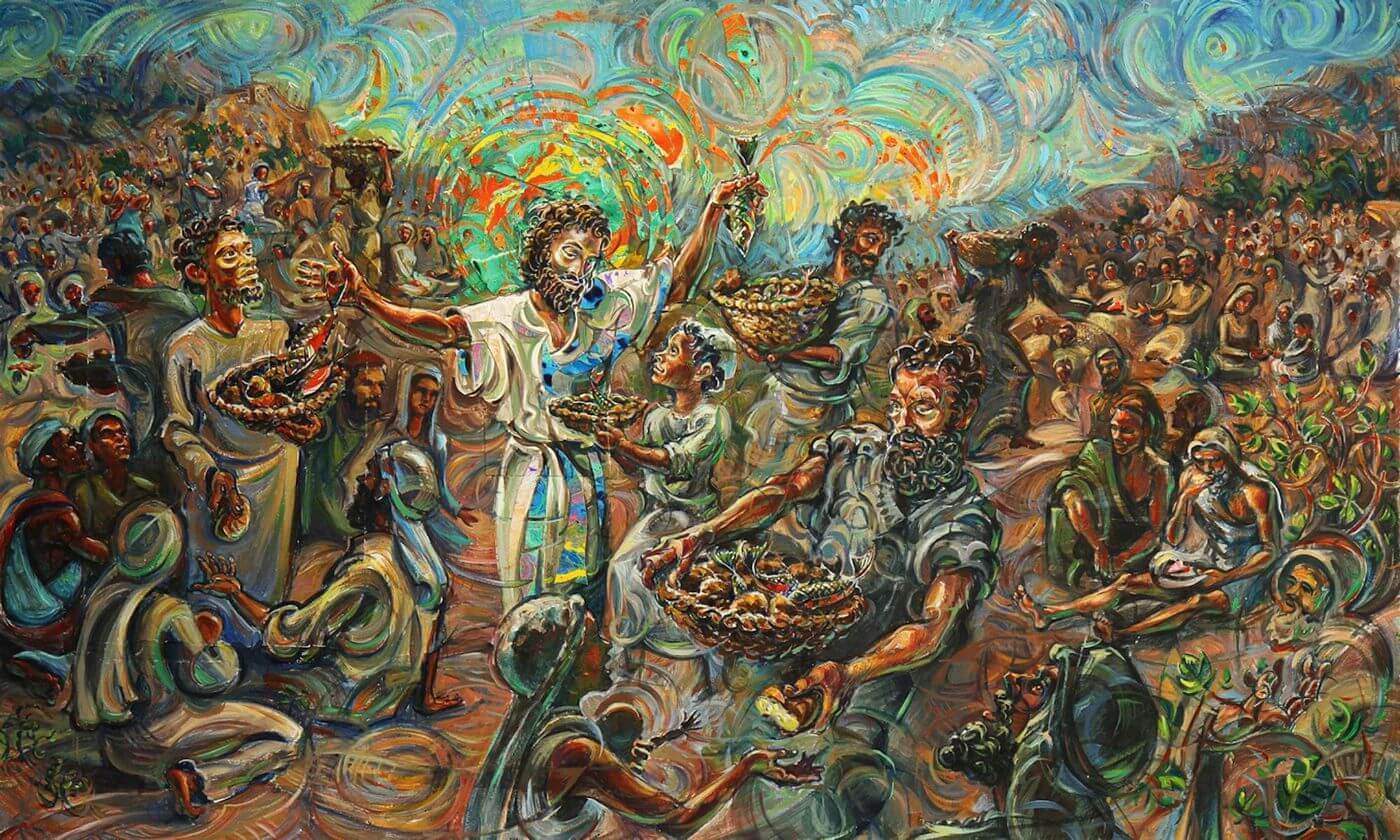
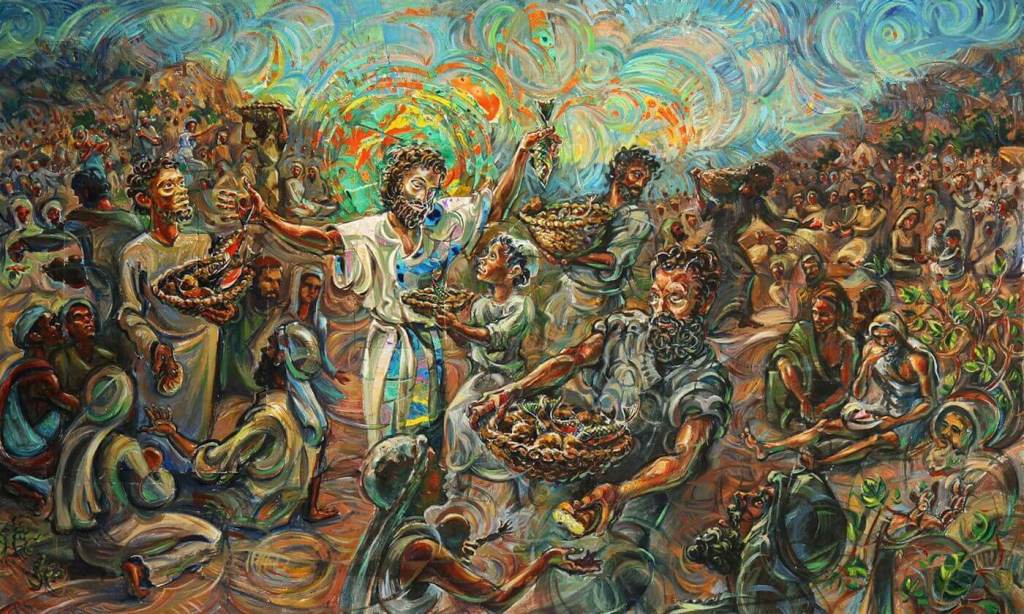
This is not coincidental. While we can find Christ anywhere, he chooses to meet us in synagogues, in churches, in the midst of the people of God. We read this in John 18:20, where, before the high priest, Jesus says, “I always taught in the synagogues or at the temple, where all the Jews come together. I said nothing in secret.” Here is Jesus affirming that he consistently taught in the centre of the synagogues, in the midst of God’s people. And in Matthew 18:20, Jesus says, “For when two or three gather in my name, there I am with them” or ‘in the midst of them’. (I have to smile at the similarity between John 18:20 and Matthew 18:20!) And in most Anglican churches, we read the Gospel in the centre of the church, not from the front, because Christ, the Word, is central to the people of God. The Word is in the midst of us.
Christ is our centre, and we congregate around him.
But, Jesus’ word is hard. Last week, we chewed through a difficult passage about eating Jesus’ flesh and drinking his blood. His teaching is challenging and hard to understand. As a result, MANY of his disciples or followers fell away and left. They could not swallow his message. It was easier – so they thought – to move on and find an easier teaching elsewhere.
Jesus seems disappointed and sad at their leaving, because he turns to his 12 disciples, and says to them, rather than asking them, “You don’t want to leave too, do you.” He hopes and trusts that his people will remain with him.
Jesus’ himself says in v63, “The words I have spoken to you – they are full of the Spirit and and of life!” One thinks of God’s Word ringing out in Genesis 1, calling the universe into being through his word. And we think of John 1, “In the beginning was the Word, and the Word was with God, and the Word was God. He was with God in the beginning.” Christ does not merely speak words; he IS The Word!
And the 12 disciples know and understand this, because they have spent so much time sitting with Christ in their midst. And so Peter says, “Lord, to whom shall we go? YOU have the words of eternal life. We have come to believe and to know that you are the Holy One of God.” Jesus, as the Word of God that creates the world and as the Bread that comes down from heaven and gives life to the world, we feast on his word and bread. We hear the Gospel preached and we participate in the Eucharist. It is here, in this church community, that we find divine food, life and hope.
We must remain clustered around the centre, where Christ is. Let us not drift away to the edges, and then slip out into the darkness. We need to remain in the centre, where Christ, our light and life is. We need to remain in the centre and our church friends need to remain in the centre. Let us not drift away. And let us call back those who have. For Jesus has Spirit and Life – away from the centre, we are cold and lost.












 Reflections of God's Love