Pruning

Click here to listen to the audio recording of this 13-minute message. Or watch the video here on Facebook (the message starts 27 minutes into the recording). Or read the text summary below.

Cutting in the Christian faith is inevitable. In John 15:1-8 Jesus makes it clear that we will be cut as part of our faith journey. If we bear no fruit, we will be cut off; and if we do bear fruit, we will be pruned. When we are cut off, we will not produce any further fruit, but when we are pruned, we will produce even more fruit. So, what Jesus says in John 15 is that we will experience cutting in our faith journey. This cutting will be either a whole branch that is cut off, or bits of a branch that will be pruned off. The purpose of this cutting and pruning is to make us even more fruitful. Jesus’ teaching here in John 15 is indeed sobering. No-one wants to be cut.

In this same passage Jesus also speaks about the importance of remaining in him. And when we remain in him, he remains in us, just as he remains in his father and his father remains in him. In this passage today of eight versus, Jesus uses the word remain eight times. It is a central theme for the message today. So how do we not remain in Christ? We do not remain in Christ when we do not invest in our relationship with Christ. And we do not remain in Christ when we are fruitless, because we will either wither will be cut off.

So then how do we remain in Christ? John’s first letter, chapter 4, provides us with some answers to this question. In verses 8 and 9, John says, “God is love. This is how we how God showed his love among us: he sent his one and only son into the world that we might live through him.” So, we remain in God’s love first because God comes to us and loves us. All remaining in Christ is always a response to Christ’s coming to us. In verse 16, John continues saying, “God is love. Whoever lives in love lives in God and God in them.” This sounds very much like remaining in Christ and Christ remaining in us. It is a reciprocal action of remaining. And further on, in verses 20 and 21, John emphasises that our love for God must manifest in our love for one another. He writes, “Whoever claims to love God yet hates a brother or sister is a liar. For whoever does not love their brother and sister whom they have seen, cannot love God whom they have not seen. And he has given us this command: anyone who loves God must also love their brother and sister.” Central to us remaining in Christ is God’s love for us, is our love for God and is our love for one another.

Therefore, let us remain grafted into Christ. We must accept that they will be cutting and pruning in our Christian journey. And yes, this is painful and uncomfortable. And sometimes it may make us question God’s love for us. But I am reminded of Peter’s response to Jesus in John 6: 67-69. Jesus had provided a difficult teaching and many of his followers turn away. And then Jesus asks his disciples, “You do not want to leave too do you?” And Simon Peter answers Jesus, “Lord to whom shall we go? You have the words of eternal life. We have come to believe and to know that you are the holy one of God.” There is no better alternative then remaining in Christ.

And so, I encourage us today to take seriously our faith in Christ: to remain in him, to be grafted into him, to accept God’s pruning, and to be fruitful in our love for God and one another.

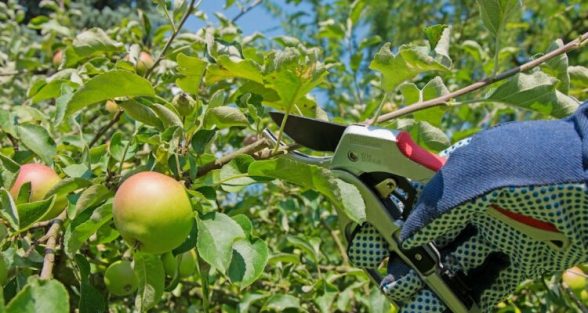
Featured image from https://moowy.co.uk/pruning-apple-trees/

Inclusive shepherd

Click here to listen to the audio recording of this 12-minute message. Or watch the video here on Facebook (the message starts 26 minutes into the recording). Or read the text summary below.

In John 10:11-18, Jesus strives to convey to us the depth of his love for and connection with us, and his desire and expectation that we should love one another. This passage is part of a larger set of “I am” statements related to Jesus being a shepherd – the good shepherd. Central to this message is this:

Jesus knows you. Jesus loves you.

I encourage you to hear these words and to take them to heart. In our service, I gave each person a paperclip, and asked them hold and fiddle with it during the sermon. A paperclip is used to hold things together, and today’s message is about Jesus holding us to himself and to each other.

  • Twice, Jesus says that he is the good shepherd – not just a shepherd, but the good shepherd (vv 11 & 14)
  • Jesus emphasises, “I know my sheep”. We are not merely a mass of sheep in a large flock. He knows each one of us. Indeed, Jesus says that he knows us and we know him “just as the Father knows me and I know the Father” (vv 14-15).
  • Four times, Jesus says that he lays down his life for his sheep – for you (vv 11, 15, 17 & 18). This points to the extravagance and not-withholding nature of Jesus love. Indeed John says (in 1 John 3:16): “This is how we know what love is: Jesus Christ laid down his life for us.”

It is hard to ignore these words of affirmation and extravagant love from Jesus. His love for you is immeasurable.

In the middle of this passage, Jesus says something a little different (v16):

I have other sheep that are not of this sheepfold. I must bring them also. They too will listen to my voice, and there shall be one flock and one shepherd.

Outside of this verse, there is a sense that Jesus loves only me. But v16 suggests not only that Jesus loves you, but also that he loves completely different groups from you. And the words, “I must bring them also”, are extremely strong in the Greek, conveying the sense that, “I absolutely have to bring them also”.

We should also note the sequence that Jesus presents: [In the present] I have other sheep [and now] I must bring them [and then in the future] they too will listen to my voice [and then after that] there shall be one flock with one shepherd. While these sheep do not yet know Jesus’ voice, Jesus still regards them as “his sheep” (“I have other sheep…”), and he loves them.

Who might these ‘other sheep’ be? The possibility that Jesus engages other groups outside of our group, outside of our congregation, outside of our denomination and even outside of the Christian faith, is tantalizing. But even if we do not go that far, think of those in your group, in your flock, that you dislike, those you think are not living an adequate Christian life, those you think are not adequately committed, those you think don’t believe correctly, those you think should rather leave your group.

Perhaps these people are sheep in Jesus’ other sheepfold. If so, Jesus loves them just as he loves you. And who are we not to love them, since Jesus loves them? Every sheep is loved by Jesus. And he is the Good Shepherd, who brings them into his fold. And so should we.

Featured image from https://media.istockphoto.com/id/1331924301/photo/stack-of-colorful-paper-clips.jpg

Seeing is not believing

Click here to listen to the audio recording of this 21-minute message. Or watch the video here on Facebook (the message starts 25 minutes into the recording). Or read the text summary below.

In Luke 24:13-35, we have the story of the two disciples who are walking to Emmaus and who encounter a stranger, who we later learn is the resurrected Jesus. They did not recognise him, despite having a long conversation. It was only as they sat down for a meal that “their eyes were opened and they recognised him” (v31), and immediately Jesus disappeared. They saw Jesus, but they did not recognise him.

In our reading set for today (Luke 24:36-48), Jesus meets the disciples in a room, and although they see him and recognise him, they do not believe him. They have moved a little further than the previous two disciples, but they have not moved to a place of belief or faith: seeing is not always believing. In response, Jesus – patient as ever with the disciples’ slowness – presents a series of evidence to prove to them that he is indeed risen from the dead and not a ghost:

v38 – Jesus asks why they are troubled and why they doubt. He confronts their lack of belief and faith. But still they do not believe.

v39-40 – Jesus invited them to look, to touch, to see. He shows them his hands and his feet, so they can get physical evidence of his wounded body. But still they do not believe.

v41-43 – So Jesus asks if they have any fish. Not because he is hungry, but to prove that he is not a ghost, but a physical being, who can eat food. But still they do not believe.

44-47 – So Jesus tells them about the scriptures – the Law of Moses, the Prophets and the Psalms – which all prophecy everything that has happened to Jesus. But still they do not believe.

48 – So Jesus reminds them that they are first-hand witnesses of everything that Jesus did – healings, forgiveness, raising people from the dead – they saw a lot and they themselves did some of these miracles in his name. But still they do not believe.

50-51 – And then, finally, he blesses them and ascends in front of them up into heaven.

And then they believed! They worshipped him and returned to Jerusalem with great joy.

Sjoe, they were really SLOW! Slow to recognise him. Slow to believe in him. Slow to put their faith in him.

Perhaps we also are slow. Perhaps we also fail to recognise Jesus’ actions in our lives and in the lives of those around us. Or perhaps we see them, but don’t believe them. Or we believe them, but we don’t put our faith in him. In the recording of the sermon I share an experience of my own slowness to believe, to illustrate my own slowness.

Fortunately – thanks be to God – Jesus is supremely patient. And he is willing to provide us with evidence and to persuade us (this also is part of my testimony in the recording). I encourage you, therefore, to make a choice to see God’s hand at work in your life. To accept that it may be possible – even likely – that God is present with you, even when you don’t perceive God. That God is working in you, even when you don’t recognise that. That God loves you, even when you may feel unloved.

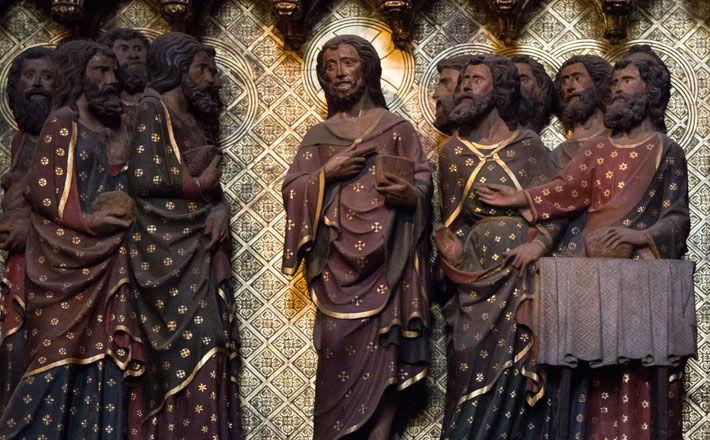
Featured image: “The Disciples give Fish to the Risen Lord to eat” from the medieval polychromed choir screen of Notre Dame de Paris. Image by Lawrence OP via Flickr; licensed under CC BY-NC-ND 2.0. (https://www.workingpreacher.org/wp-content/uploads/2020/06/LawrenceOP_Jesus_Fish_710.jpg)

Second-hand Faith

Click here to listen to the audio recording of this 16-minute message. Or watch the video here on Facebook (the message starts 24 minutes into the recording). Or read the text summary below.

Today’s message is about second-hand faith, meaning faith that rests on other people’s experiences of God, rather than on our own. 1 John 1: 1-4 presents such a faith. John emphasises his and the other disciples’ first-hand experience of Jesus, using words like see, looked, appeared, heard and touched a total of nine times in just a few verses. And he concludes by saying that we must believe him, and through believing him, who knows God, we get close to God. We are given a second-hand faith. Most of us don’t want a second-hand faith! We want our own, first-hand faith!

John 20:19-25 has a similar narrative. The disciples – minus Judas, who was not there – have a first-hand encounter with the risen Christ, who shows them his hands and his side. When Thomas joins them later, they say, “We have seen the Lord!” and expect that Thomas will be satisfied with this second-hand account. But Thomas says, “Unless I see the nail marks in his hands and put my finger where the nails were, and put my hand into his side, I will not believe.” Thomas wants simply what everyone wants – he wants to know first-hand that Jesus is risen. He wants to see and to touch. And Jesus meets this need.

We also want a first-hand faith. We want to know for sure and for ourselves that Jesus exists. We want to see him. We want to touch him. Where can we get such first-hand experiences? Three places: (1) We get them from the Scripture, where we read first-hand accounts of others and have confidence that their testimony is true. We can tag these accounts for future reference. (2) We rely on what others in our community tell us about God’s grace and working, and have confidence that their testimony is true. We can tag these accounts also for future reference.

(3) And we rely on our own experiences of God working in our own lives. We may not have many such experiences of our own, and they may not be particularly spectacular. But they are first-hand – they are OUR experiences and we KNOW them. These are the experiences we need to recover and treasure. We can tag them, because they are our first-hand encounters with God. They are the touchstones or reference points that we turn to when our faith gets shaky.

Featured image from https://ericclapp.com/wp-content/uploads/2021/04/doubting-thomas-by-julia-ward.jpg