Noah’s Ark foreshadows Christ’s Cross

Click here to listen to the audio recording of this 27-minute message. Or watch the video here on Facebook (the message starts 24 minutes into the recording). Or read the text summary below.

Our readings for today – the First Sunday in Lent – includes God’s Covenant with Noah after the great flood, in Genesis 9:8-17. Below I present this text from the interlinear bible, which endeavours to translate the Hebrew word-for-word into English:

8And God spoke to Noah, and to his sons with him, saying, 9“Behold, I, even I, am establishing my covenant with you, and with your seed after you, 10and with every living creature which is with you, among fowl, among cattle, among every animal of the earth with you, from all that go out from the ark, to every animal on earth. 11And I have made stand my covenant with you, and all flesh shall not be cut off again by the waters of a flood; nor shall there ever again be a flood to destroy the earth.”

12And God said, “This is a sign of the covenant, which I am about to make between me and you, and every living soul which is with you, for everlasting generations. 13I have set my bow in the cloud, and it shall be a sign of a covenant between me and the earth. 14And when I gather the clouds on the earth, then the bow shall be seen in the clouds. 15And I will remember my covenant which is between me and you, and every living soul in all flesh. And the waters shall not again become a flood to destroy all flesh. 16And the bow shall be in the clouds, and I shall see it, to remember the everlasting covenant between God and every living soul, in all flesh which is on the earth.”

17And God said to Noah: “This is the sign of the covenant which I have made stand between me and all flesh that is on the earth.”

It is worth taking careful note of the language used this passage, to gain an understanding of how radically inclusive God’s post-flood covenant with Noah was. See below the same text with coloured key words.

  1. In green, note the 8 uses of “you“: 5x “with you”, 1x “with your seed” and 2x “me and you”. God’s message to Noah is very directed towards him and particularly towards a partnership with him – the ‘with’ and the ‘and’.
  2. In yellow, note the 6 uses of “every“: 1x “every living creature”, 2x “every animal” and 3x “every living soul”. The Hebrew words behind the English all point towards living entities, whether human or animal – context may lean us towards one or other, but overall, the passage speaks equally about both people and animals.
  3. In blue, note the 5 uses of “all flesh“. In the Hebrew, ‘all flesh’ refers to the skin or flesh of any living being – again, people or animals, and also plants. The verb form of this Hebrew word means to be full of life, hence the skin (perhaps with its reddish colour) prompts us to think of living beings. But the Hebrew verb also means ‘good news’ and that’s a lovely link between this passage and the goodness of the Kingdom of God that Jesus preaches.
  4. In pink, note the 7 (yes 7!) mentions of the “earth“. In 5 of these, the reference is merely to people or animals “on the earth” – the earth is just a ground (soil) on which living things live. But in verses 11 and 13, we get two radical statements. In v11, God says that a flood will never again destroy the ‘earth’ – this is an expansion on God’s covenant not to destroy living things (animals and people) – now God also commits to protecting the earth itself. Moreover, in v13, God says that the rainbow “shall be a sign of a covenant between me and the earth”! Not only is the Noahic Covenant with Noah, people, animals AND plants, it is ALSO with the very earth itself. As if the earth is a living and sentient being! A great passage for those committed to ecospirituality.
  5. Finally, in lime, note the 5 uses of “between“. Two of these are “between me and you” emphasising a close partnering between God and Noah. The other three ‘between’s are between God and the earth, every living soul and all flesh. Here God shows his partnering with people, animals, plants and the planet (and perhaps by implication, the cosmos).

In short, this passage strongly emphasises a radical inclusivity by God towards the whole of God’s creation, encompassing not only all of humanity, not even also only of all animals, but also of the entire planet itself. This implies a universal covenant – a broad baobab tree with enough space for all created things to shelter under is branches. Humans, plus, plus, plus!

In this same passage, we also have 7 uses of the term “covenant”, which is why this passage is referred to the Noahic Covenant, following the devastating flood. A covenant is a binding agreement, and we get the heart of it in v11, “I have made stand [erected] my covenant with you, and all flesh shall not be cut off again by the waters of a flood; nor shall there ever again be a flood to destroy the earth.” The famous rainbow (mentioned three times as “bow”) is “a sign of the Covenant” – it is not the Covenant itself; just a symbol or sign that points to it (vv 12-13).

But what is most striking about this sign, is that it appears to be more for God’s benefit than for ours. God says in v16, “And the bow shall be in the clouds, and I shall see it, to remember the everlasting covenant between God and every living soul, in all flesh which is on the earth.” The bow is there for God to see, so that God will remember the covenant. It is hard to imagine God might forget about the covenant, so this is particularly intriguing, suggesting a strong commitment on God’s part.

It is reminiscent of the Passover blood that the Israelites painted on the doors of their homes. Exodus 12:13 has God saying, “When I see the blood, I will pass over you.” Here again is a sign that God sees that activates Covenant protection and blessing.
Image from https://img.freepik.com/premium-photo/cross-hill-with-rainbow-clouds-sunset_879736-1041.jpg

God’s covenant with Noah is universal – humans, plus, plus, plus. It foreshadows a far later Covenant, made in Christ.

This new covenant that we have through Jesus Christ is similarly radically inclusive and universal. Jesus died for the sins of the whole world, not just of some. Thus everyone can potentially be saved. And perhaps, if one adopts a universalist theology, God may just find a way to actually save every person. I don’t know, but I hope so!

Christ expands the Noahic covenant and completes it. His death and resurrection is God’s final Word on salvation. Christ incarnated, ministering, on the cross, resurrected and ascended is the new sign, replacing the rainbow. It fulfils the Noahic covenant.

We look forward in Lent towards remembering and walking through this new covenant that Jesus makes possible for the whole of creation.

Transfiguration – a moment of light

Click here to listen to the audio recording of this 22-minute message. Or watch the video here on Facebook (the message starts 23 minutes into the recording). Or read the text summary below.

The transfiguration of Christ, which is reported in Mark 9 (our reading for today), Matthew 17 and Luke 9 (all with very similar content), is a remarkable story. I wish I had been there with Peter, James and John, to see this for myself! What a beautiful and transcendent experience. And also how terrifying and mind bending. No wonder the disciples were rendered virtually unconscious. We read this passage every year and get a sermon on it every year. What more can be said?

This year, I spent time reading the texts on either side of the transfiguration narrative, and found that these passages also were congruent across the synoptic Gospels (Matthew, Mark and Luke). What struck me the most was how difficult and dark these passages were. The transfiguration is just a brief moment of light – brilliant, blinding, cosmic light – within a much darker narrative.

Before the transfiguration, we read about Peter declaring Jesus to be the Messiah (v29), Jesus telling the disciples that he will soon be killed (v31), Peter rebuking Jesus for saying this (v32), Jesus rebuking Peter and uttering these dreadful words – “Get behind me Satan!” (v33, reported also in Matthew, but not Luke) and Jesus explaining the cost of discipleship and the way of the cross (v34). Wow, dark material indeed!

After the transfiguration, the dark material continues. Jesus and the three disciples find a major argument going on among the people because the disciples were unable to cast out a demon (v18), Jesus gets angry asking, “You unbelieving generation, how long shall I stay with you?” (v19) (or “how long must I put up with you?” in Matthew). And then Jesus repeats his message that he will soon be killed (v31).

These passages before and after the transfiguration are in such stark contrast with the transfiguration itself. In the midst of dark, difficult, conflictual narrative is this brief blinding moment of Christ’s glory as God the Son. But it is so short lived – the three disciples come crashing back into a challenging world.

This contrast reminds me of our Palm Sunday services in our (Anglican) tradition. We start our service outside in red, with crosses and candles and incense and palm branches, shouting “Hosanna! Blessed is he who comes in the name of the Lord!”, processing around the church and into the road singing “All glory, laud and honour!” Such an exciting and happy time. And then our reading for the day is the whole of the passion narrative (from the last supper to Jesus’ burial). This contrast in tone (from joy to despair) is stark and shocking.

We ought not to think that we are promised a happy joyful, prosperous, wealthy, healthy life, even though some churches do teach this. We do not find it in the scriptures – it is not in the life of Jesus, it is not in Jesus’ teachings and it is not in the transfiguration narrative. Instead, we are invited to grapple with faith, discipleship, health, death, effectiveness and power. And within this real but difficult life, there are moments of light, joy and peace.

This is not to say that we should wallow in depression or succumb to despair and hopelessness. No! Certainly not! Rather, we need to face and confront depression, despair, hopelessness and all the other challenges we face in life. We walk in faith, trusting in God’s abiding presence, even in the darkness. We call on him for life, for salvation, and to offer thanks. We journey through the challenges of life, knowing that God is on our side.

To help us with this, I encourage you to read Psalm 116. And if life is sitting heavily on you, I encourage you read it multiple times each day, as a prayer for protection and God’s sustaining presence. Here it is:


I love the Lord, for he heard my voice;
    he heard my cry for mercy.
Because he turned his ear to me,
    I will call on him as long as I live.

The cords of death entangled me,
    the anguish of the grave came over me;
    I was overcome by distress and sorrow.
Then I called on the name of the Lord:
    “Lord, save me!”

The Lord is gracious and righteous;
    our God is full of compassion.
The Lord protects the unwary;
    when I was brought low, he saved me.

Return to your rest, my soul,
    for the Lord has been good to you.

For you, Lord, have delivered me from death,
    my eyes from tears,
    my feet from stumbling,
that I may walk before the Lord
    in the land of the living.

10 I trusted in the Lord when I said,
    “I am greatly afflicted”;
11 in my alarm I said,
    “Everyone is a liar.”

12 What shall I return to the Lord
    for all his goodness to me?

13 I will lift up the cup of salvation
    and call on the name of the Lord.
14 I will fulfill my vows to the Lord
    in the presence of all his people.

15 Precious in the sight of the Lord
    is the death of his faithful servants.
16 Truly I am your servant, Lord;
    I serve you just as my mother did;
    you have freed me from my chains.

17 I will sacrifice a thank offering to you
    and call on the name of the Lord.
18 I will fulfill my vows to the Lord
    in the presence of all his people,
19 in the courts of the house of the Lord—
    in your midst, Jerusalem.

Praise the Lord.

Image from http://livingwordrec.ca/archive/the-transfiguration-who-do-you-say-that-i-am/

Healthy church

Click here to listen to the audio recording of this 30-minute message (yes, again a bit longer than usual). Or watch the video here on Facebook (the message starts 24 minutes into the recording). Or read the text summary below.

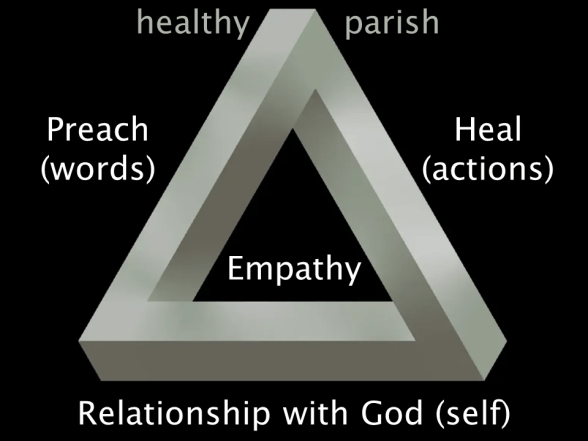
This sermon (preached a week ago on 4 February 2024) is about a healthy parish – what makes for healthy parish life. It emerges, in part, in light of various churches failing to uphold core values around clergy integrity and sexual relations. A model for a healthy church is presented, based on the readings that were set for today in the Revised Common Lectionary, viz. Isaiah 40:21-31, Psalm 147:1-11, 1 Corinthians 9:6-23 and Mark 1:29-39.

Jesus is always our model for everything to do with Christian living, including corporate or collective Christian living – the church. This model is influenced by the readings above and also by how Jesus lived his life, related to God and people, and exercised his ministry.

1. Personal relationship with God

The foundation of a healthy church – and the foundation the triangle above – is each member’s personal relationship with God. Our collective well-being rests on the aggregate of each individual person’s health relationship with God. In Mark 1:35, Jesus leaves his ministry to spend time in his personal relationship with God – he does so repeatedly, even though there are so many people waiting for his healing ministry and teaching. If a personal relationship with God is important to Jesus – who is God, the second person of the Holy Trinity – how much more important should it be to each of us.

When you fly on an airplane, you will be told that, in the event of cabin decompression, oxygen masks will drop down from above your seat. And you will be told to put your OWN mask on FIRST, before helping others (including your children). This is an apt illustration of the need for each of us to see to our personal relationship with God. I, as priest, must ensure the robustness and depth of my relationship with God.

2. Preach words

In 1 Cor 9:16-18, Paul refers to his preaching as central and as God-given. In Mark 1:38-39, Jesus says he needs to go to other villages to “preach there also”. He goes on to say, “That is why I have come”. Preaching words is important to build people’s faith.

But for a health church, I suggest we translate preaching as our words. Too often our words are harsh, judgmental, critical and gossipy. Such words break down, alienate, diminish and harm. There is no place for such words in a healthy church.

Our words should heal and create. Psalm 147:4 says, God “determines the number of stars and calls them each by name”, while Isaiah 40:26 reiterates, “Lift up your eyes and look to the heavens: who created all these? He who brings out the starry host one by one and calls forth each of them by name. … not one of them is missing”. These verses indicate how the words of God bring stars into being, as he names and calls them. Similarly, our words – whether good or bad – can call things into being.

Therefore, our words should be deliberately encouraging, edifying, building up, loving. Last year, we spent the whole of Lent reflecting on Jesus’ command to “love one another”, where we teased this out in detail.

3. Heal through actions

Mark 1:29-34 and 39 say, “…[Jesus] went to her, took her hand and helped her us. The fever left her … Jesus healed many who had various diseases. He also drove out many demons … So he travelled throughout Galilee … driving out demons.” Isaiah 40:29-31 says, “He gives strength to the weary and increases the power of the weak. Even youths grow tired and weary, and young men stumble and fall, but those who hope in the Lord will renew their strength. They will soar on wings like eagles; they will run and not grow weary, they will walk and not be faint.” Psalm 147: 2-3, 8-9, says, “The Lord builds up Jerusalem; the gathers the exiles of Israel. He heals the broken-hearted and binds up their wounds. … He covers the sky with clouds; he supplies the earth with rain and makes grass grow on the hills. He provides food for the cattle and for the young ravens when they call.”

These words are all of healing actions. How we behave impacts the health of a church. When we exclude, abandon or just do nothing, we harm the church. We break it down and weaken it. Rather, we should engage in actions that build up a health community. We can do this by simply showing up, instead of being absent. And through simple acts, like cooking a family a meal when they’re going through a hard time, giving someone a call or sending them a message, helping to clean up. In our tradition, we share the peace during the service – we can make sure we greet all the people around us, instead of rushing off to chat with our friends and ignoring a visitor.

4. Empathy

I have placed ’empathy’ at the centre of the graphic of a healthy church, even though the word ’empathy’ does not appear in the Bible. But the concept is there, for example in 1 Corinthians 9:19-23, Paul writes:

19 Though I am free and belong to no one, I have made myself a slave to everyone, to win as many as possible. 20 To the Jews I became like a Jew, to win the Jews. To those under the law I became like one under the law (though I myself am not under the law), so as to win those under the law. 21 To those not having the law I became like one not having the law (though I am not free from God’s law but am under Christ’s law), so as to win those not having the law. 22 To the weak I became weak, to win the weak. I have become all things to all people so that by all possible means I might save some. 23 I do all this for the sake of the gospel, that I may share in its blessings.

Here Paul steps into the shoes of others, in order to understand them from inside, in order to share the Gospel in a way that makes sense to them. This effort to feel with others is core to empathy.

We see this profoundly in Jesus. Until Jesus was conceived, God had no first-hand understanding of what being human was like. God was not a man, and didn’t have personal experience of being human. But when Jesus incarnated in Mary’s womb and was born like any other human, God got a first-hand experience of being human – God discovered empathy for the human condition.

Too often, however, we jump to negative conclusions, without first exercising empathy. We assume the worst of people, rather than considering other less judgmental reasons for their behaviour. For example, if we don’t see someone for a few weeks we assume they have lost their faith or reneged on their responsibilities, when in fact they might be ill. Instead, let us rather assume the best – if we’re going to make an factless assumption, let’s make a positive one rather than a negative one, until the facts suggest otherwise.

A church that is grounded in personal relationships with God, that speak and act in ways that build up and encourage, and that chooses to empathise with each other, is likely to be a healthy community. This is the kind of community or body that God desires for us. It takes some effort on each person’s part. Working together, we can build a healthy church centred on God.