Today is Trinity Sunday and I provide a reflection on the notion of a triune God, drawing particularly on Proverbs 8, as well as Genesis 1 and Romans 5. The crux of it is that relationality is central to the being of God – the three-in-oneness of God. Therefore, the core of human life also is relationality. We need to invest in relationships, and we need to give particular attention to those relationships that are struggling or fragile.
Today we celebrate Christ’s baptism, which inaugurates his ministry. John the Baptist had been preaching a Gospel of repentance for the forgiveness of sin, made tangible through baptism. And Jesus came to him to be baptised, even though Jesus was without sin.
As Jesus comes up out of the water, the heavens open and the Spirit of God descends on Jesus in the form of a dove, and the voice of God is heard saying, “You are my Son, whom I love; with you I am well pleased.” This is the only place in the Bible where Father, Son and Holy Spirit are tangibly present at the same time. This is an expression of the Epiphany, which is the season we’re currently in – Epiphany being all about God’s revelation of God’s self to the world. And this scene is certainly a great revelation of the triune God!
We could also think about this moment as an incarnation not only of Christ himself, but of all three persons of the Trinity – Jesus is there in the flesh, the Holy Spirit comes in bodily form like a dove, and God’s voice is audible to human ears (sound waves moving through the air). Father, Son and Spirit all materialise in the human world in that brief moment. This conveys the sense that the triune God works together for the salvation of humankind.
In our service, I invited three people to create a tableaux of the Father, the Spirit and the Son, similar to the paintings of Jesus’ baptism (see picture below). They are standing with their arms outstretched in love. This is an image of the triune God: three persons working in perfect harmony to pour out God’s love and salvation on humanity.
This expression of the triune God is flooded with love. Today’s first testament reading from Isaiah 43:1-7 contains these words from God: I created you, I have redeemed you, I have summoned you by name, I will be with you, I love you, I am with you, I will bring you, I will gather you, I formed you, I made you. And in Luke 3:22, we hear God saying, “You are my son, whom I love; with you I am well pleased”. We hear in these words the great enduring love that God has for his son and for us. And this is expressed through the incarnation and through the epiphany. It reminds us that love is the central characteristic of God – the foundation on which God engages within the triune Godhead and on which God engages with us.
We are encouraged, therefore, to rest into the great and generous love that God lavishes on us, which we see so clearly in the baptism of Christ.
From back to front: Father, Spirit, Son – replicating the painting below of Jesus’ baptismJuan Fernández Navarrete: The Baptism of Christ (c1567)
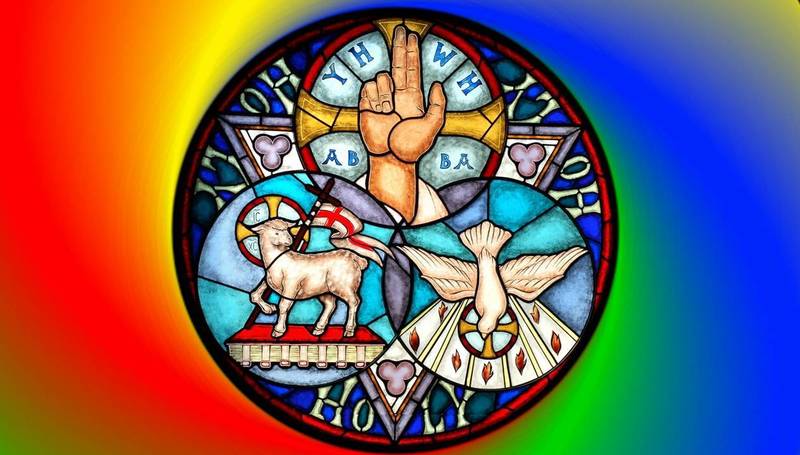
The Trinity (the three-in-one God) is a central belief for Christians, even though the term is not in the Bible and there are few explicit statements about a three-in-one God in the Bible. But there are hints and clues all over the place, e.g., in today’s readings with have:
God referring to God’s self as “us” in Isaiah 6:8,
Paul referring to God the Father, the Spirit and Christ as three distinct divine persons in Romans 8:12-17; and
Jesus speaking about the Spirit and God as two distinct divine persons in John 3:1-17.
Jews and Muslims share with us Christians the First Testament, and so it can be argued (though not all will agree) that we all worship the same God, whether by the name of Jehovah, Allah or God our Father. And all recognise Jesus as a significant person, though Jews see him as a Rabbi and Muslims as a Prophet, while we see him as God the Son. They do not recognise God as three-in-one; indeed, it sounds to them like we have three Gods. For Jews and Muslims, God is a single, male ruler – a King. They follow a pattern of a single line of authority, similar to how the military is structured. There is only One God.
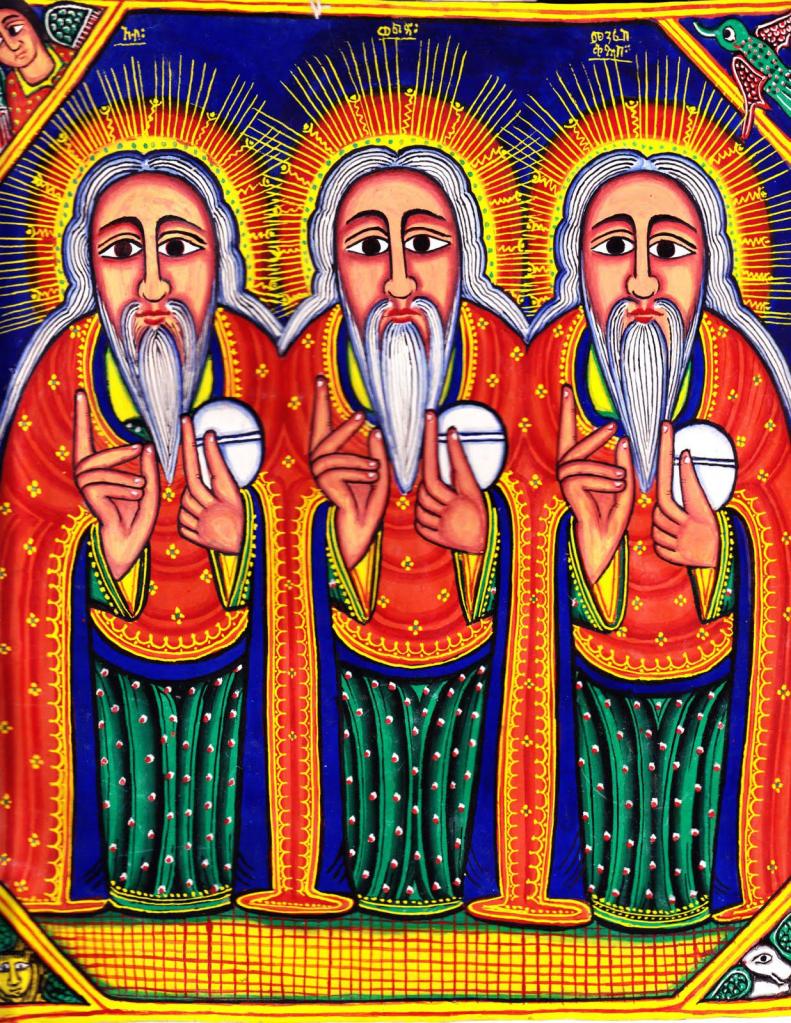
For Christians, by contrast, God is plural, diverse and relational. But this plurality in the Godhead, however we might understand it, is characterised by harmony and concord. There is no conflict, competition or divergence in the triune Godhead. This is a very different conception of God.
Do we understand God’s three-in-oneness? Can we rationalise it and explain it? No, not really. It is hard enough to understand a single human being; how much harder is it to explain God, let alone a triune God! We can, should and do think about the Trinity – we theologise and theorise how God be both three and one. But ultimately, we do not find fully satisfying explanations and understandings. We often come up with analogies to explain God’s three-in-oneness: states of water, an egg, a clover, family, etc. But all of these lead us into one or other heresy about the nature of God.
We are well advised to discard all these analogies and simply gaze upon the mystery of the Godhead. We should apprehend God, not analyse or dissect God. All we can really conclude with any confidence is that God is inherently relational – there are relationships within the centre of the Godhead; relationships characterised by immense, enduring and steadfast love. Let us hold to this beautiful mystery.
So, God is not a monarch, but a cooperative, and that leads me to think about words starting with co- and com-
Community, communal, in common, companion, compassion, comradery
These co-/com- words emphasise the relational quality that is central to the being of God. And because these are central to who God is, they are central to the world that God has created. And they are central to how we live our lives. Everything that God does is relational and we are part of this relational mix. Our readings today provide important examples of this:
In Isaiah 6, God is surrounded by seraphim – heavenly beings, keeping God company. And God send Isaiah to go out as God’s spokesperson – God collaborates with Isaiah, as partners.
In Romans 8, we learn that we are adopted by God, heirs and sons of God, co-heirs (siblings) with Christ, and that we share in Christ’s suffering and also in Christ’s glory – there is a close sibling-like relationship between us and the Son of God.
In John 3, we learn that the Son came to save not just individuals, but indeed the whole world – God is interested in the human collective, not only in human individuals.
The key implication for us worshiping a triune, collective God is to develop collective thinking and behaving. Relationships are primary to God and primary to us.
The concept of the Trinity can be hard to get one’s head around. But when we get down to the basics, it is the understanding that the one God comprises three persons – Farther, Son and Spirit. The theology to explain how this works is hard to grasp. Eventually, we are invited to gaze upon and appreciate the mystery of God who is three-in-one.
In today’s message, I suggest there three key practical implications of worshipping a triune God:
Since God has, for eternity, been three-in-one, a united collective rather than a singular entity, there is little room among Christians for othering, excluding, judging and discriminating. The three-in-one collective God created humanity to be in harmony with one another, much as God is harmony with God’s self. Racism, sexism, xenophobia, aging, homophobia and so on have no place the hearts of Christians. We need to be vigilant in examining our assumptions and judgements about others, and to repent of any form of othering.
Father, Son and Holy Spirit were jointly involved in creation, according to Genesis 1, Proverbs 8 and John 1 (among many other passages). Creation was a collaborative, joint effort by God, with humanity coming along only right near the end. The natural world is the outpouring of God’s generous love and we should treat it as such. Each of us can do even just small things to protect the earth – switching off the tap when we brush our teeth, switching off the light when we leave a room, planting an indigenous tree or a few spekboom plants. None of these is particularly difficult, time consuming or expensive, but collectively can make a difference to the future of God’s planet.
God’s entire mission for the salvation of humankind has been a collaborative and coordinated effort between Father, Son and Spirit. Each person of the Trinity had their own role and their time to lead, but everything they have done and continue to do has been of one accord, of one mission. In a similar way, the church can do its mission only through a collaborative effort, with the inputs of every member. The priest or wardens or lay ministers cannot do it – we all, every one of us, have to do it. Each person playing their part, whether big or small, is necessary for the church to do what it was put here to do.
Even if we cannot theologise the triune God, the Trinity, we can understand that God works in a collaborative and purposeful way to build healthy human relationships, to protect and nourish the earth and to accomplish God’s mission. We as the church are called to work in the same way.
The church’s teaching on the Trinity (God as three persons in one being) is one of the most complex and difficult concepts for us to grasp. While 1+1+1=3, 1x1x1=1, and that’s kind of what we’re trying to get our minds around when we think about the Triune (three-in-one) God. God’s self-revelation to humankind was progressive: first, the world met only God the Father (in the First Testament); then later God the Son appeared (in the Gospels) and there was a gradual realisation that Jesus was not just a prophet or teacher, not even just the Son of God, but in fact God the Son; and still later (at Pentecost most clearly) God the Holy Spirit appeared (in Acts 2) and there was a gradual realisation that the Spirit was not a force or power, but also God.
The early church was now faced with the challenge of three divine persons (Father, Son and Holy Spirit) yet still holding to the believe that there is but one God, one divine being or essence. Gradually, over the first centuries after Christ’s earthly ministry, the church come to settle on the Nicene Creed that sets out the orthodox theology of a triune God: three divine persons somehow blended together in one divine being.
Many metaphors are used to make sense of God as 3-in-1: the three states of H2O, the egg, a clover leaf, a man, etc. All of these diminish God and tend towards the heresy of modalism – the idea that there is one God who manifests in three modes, ways of presenting to us or masks/faces. In other words, they tend to over-emphasise the oneness of God at the expense of three distinct persons. Modalism contradicts what we see in Scripture, particularly in Jesus’ words, where he clearly and repeatedly refers to the Father and the Spirit as being separate persons from himself and persons with whom he as a relationship.
It is, therefore, more aligned with the facts as we have them to start with the three persons of the Trinity and try to figure out how the three might be one being. In the recording of the sermon (particularly the video recording) you will see an exercise I do with the congregation to consider this three in one, the challenges of it, and the potential ‘solution’ to it (as much as one can hope for a solution).
We have to imagine what might be powerful enough to bind three distinct persons together into one being, and the only force powerful that I can imagine is love. A love that is so extreme, so fiery, so consuming, so utterly self-giving, so passionate, so deep in its joining, yet also so delighted in diversity and distinctness, that it welds the three persons together into one being. Love is thus the centre of the experience of the Godhead. And it is not that God was three and then become one; no! Rather, God has eternally been three persons in one being, joined together by ultimate love.
This itself is almost unimaginable, so the best we can do is to simply gaze upon a love so amazing, so divine, that three are one. And appreciate the depth and expansiveness of this love. And delight in the fact that this is what drove God to create everything that is – to share that love with us, so that we might share it among each other, and with God. We are therefore, most human and most divine and most in the image of God, when we live in relationships characterised by ultimate love. That is the centre of God. And that explains why Jesus is always going on and on about Love. It is the quintessential character trait of the triune God.
For those interested in reading up more about this, search for the terms perichorsesis and social model of the Trinity (or social trinitarianism). I’ve here provided Wikipedia links, which provide a good brief introduction to the formal theology that underlies this sermon. Beyond these, there are numerous volumes written on this.
1. Pre-existent Spirit. The Spirit of God has been present since before the beginning. Spirit was already hovering over the waters at the time of creation in Genesis 1:2. Holy Spirit has always been.
2. God – the third person. Holy Spirit is God, as much as Jesus is God and the Father is God. Holy Spirit is the third person of the Trinity.
3. Person just like God. Holy Spirit is a person, just as the Father is a person and the Son is a person. Holy Spirit has personality, emotions, intentions and actions. Holy Spirit is not a force, not a love that binds together Father and Son, not the breathe of God. Holy Spirit is a person. Thus we must (in English) refer to Holy Spirit with the word “who’, not “which”, for example, we must say, “The Spirit who was poured out at Pentecost,” not ‘which was poured out’.
4. Holy Spirit as a name. ‘The Father’ and ‘the Son’ are titles or offices. Similarly, ‘the Holy Spirit’ is a title or office. But when we talk with the Father and Son, we use their names: “Father”, “Yahweh”, “Jesus”, “Christ”, etc. What can we call Holy Spirit, then? I suggest we drop the definitive article “the” and call Holy Spirit “Holy Spirit”, as a name.
5. Pronouns. If Holy Spirit is a person with whom we can talk and relate, do we refer to Spirit as ‘him’? In the Bible, Jesus always refers to Holy Spirit with a personal pronoun: he, him. However, we know that God is not ‘male’, not a ‘man’. God transcends gender. So God the Spirit is no more male than female. So we can use either ‘he’ or ‘she’. Unfortunately, English does not have a gender-inclusive pronoun (‘they’ or ‘ze’ are being used, but have not yet caught on). So I prefer to use ‘she’, to contribute to a deconstruction of the misperception that God is male.
6. Gifts vs relationship. Christians often chase after the gifts of the Spirit, when rather we should chase after a relationship with Holy Spirit. Spirit is not a cash dispenser of spiritual gifts. Spirit is a person, who desires to be in relationship with us. And in the context of that relationship, she gives us gifts. The focus is the relationship, not the gifts.
7. Sanctification. We are saved through the enabling of the Spirit. Christ did the work for our salvation, but Spirit enables our regeneration (our being born again) and our sanctification (our becoming increasingly Christlike). We need Spirit for every moment of our journey as Christians.
8. Fruit of the Spirit. The fruit of the Spirit are the result of having Holy Spirit residing in us, and of us relinquishing ourselves to Spirit. When we allow Spirit to work in us, we will begin to be transformed into the likeness of Christ, and we will bear the fruit of the Spirit: love, joy, peace, patience, kindness, goodness, faithfulness, gentleness, and self-control.
9. Gifts of the Spirit. As much as we don’t run after gifts from Holy Spirit, we do need and desire the spiritual gifts, and Holy Spirit is the one who gives them to us, as she determines, to enable the building up of the body of Christ and to empower us for God’s mission.
10. Presence of God. And finally, Holy Spirit is the person of the Trinity who is present among us now. The Father and Son sit in heaven; but Holy Spirit is among us. So, we sometimes refer to her as the go-between God, because she connects us to God the Father and God the Son. When we experience the presence of God, we are experiencing Holy Spirit.
In light of all this, can we see how important Holy Spirit is? How wonderful it is to have a relationship with her? To experience her working in our lives? Holy Spirit has been poured out into the lives of all believers. Let us embrace her presence and grow in faith through her.
In John 5, Jesus is accused of considering himself “equal with God”. And in his response (in verses 19-23), instead of defending himself, Jesus actually confirms the charge:
Jesus gave them this answer: “Very truly I tell you, the Son can do nothing by himself; he can do only what he sees his Father doing, because whatever the Father does the Son also does. For the Father loves the Son and shows him all he does. Yes, and he will show him even greater works than these, so that you will be amazed. For just as the Father raises the dead and gives them life, even so the Son gives life to whom he is pleased to give it. Moreover, the Father judges no one, but has entrusted all judgment to the Son, that all may honor the Son just as they honor the Father. Whoever does not honor the Son does not honor the Father, who sent him.
Jesus considers himself one with God – he and his father are one. They are equal, one being, even though he clearly shows that they are not the same person – for example, the Father does not judge; that role is given to the Son. But there is a closeness and alignment of purpose and desire between Father and Son (and also Holy Spirit) that leads us to the doctrine of the Trinity.
Given close unity between Father and Son, we also should strive to be one with God – to act in accordance with God’s will, to align our desires and intentions with God’s, to adopt as our own God’s values and priorities. Jesus is our example for all life. Let us become one with God.
The first Sunday after Eastertide focuses on God as three-in-one (triune). This is a hard concept for us – the maths doesn’t work well. Yet, the relational God (or social trinity) is a vital theology for understanding God, our personal relationship with God and the implications of a relational God for the world. In this rather long message I try to explain and apply the social model of the trinity.
John 14:6-11 is located immediately after the Last Supper and the washing of the disciples’ feet, as well as Jesus’ prediction of Judas’ and Peter’s betrayals. John 14 starts a four-chapter long sermon – Jesus’ final words to his disciples before his death.
In the opening of this section, Jesus presents himself as at the centre of our faith. He says to Peter, “You [already] believe in God [the Father]; [I now invite you to] believe also in me” (John 14:1). To believe in the Father is to believe in the Son. He goes on famously tosay, “I am the way and the truth and the life. No one comes to the Father except through me” (John 14:6). Jesus places himself at the centre of our relationship with God the Father. It is through him that we encounter God. Jesus is the centre.
But lest we think that Jesus is setting himself up as the mediator between us and God, he goes even further, audaciously, to say that he and the Father are one. “If you really know me, you will not know my Father as well … Anyone who has seen me has seen the Father … Don’t you believe that I am in the Father and that the Father is is in me? … I am in the Father and the Father is in me” (John 14:7-11). And just a few chapters earlier, Jesus had said, “I and the Father are one” (John 10:30).
Jesus is not merely a path to God. He is God. He is God the Son. He is locked into the Father and the Father is locked into him. In the very following passage (John 14:15-27), Jesus speaks about Holy Spirit, the third person of the Trinity, who will come to continue the work of the Father and the Son, once the Son has returned to the Father. When we relate to Jesus, we are relating to God, because Jesus is God.
Ultimately, sensing that Philip and the other disciples are grappling to grasp these complex and elusive concepts, Jesus says, “At least believe on the evidence of the works themselves” (John 14:11): You have heard me teaching. You have seen me heal people, raise the dead, feed thousands. You have witnessed me reaching out to women, tax collectors, lepers, prostitutes, menstruating women, disabled people, Samaritans and Gentiles. You have heard me speak truth to power and challenge rigid interpretations of the law. You have heard me proclaim a new Law that supersedes the Law of Moses.
What you are seeing is God at work among you!
Jesus must be at the centre of our personal and collective faith. The things of the church are helpful and perhaps even important. Jesus does not do away with them. But they must not be at the centre.
Jesus – the person Jesus – is the only one worthy of being at the centre.
He is our friend, our brother, our teacher, our healer, our saviour, our Lord, our very God.
Today we celebrate the Feast of the Epiphany (which actually takes place on 6 January tomorrow). ‘Epiphany’ means ‘manifestation’ or ‘revelation’. Something is revealed and made known to us. What is this thing? Let me answer in thee steps.
1. Jesus is the light
Our key reading for today, from Matthew 2:1-12, about the visit of the Magi to the young Jesus, refers repeatedly to the star that the Magi see, interpret and follow. It is a light that they see that reveals the coming of a King, a saviour, and the follow it:
1-2 After Jesus was born in Bethlehem in Judea, during the time of King Herod, Magi from the east came to Jerusalem and asked, “Where is the one who has been born king of the Jews? We saw his star when it rose and have come to worship him.”
7 Then Herod called the Magi secretly and found out from them the exact time the star had appeared.
9-10 After they had heard the king, they went on their way, and the star they had seen when it rose went ahead of them until it stopped over the place where the child was. When they saw the star, they were overjoyed.
John 1:1-9 tells a similar story about John’s cosmology of Christ as the incarnate light:
1-3 In the beginning was the Word, and the Word was with God, and the Word was God. He was with God in the beginning. Through him all things were made; without him nothing was made that has been made.
4-5 In him was life, and that life was the light of all mankind. The lightshines in the darkness, and the darkness has not overcome it.
6-9 There was a man sent from God whose name was John. He came as a witness to testify concerning that light, so that through him all might believe. He himself was not the light; he came only as a witness to the light. The true light that gives light to everyone was coming into the world.
The prophecies of old also speak to the coming of light into the world, as we see in Isaiah 9:2:
2 The people walking in darkness have seen a great light;
on those living in the land of deep darkness a light has dawned.
Simeon, a righteous, devout and Spirit-filled man of God, prophesies similarly over the infant Jesus when he was brought to the temple for a blessing, in Luke 2:29-32:
30-32 “For my eyes have seen your salvation,
which you have prepared in the sight of all nations:
a light for revelation to the Gentiles,
and the glory of your people Israel.”
While all of these references to the light refer to Jesus as the light, Jesus himself refers to us as the light, in Matthew 4:14-16:
14-16 “You are the light of the world. A town built on a hill cannot be hidden. Neither do people light a lamp and put it under a bowl. Instead they put it on its stand, and it gives light to everyone in the house. In the same way, let your light shine before others, that they may see your good deeds and glorify your Father in heaven.”
So, the narrative of Jesus being the Light is compelling. But what does it mean? What is he the light of?
2. Jesus is the light of God
Central to our (Western Church, i.e., Protestant and Catholic) understanding of the Epiphany, is that Jesus is revealed as the Son of God, as the Anointed One, as the Messiah, as God in the flesh. This leads us to the concept of the incarnation, which is foundational to everything we understand of Christ and his work among us. (Click here to listen to a previous message I’ve preached on the incarnation or hereand hereto read reflections on the incarnation and the kenotic U.) The incarnation is the idea that God emptied God’s self, pouring himself out to become smaller and smaller, more and more finite and situated, into a single cell, into an embryo.
For our friends in the Eastern Orthodox churches, however, Epiphany focuses not on the Magi but on the Baptism of Christ, where the revelation is not just about Christ, but about the Trinity: Father, Son and Holy Spirit. So, in essence, Epiphany lead us to a manifestation of the Triune God, made visible in the light that Jesus Christ brings into the darkest of places.
(If you are listening to this message, you might like to watch this video during this section of my sermon. It was playing on the screen while I presented it. Be patient – it takes several seconds before you’ll see anything. And be at peace – it was designed to be a subtle visual cue in the background, not a wildly exciting video.)
So, who is this light for?
3. Jesus is the light of the world
The importance of the Magi is that they were not Jews. They came from a long way away (for those days) – Persia (now Iran) or Yemen (where the ingredients for Frankincense and Myrrh are produced and a conduit of gold from Africa to the Middle East). Wherever they came from, their symbolic significance is that they were Gentiles, and thus represent everyone else who is not part of the ‘inner circle’.
In Jesus time, and even in the early church, this meant those who were not Jewish. The fact that Gentiles were among the first to worship Jesus (let’s not forget the shepherds, who represent rural, blue collar workers) indicates that the Gospel is for them also.
Today this means that the Gospel is for the LGBTQI+ community, for Muslims, Hindus, Buddhists, atheists and agnostics. For the smart and not so smart. For the morally good and for the morally bad. For young and old, black and white, rich and poor. For everyone. No person is excluded from the great project of God to redeem humanity, as we read in many passages of the Bible, e.g.,
God made known to us the mystery of his will according to his good pleasure, which he purposed in Christ,to be put into effect when the times reach their fulfillment—to bring unity to all things in heaven and on earth under Christ. (Ephesians 1:9-10)
In him was life, and that life was the light of all mankind. (John 1:4)
For my eyes have seen your salvation, which you have prepared in the sight of all nations. (Luke 2:30-31)










 Reflections of God's Love
