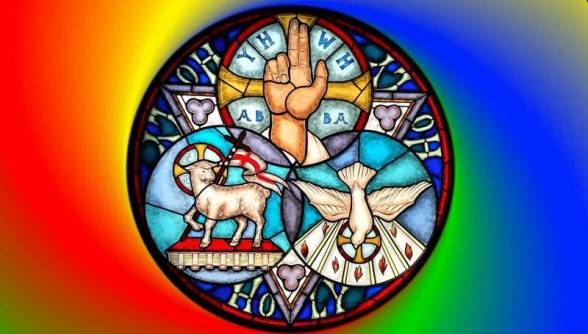
Thinking Trinity

Click here to listen to the audio recording of this 22-minute message. Or watch the video here on Facebook (the message starts 24 minutes into the recording). Or read the text summary below.

The Trinity (the three-in-one God) is a central belief for Christians, even though the term is not in the Bible and there are few explicit statements about a three-in-one God in the Bible. But there are hints and clues all over the place, e.g., in today’s readings with have:

  • God referring to God’s self as “us” in Isaiah 6:8,
  • Paul referring to God the Father, the Spirit and Christ as three distinct divine persons in Romans 8:12-17; and
  • Jesus speaking about the Spirit and God as two distinct divine persons in John 3:1-17.

Jews and Muslims share with us Christians the First Testament, and so it can be argued (though not all will agree) that we all worship the same God, whether by the name of Jehovah, Allah or God our Father. And all recognise Jesus as a significant person, though Jews see him as a Rabbi and Muslims as a Prophet, while we see him as God the Son. They do not recognise God as three-in-one; indeed, it sounds to them like we have three Gods. For Jews and Muslims, God is a single, male ruler – a King. They follow a pattern of a single line of authority, similar to how the military is structured. There is only One God.

For Christians, by contrast, God is plural, diverse and relational. But this plurality in the Godhead, however we might understand it, is characterised by harmony and concord. There is no conflict, competition or divergence in the triune Godhead. This is a very different conception of God.

Do we understand God’s three-in-oneness? Can we rationalise it and explain it? No, not really. It is hard enough to understand a single human being; how much harder is it to explain God, let alone a triune God! We can, should and do think about the Trinity – we theologise and theorise how God be both three and one. But ultimately, we do not find fully satisfying explanations and understandings. We often come up with analogies to explain God’s three-in-oneness: states of water, an egg, a clover, family, etc. But all of these lead us into one or other heresy about the nature of God.

We are well advised to discard all these analogies and simply gaze upon the mystery of the Godhead. We should apprehend God, not analyse or dissect God. All we can really conclude with any confidence is that God is inherently relational – there are relationships within the centre of the Godhead; relationships characterised by immense, enduring and steadfast love. Let us hold to this beautiful mystery.

So, God is not a monarch, but a cooperative, and that leads me to think about words starting with co- and com-

  • Collaborate, co-operate, co-lead, co-ordinate, collective, correlate, coincide, colleague, collegial, co-worker
  • Community, communal, in common, companion, compassion, comradery

These co-/com- words emphasise the relational quality that is central to the being of God. And because these are central to who God is, they are central to the world that God has created. And they are central to how we live our lives. Everything that God does is relational and we are part of this relational mix. Our readings today provide important examples of this:

  • In Isaiah 6, God is surrounded by seraphim – heavenly beings, keeping God company. And God send Isaiah to go out as God’s spokesperson – God collaborates with Isaiah, as partners.
  • In Romans 8, we learn that we are adopted by God, heirs and sons of God, co-heirs (siblings) with Christ, and that we share in Christ’s suffering and also in Christ’s glory – there is a close sibling-like relationship between us and the Son of God.
  • In John 3, we learn that the Son came to save not just individuals, but indeed the whole world – God is interested in the human collective, not only in human individuals.

The key implication for us worshiping a triune, collective God is to develop collective thinking and behaving. Relationships are primary to God and primary to us.
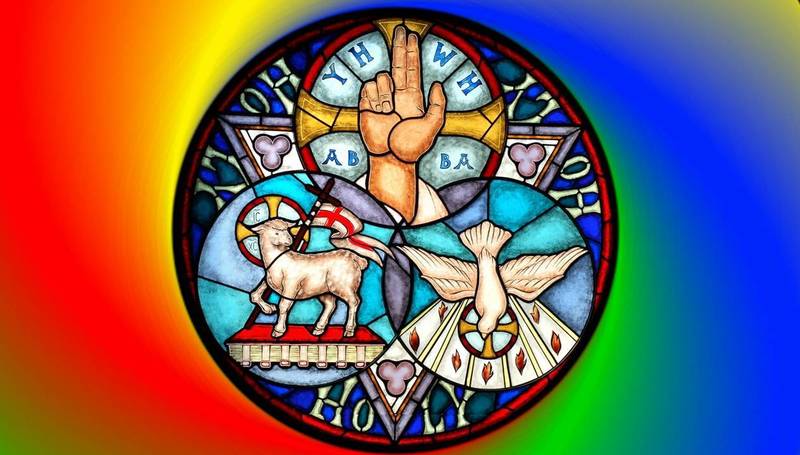
Featured image from https://www.stpaulscalgary.ca/podcasts/media/2020-06-07-trinity-sunday

Appreciating the Trinity

Click here to listen to the audio recording of this 19-minute message. Or watch the Facebook video (the message starts 27 minutes into the service). Or read the short text summary below – but this is really a message you need to watch or listen to as requires your active participation.

The church’s teaching on the Trinity (God as three persons in one being) is one of the most complex and difficult concepts for us to grasp. While 1+1+1=3, 1x1x1=1, and that’s kind of what we’re trying to get our minds around when we think about the Triune (three-in-one) God. God’s self-revelation to humankind was progressive: first, the world met only God the Father (in the First Testament); then later God the Son appeared (in the Gospels) and there was a gradual realisation that Jesus was not just a prophet or teacher, not even just the Son of God, but in fact God the Son; and still later (at Pentecost most clearly) God the Holy Spirit appeared (in Acts 2) and there was a gradual realisation that the Spirit was not a force or power, but also God.

The early church was now faced with the challenge of three divine persons (Father, Son and Holy Spirit) yet still holding to the believe that there is but one God, one divine being or essence. Gradually, over the first centuries after Christ’s earthly ministry, the church come to settle on the Nicene Creed that sets out the orthodox theology of a triune God: three divine persons somehow blended together in one divine being.

Many metaphors are used to make sense of God as 3-in-1: the three states of H2O, the egg, a clover leaf, a man, etc. All of these diminish God and tend towards the heresy of modalism – the idea that there is one God who manifests in three modes, ways of presenting to us or masks/faces. In other words, they tend to over-emphasise the oneness of God at the expense of three distinct persons. Modalism contradicts what we see in Scripture, particularly in Jesus’ words, where he clearly and repeatedly refers to the Father and the Spirit as being separate persons from himself and persons with whom he as a relationship.

It is, therefore, more aligned with the facts as we have them to start with the three persons of the Trinity and try to figure out how the three might be one being. In the recording of the sermon (particularly the video recording) you will see an exercise I do with the congregation to consider this three in one, the challenges of it, and the potential ‘solution’ to it (as much as one can hope for a solution).

We have to imagine what might be powerful enough to bind three distinct persons together into one being, and the only force powerful that I can imagine is love. A love that is so extreme, so fiery, so consuming, so utterly self-giving, so passionate, so deep in its joining, yet also so delighted in diversity and distinctness, that it welds the three persons together into one being. Love is thus the centre of the experience of the Godhead. And it is not that God was three and then become one; no! Rather, God has eternally been three persons in one being, joined together by ultimate love.

This itself is almost unimaginable, so the best we can do is to simply gaze upon a love so amazing, so divine, that three are one. And appreciate the depth and expansiveness of this love. And delight in the fact that this is what drove God to create everything that is – to share that love with us, so that we might share it among each other, and with God. We are therefore, most human and most divine and most in the image of God, when we live in relationships characterised by ultimate love. That is the centre of God. And that explains why Jesus is always going on and on about Love. It is the quintessential character trait of the triune God.

For those interested in reading up more about this, search for the terms perichorsesis and social model of the Trinity (or social trinitarianism). I’ve here provided Wikipedia links, which provide a good brief introduction to the formal theology that underlies this sermon. Beyond these, there are numerous volumes written on this.

Featured image by Joan Stratton, from https://pixels.com/featured/celtic-triquetra-or-trinity-knot-symbol-3-joan-stratton.html

The Triune God

Click here to listen to the audio of this 28-minute message. Or watch the YouTube video below.

The first Sunday after Eastertide focuses on God as three-in-one (triune). This is a hard concept for us – the maths doesn’t work well. Yet, the relational God (or social trinity) is a vital theology for understanding God, our personal relationship with God and the implications of a relational God for the world. In this rather long message I try to explain and apply the social model of the trinity.

2020.06.07_Trinity

Featured image from https://www.stainedglassinc.com/window/12754/