
Click here to listen to the audio recording of this 15-minute message. Or watch the video here on Facebook (the message starts 32 minutes into the recording). Or read the text summary below.
Today we get two of Jesus’ parables: the parable of the growing seed and the parable of the mustard seed. These follow the parable of the sower (the one who sowed seeds in different kinds of ground) and the lesson about putting our lamp on a stand.
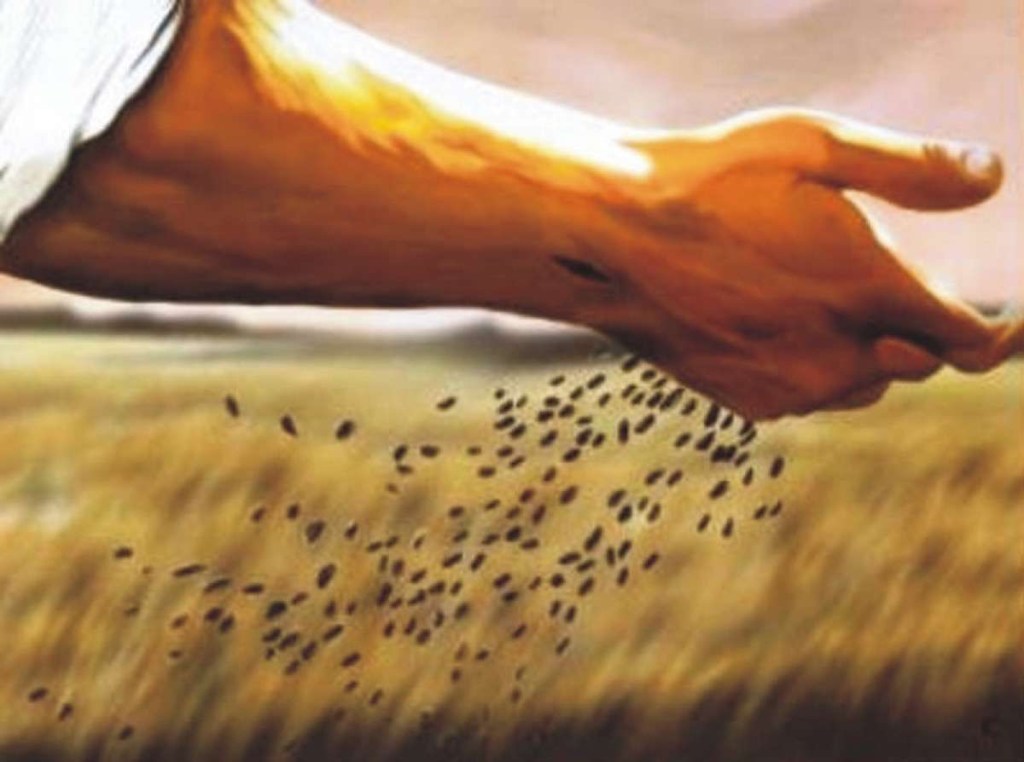
First, in the parable of the seed, the sower scatters the seed and then does nothing more. That’s his only role – to scatter seed. Then, spontaneously or (in the Greek) automatically the seeds grow. It is in their nature to grow, once they have been scattered. So the man goes to sleep and gets up and the seeds are doing their thing. “All by itself, the soil produces corn.” And the seed knows the steps of growth – they are programmed into the seed: “first the stalk, then the ear, then the full grain in the ear.” And when it is ripe and ready, the man comes to harvest the result.
This parable suggests that our role and responsibility as followers of Christ is to scatter seed. Presumably, this is good seed – seed that produces a crop: wheat, maize, barley. Our job is to scatter the seed. God’s job is to make that seed grow. The ‘automatic’ growth of the seed in this parable is the code that God has embedded into the DNA of the seed. (Apologies if my scientific understanding of seeds is incorrect!) For example, we may speak to someone about our faith (scattering seed), but we cannot force them to believe or come to faith (that is God’s work). We may encourage parishioners to attend church (scattering seed), but we cannot compel them to come (that is God’s work). We are encouraged by this parable to do our part and trust God to do his.
This resonates with 1 Corinthians 3:6-7, where Paul writes,
“I planted the seed, Apollos watered it, but God made it grow. So neither he who plants nor he who waters is anything, but only God, who makes things grow.”
This gives us perspective on what is our role, and what is not.
Second, in the parable of the mustard seed, Jesus contrasts the size of the mustard seed (which he says is the smallest of all seeds on the earth) and the resultant mustard plant (which he says is the largest of all garden plants or shrubs, with such big branches that the birds can perch in its shade).
This parable suggests that the scattering of even a tiny seed – even a very small act in the world – could produce a very large tree – a substantial change. Much like a lever, where a small amount of strength and effort can move a large heavy object, the tiny mustard seed, when scattered, can produce a large bush.
This resonates with Matthew 13:33, where Jesus says,
“The kingdom of heaven is like yeast that a woman took and mixed into about 23kg of flour until it worked all through the dough.”
A tiny amount of yeast can spread through a large amount of flour and rise to produce a massive number of loaves of bread. Small efforts can have large results.
These parables suggest that we ought to be scattering seed into the world, and that these seeds need not necessarily be big, dramatic, sophisticated or demanding. They might be small, understated comments or actions that go a long way. The key is to scatter these seeds – to be mindful and intentional about scattering them. And then to leave them to God to grow.
Third, although Jesus does not say this in Mark 4, this reading also evokes a warning: to be careful about what kind of seeds we sow. The seeds Jesus refers to are corn and mustard. It is hard to believe Jesus would support the scattering of weed seeds – indeed, he spoke out against weeds or thorns in the parable of the sower (Mark 4:18-19).
When we scatter bad seed, these too may grow fast and spread, just like the good seed, but with potentially terrible consequences. This resonates with James’ teaching about the tongue:
“Those who consider themselves religious and yet do not keep a tight rein on their tongues deceive themselves, and their religion is worthless” (1:26). “The tongue is a small part of the body, but it makes great boasts. Consider what a great forest is set on fire by a small spark. The tongue also is a fire, a world of evil among the parts of the body. It corrupts the whole body, sets the whole course of one’s life on fire, and is itself set on fire by hell. … With the tongue we praise our Lord and Father, and with it we curse human beings, who have been made in God’s likeness. Out of the same mouth come praise and cursing. My brothers and sisters, this should not be. ” (3:5-6, 9-10)
Just as we cannot make seeds grow into bushes, we cannot stop harmful words from causing damage. We are called to sow seeds, but only good seed; bad seed should not be scattered – it should be eliminated from our minds and tongues.

Featured image from https://www.algiersumc.com/woman-scattering-seeds/

 Reflections of God's Love
