Encountering the risen Christ

Watch the video below of this 42-minute message. Yes, much longer than usual! I’m sorry about that, but it is – I think – worth the time, as a close reading of John 20:19-29 sheds to much light on Jesus’ character, his relationship with the disciples and his work as the Son of God. My notes are available below the video

Verses 19, 26    Both times Jesus “stood right in the middle of them”

Christ is the centre – not the priest, Bible, APB – only the person Christ

Christ-centred church

1, 19, 26               Easter Sunday morning – Jesus appears to Mary

Easter Sunday evening – Jesus appears in the upper room

Following Sunday (today) – Jesus appears again, to Thomas

19, 21, 26             Peace be with you – Shalom alechem x3

Easter Sunday – Christ made peace between us and God

Forgiveness of sins – done, paid for, wiped clean, forgotten, cast the deep

Everything is good. It’s all okay

Easter is the Great Forgiveness!

20           He showed them his hands and side

Emphasis on bodily resurrection, reconnected to his people

Not just some spiritual, esoteric thing

He is fully embodied, albeit with some unusual capacities

20           He could have come back healed, but doesn’t. Why?

His identification with us, solidarity with our pain & suffering

He remains the suffering servant of Isaiah 53 (4-5):

He took up our pain and bore our suffering. He was pierced for our transgressions, he was crushed for our iniquities, the punishment that brought us peace was on him, and by his wounds we are healed.

20           The disciples were overjoyed – full of joy

Joy (chara) & grace/gift (charis) – joy is a gift of God – because Jesus is back

21           “As the father has sent me, I am sending you”

We are to continue God’s work. We are sent, just as Christ was sent

Jn 3:16/7 “God so loved the world that he gave [sent] his one and only Son … For God did not send his Son to condemn the world, but to save it”

Every Christian is sent – not just clergy or evangelists

22           He breathed on them, “Receive the Holy Spirit

Hebrew for spirit & breath are both? Ruach

Gen 1:2: Spirit of God hovering

22           Gen 2:7: “Then the Lord God formed a man from the dust of the ground and breathed into his nostrils the breath of life, and the man became a living being”

To receive Jesus’ breath & Holy Spirit is to be made a new living being

22           To receive Jesus’ breath & Holy Spirit is a grace/gift (charis)

As the Spirit/breath was active in the creation of earth and humanity

2 Cor 5:17: “If anyone is in Christ, they are a new creation. The old has passed away, the new has come.”

22           Holy Spirit poured out on Pentecost: Easter Season is from Easter Sunday to Pentecost

23           Forgive anyone’s sin

The gift of HS is not so much miraculous signs, etc.

Instead the central commission – sending – is to forgive

And to warn that to not repent = no forgiveness

The Great Forgiveness!

24           Thomas was not with the disciples when Jesus came.

Where was he? He should have been in church! We should be in church!

27           Touch, see

V20. Jesus showed them his hands and side.

Thomas wants what the others got – to see. But also to touch

Our Eucharist is a see and touch moment

– receive the body of Christ broken for you (not receive this bread)

– receive the blood of Christ (not receive this wine)

Not clear if Thomas did actually touch: “Thomas answered and said…”

Perhaps seeing and the invitation to touch was enough for him

27           Stop doubting and believe. Be a believer!!

Accept the small and periodic signs of God and believe into him

28           My Lord and my God!

Hebrew: Yahweh & Elohim – names for God

Greek: Kyrie & Theos – names for God

The only place in the Gospels where Jesus is referred to as God – A profound statement of faith – perhaps the most

Pneumatology 101

Click here to listen to the audio recording of this 28-minute message. Or watch the video here on Facebook (the message starts about 25 minutes into the recording). Or read the text summary below.

Today (28 May – this post is going out a bit late – sorry) is Pentecost, where we celebrate the coming of the Holy Spirit of God. We talk a lot in church about God the Father and God the Son, but much less about God the Holy Spirit. So, today I thought to share 10 fun facts about Holy Spirit, so that we have a better understanding and appreciation of who s/he is. Let’s call it “Pneumatology 101”! Are you ready? Here we go!

  1. Holy Spirit is the third person of the Trinity (along with the Father and Son) and therefore is God, as much as the Father and Son are God. Three persons in one being. The Spirit is as much God as the Father and Son are.
  2. Holy Spirit is a person, as much as the Father and Son are persons. Theologically, we can debate what ‘person’ means in the Godhead. But, through our exposure to God the Father in the first Testament and God the Son in the Second Testament, we have no trouble thinking of Father and Son as persons. The same must apply to the Spirit, who is the third person of the Triune Godhead. This means we can talk with, relate to and pray to Holy Spirit, just as we pray to Father and Son. To help me think of the Spirit as a person, I drop the definite article ‘the’ and refer to the Spirit as ‘Holy Spirit’, as if that is their name, like Jesus is the Son’s name.
  3. Holy Spirit is genderless, neither male nor female, gender neutral or gender fluid. God the Father is presented to us as a father, thus male. And God the son is presented to us as a son, as Jesus, a man, thus male. But Holy Spirit is not clearly presented with gender. It is as wrong to refer to Holy Spirit as ‘he’ as it is to refer to Spirit as ‘her’. Both are equally incorrect. All we can be sure of, is that Holy Spirit is not an ‘it’ – Holy Spirit is a person, not a power, force, wind, etc. They are a person. I choose to refer to Spirit as ‘her’, to recognise and emphasise that God is neither male nor female, or rather, that God incorporates both male and female. It helps to demasculinise my thinking about God.
  4. Holy Spirit is active in creation – the Spirit was hovering above the waters of the deep in Genesis 1. And Holy Spirit is continually active in creating the world we live in (Psalm 104:30). Spirit is creative, artistic, extravagant, producing, making, bringing into being, empowering, enabling – all things creative.
  5. Holy Spirit plays the key role in our sanctification. Jesus enables our salvation, but Spirit enables our becoming more and more Christlike as we journey through the ups and downs of life (1 Corinthians 6:11). Holy Spirit is the one who takes up residence on our hearts – in the temple of our body (1 Corinthians 6:19-20). She transforms us from the inside out, into the likeness of Christ.
  6. Holy Spirit nurtures in us the Fruit of the Spirit (Galatians 5) – these are qualities of living that exemplify Christlikeness, thus the manifestation of sanctification.
  7. Holy Spirit gives to every Christian one or more gifts – Gifts of the Holy Spirit (1 Corinthians 12). Some of these gifts appear quite ordinary (giving, mercy, helps, hospitality), while others appear quite supernatural (healing, prophecy, tongues, words of knowledge). But they are all Gifts of the Spirit, Spiritual Gifts, and thus all are supernatural gifts from God. And you have at least one.
  8. Holy Spirit operates autonomously. She is not a cash machine that dispenses goodies on demand. She decides when and to whom to give what. 1 Corinthians 12:11 tells us that she gives gifts just as she determines. Numbers 11 has a story about 70 men selected by Moses to receive the Spirit of God; but two other men who were not selected receive the Spirit even more powerfully. Joshua is put out by this, but Moses stops him – the Spirit decides who gets what, when and how much.
  9. Holy Spirit empowers the church for mission. She is interested in each of us as individuals, but her empowerment of us is for the work of the church. 1 Corinthians 12:7 tells us that gifts are given for the ‘common good’, not for personal edification. They are not for us ourselves and our own spiritual growth, but rather for us to serve more effectively in God’s mission to save the world.
  10. And finally (not that there are only 10 characteristics of Holy Spirit!), Holy Spirit seems deeply committed to diversity. At Pentecost (Acts 2) many people, speaking many languages, from different parts of the world, receive the gift of tongues or hear the Gospel in their own languages – they are united in their diversity through the outpouring of Holy Spirit. Acts 2 continue continues to talk about diverse people, languages, gifts, men and women, young and old, rich and poor. Psalm 104, which speaks about Holy Spirit, emphasises the great diversity of animals in God’s creation.

It is my hope that these ideas, which you may agree with more or less, will stimulate your interest in Holy Spirit, learning more about her and getting to know her better.

Featured image from https://www.christiantruthcenter.com/wp-content/uploads/2016/09/holy-spirit.jpg

Barrier-breaking Spirit

Click here to listen to the audio of this 10-minute message. Or watch the YouTube video below or read the text summary after that.

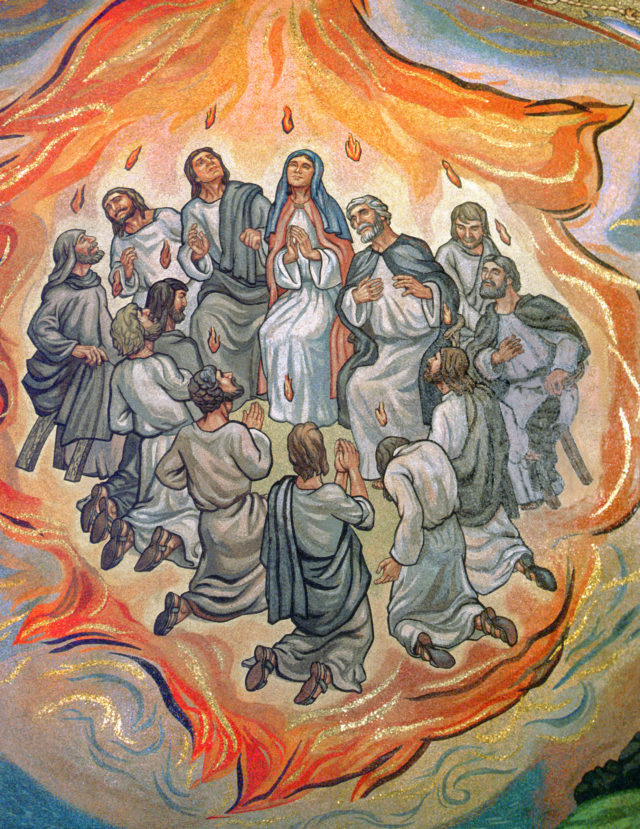
Pentecost occurs 50 days after Easter and 10 days after Jesus’ ascension. Acts 2:1-12 tells us that the disciples were meeting together in one place. “Suddenly”, writes Luke, “a sound like the blowing of a violent wind came from heaven and filled the whole house where they were sitting. They saw what seemed to be tongues of fire that separated and came to rest on each of them. All of them were filled with the Holy Spirit.”

This remarkable story give us two of the three key images we have of Holy Spirit: Wind, Fire and the Dove (from Jesus’ baptism).

Filled with the Spirit, the disciples begin to speak in different languages. Now Jerusalem, as the spiritual hub for Jewish people, was full of Jewish people from all over the place, speaking many different languages. They were initially drawn by the commotion – presumably the sound of the violent wind, like a tornado in a room.

But then they were “bewildered” and “amazed” and “perplexed” because “each one heard their own language being spoken”. Of all the things that Holy Spirit could have done to inaugurate her ministry among humankind, she chose to enable the disciples to speak the Gospel message in languages that the disciples did not know, so that a racially and culturally diverse group of people could hear the Gospel in words that they could understand. This tells us that:

Central to the ministry of Holy Spirit is to break down barriers

Indeed, Holy Spirit is just continuing the ministry of Jesus. Jesus himself was constantly breaking down the barriers that divide people:

  • His incarnation, when the boundary between divine and human was traversed
  • His speaking with the Samaritan woman – breaking boundaries of ethnicity, religion and gender
  • His healing of woman who bleeding – breaking purity and gender boundaries
  • His healing of the Centurion’s daughter – breaking racial, class and power boundaries
  • His touching of the dead boy and raising him to life – breaking purity laws
  • His salvation of the whole world – breaking the power of sin and death

Paul’s letters are filled with similar references to the barrier-breaking work of Christ and thus also of his followers:

  • Galatians 3:28 tells us, “There is neither Jew nor Gentile, neither slave nor free, nor is there male and female, for you are all one in Christ Jesus.” These are the classical sociological categories of race, class and gender. Jesus breaks them all.
  • Ephesians 2:14 tells us, “For he [Jesus] himself is our peace, who has made the two groups [Jew and Gentile] one and has destroyed the barrier, the dividing wall of hostility”.
  • Ephesians 1:10 tells us that God’s ultimate will is “to bring unity to all things in heaven and on earth under Christ”.
  • And Colossians 1:20 tells us that God was pleased “through him [Christ] to reconcile to himself all things, whether things on earth or things in heaven, by making peace through his blood, shed on the cross”.

Just as Jesus’ ministry involved boundary-breaking, so too, Holy Spirit’s ministry is about boundary-breaking. And she continues this work as her first Act at Pentecost. And the rest of the Acts of the Apostles is a working out of what boundary-breaking ministry is all about.

If you are a follower of Christ – even if your faith feels thin and weak, even if you don’t feel gifted or confident – Holy Spirit lives in you. She has taken up residence in you. And she wants to continue to do this barrier-breaking ministry through you, so that all people and the whole of creation can be reconciled under Christ.

ARTWORK WITH BIBLE BY KELLY

Pentecost image found in the Cathedral Basilica of St. Louis, from http://thedialog.org/catechetical-corner/living-our-faith-pentecost-filled-with-the-spirit/

Good Morning, Holy Spirit!

Click here to listen to this 18-minute message.

Today is Pentecost Sunday, when we celebrate the outpouring of the Holy Spirit on the early church, 50 days after Easter. Holy Spirit is a person we talk about far too infrequently, so today I seize the opportunity to talk about him (or her) in greater detail. In this message, I answer two question: Who is Holy Spirit? and What does Holy Spirit do in our lives? I draw on three great readings about the Spirit, viz. John 15:26-16:15; Romans 8:9-11, 22-27; and Acts 2:1-21.

Regarding the first question, my answer is in three parts:

  1. Holy Spirit is the third person of the Trinity (or the triune God) – as much God as Jesus and the Father are God.
  2. Holy Spirit is a person (not a force, or presence, or love) – as much a person as Jesus and the Father are persons.
  3. Holy Spirit is active in numerous ways in our present lives and in the lived-experience of our faith, thus very much to be incorporated into our faith life.

Regarding the second question, I give two answers, briefly:

  1. Holy Spirit dwells within us, and is thus present in the body and heart of every believer, working to align our spirit with the risen Christ, and helping us in living out our faith.
  2. Holy Spirit empowers and equips Christians for living and speaking out our faith in the world, through equipping us with gifts and strengths, and growing our confidence.

I hope that you will find this an accessible explanation of Holy Spirit. It was preached at our family service – half of those present were children and youth.

May you experience a rising of the Holy Spirit in your heart this Pentecost.

Blessings
Adrian

In-Filling and Out-Pouring of the Holy Spirit

Click here to listen to this 17-minute sermon.

Today is Pentecost, the last day of the Easter season, on which we celebrate the coming of the Holy Spirit among the new Christian Church in Acts 2. It is one of the high days in the Christian calendar. In today’s sermon, I draw on key themes that emerge from Jesus’ teaching on the Holy Spirit in John 16, the Pentecost narrative in Acts 2 and the vision of the valley of dry bones in Ezekiel 37. Based on these passages, I suggest that the Spirit has two main ways of working: he in-fills us in quiet and individualised ways to develop faith, life and truth, and he out-pours in dramatic and public ways to demonstrate the love and power of God and to proclaim the Gospel of the Kingdom of God.

My thanks to Fiona Langham for sharing her Spirit Tapestry that was part of a Pentecost Art Festival I organised back in 2008. You can see more of our works at adrian.vanbreda.org.

Being God’s Beloved: Day 38: The Spirit of Persistence

If you are a Christian, Holy Spirit dwells in your heart.

Some Christians question and doubt this. But you need have no doubt about the persistence of Spirit in your life.

Jesus says to the disciples, before Pentecost, “You know him [Spirit], for he lives with you and will be in you” (John 14:17). The first part of this sentence is written in the present tense (you currently know him because he currently lives in you) to emphasise that Spirit is already dwelling in them. And the second part of the sentence is written in the future tense (he will be in you in the future) to emphasise that Spirit will persist in them – he will not leave. The same is true of all children of God today – if you are a Child of God, Spirit has already taken up residence in your heart, and will remain there forever.

As we journey through life, however, we may have fresh and new experiences of Holy Spirit – new outpourings of Spirit into our hearts. The disciples experienced this from Jesus after the resurrection. In John 20, Jesus appears first to Mary and then to the disciples. He greets them, “‘Peace be with you! As the Father has sent me, I am sending you.’ And with that he breathed on them and said, ‘Receive the Holy Spirit’” (John 20:21-22). Just a few days earlier, Jesus had affirmed that Spirit was already living with them. So they are not now receiving Spirit for the first time. Rather, this is a new outpouring of Spirit into them.

And some weeks later, at Pentecost, they receive another outpouring of Spirit – this time with “a violent wind from heaven” and “what seemed to be tongues of fire that separated and came to rest on each of them” and with the ability to speak in different languages (Acts 2:2-4). Again, this is a new experience of Spirit, but that does not mean they did not previously have Spirit in them. This time, however, we see radical transformation in their faith and witness, and an explosive growth of the church. Clearly, the outpouring of Spirit is a vital part of our spiritual growth. We should eagerly desire to know Spirit like this!

‘Baptism in the Spirit’ or being ‘filled with the Spirit’, which are sometimes accompanied by supernatural gifts such as tongues, does not mean receiving Holy Spirit for the first time. Spirit is intimately involved in our salvation, so if you are saved then Spirit is with you. We cannot be saved without Spirit’s participation. But, baptism and filling will provide you with ‘more’of Spirit, though I don’t like how ‘more’ suggests that Spirit is something that can be quantified and dispensed, like water or power. Remember that Spirit is a person. It is more helpful to think of baptism and filling as the removal of chains that constrain Spirit within you, so that you give Spirit space to work within you. Baptism and filling free Spirit up to do what he does best – to work in and through us for the glory of God. And this is something we should all pray for.

Yesterday we reflected that when Spirit saves us and dwells in us, we become children of God (Romans 8:15-17). This too sounds wonderful, does it not? Not only can we be filled with Spirit, but we can also become children of God and coheirs with Christ! This would suggest that once we are saved, we can expect to live the good life!

Of course, we all know that this is not true. Being a Christian does not secure the good life. Sometimes, being a Christian actually seems to work against us – we choose to give up activities or friends we enjoyed before, we feel obliged to be honest in our work and our tax returns, we feel persuaded to forgive someone who has harmed us, we grapple with guilt because we repeatedly fail to live up to God’s standards. This does not feel like the good life.

Paul recognises this, and so in Romans, immediately after several verses about how wonderful it is to live in step with Spirit, he begins to write about suffering and about the hope for a future glory – the good life that we will experience sometime in the future, if not now. He uses words like (Romans 8:18-27): sufferings, eager expectation, frustration, subjected, liberated, bondage, decay, groaning, the pains of childbirth, groan, eagerly wait, hope, patiently, weakness, groans.

Why does Paul write like this?

It is because the Christian path is not an easy one. It is because there are many times that we will feel like giving up, we may question if all this is worth it. It is because there are times when we will feel that God has abandoned us.

It is significant that Paul uses ‘groans’ three times and ‘hope’ five times in these 10 verses. This combination of groaning and hoping is often the experience of being a child of God. We groan because things are not how we want them to be. And we hope because we look forward to a better time. Hope helps us tolerate groaning. Hope helps us to persist through the groans.

And then Paul offers us two promises – promises that serve to give us courage and hope in the face of adversity, promises that remind us that the heart of God is filled with love towards us, promises that assure us that Spirit persists with us.

The first promise is this: that God is always working to transform bad experiences into good opportunities for us. “And we know that in all things God works for the good of those who love him, who have been called according to his purpose” (Romans 8:28).

Bad things do happen. They happen to us. They happen to the people we love. And they happen to people throughout the world. Bad things do happen. We can write many books to explain suffering. But the bottom line is that we do suffer. It is a fact of living in a fallen world. God does not protect us from suffering.

But what we can trust God for, is that God will work with us, in all things, to transform bad into good. The thing that happened remains a bad thing. But God works to change the effects of that bad thing into something good. This is something God does in partnership with us – God partners with us to transform bad into good. God did this with the Cross: the Cross is a bad thing; but God transformed the effects of the Cross into something good for us.

For example, someone may experience a violent crime – that is a bad thing. God will work to transform that bad experience into something valuable – for example, the person may discover a fire in their belly to start a programme for people who commit violent crimes. The violent crime has not become good, just because it lead to something good. The crime itself is still a bad thing. But God has “worked together with those who love him to bring about what is good” (an alternative translation of Romans 8:28).

We can always trust God to help us transform bad things into good results.

And the second promise is this: that we will never be separated from God’s love. “Who shall separate us from the love of Christ? Shall trouble or hardship or persecution or famine or nakedness or danger or sword? … No, in all these things we are more than conquerors through him who loved us. For I am convinced that neither death nor life, neither angels nor demons, neither the present nor the future, nor any powers, neither height nor depth, nor anything else in all creation, will be able to separate us from the love of God that is in Christ Jesus our Lord” (Romans 8:35-39).

Whenever I read this passage out loud, I find myself emphasising that “No!” in verse 37. It is one of Paul’s emphatic No’s, as if he had been sitting down and now stands up to emphasise this word. And then I find that I get louder and slower and more emphatic as I move through the last two verses, “For I am convinced…”

Nothing, absolutely nothing, will be able to separate us from the love of God that is in Christ Jesus our Lord! Nothing!!

God’s love does not give up on us. God’s love is not thwarted. God’s love is not contingent on whether we feel God’s love. God’s love does not get turned away by things that happen to us. God’s love is not doused by our own faithlessness. There is nothing in the universe that can separate us from God’s love.

Yesterday we reflected on the idea that Spirit is the love of God. Paul in Romans 8 has been writing extensively about Spirit in the lead up to these verses. So it is not too great a stretch to conclude that we can never be separated from God’s love because we can never be separated from Spirit. Spirit, who is the love of God, dwells in us – we are Holy Spirit’s temple (1 Corinthians 6:19) – and so God’s love dwells in us.

No matter what happens, no matter what we go through, Spirit remains with us, God’s love remains with us. Spirit will never leave us nor forsake us, so we need never fear nor be discouraged (Deuteronomy 31:6-8). We can have confidence that “if God is for us, who can be against us. He who did not spare his own Son, but gave him up for us all – how will he not also, along with him, graciously give us all things?” (Romans 8:31-32).

And no matter what we ourselves do, no matter what we say, Spirit remains with us, God’s love remains with us. We are incapable of escaping Spirit, as the psalmist has written, “Where can I go from your Spirit? Where can I flee from your presence? If I go up to the heavens, you are there; if I make my bed in the depths, you are there. If I rise on the wings of the dawn, if I settle on the far side of the sea, even there your hand will guide me, your right hand will hold me fast” (Psalm 137:7-10). God remains with us, because God knit us together in our mother’s womb (Psalm 137:13). God knows everything there is to know about us – all the wonderful and all the terrible things about us – and still loves us, is not ashamed of or repulsed by us.

Today we give thanks for Holy Spirit, for the Love of God, who dwells in us, in the innermost place in our hearts, who works continuously for our good, who is present with us in suffering and hardship, and who loves us to the ends of time.

Meditation for the Day

Consider the presence of God’s Spirit in your heart right now. Even if you do not sense his presence, affirm and meditate on the truth that he is there and that he will persist in you.

Prayer for the Day

Spirit of Christ, Spirit of Love. Thank you that you reside in me and that you have promised to never leave nor forsake me. Open my heart to your presence and stir up in me faith and hope. Give me courage and ability to do your work in the world.

Being_Gods_Beloved_square_3