Blessed are the families

Jesus’ teaching referred to as the beatitudes is a series of blessings for those who espouse Jesus’ value framework, a framework that is countercultural, that is, not aligned with the majority culture of this world. In this message, I interpret Jesus’ beatitudes for family life. It is my hope that this will enrich our families and strengthen the quality of love we have between each other. Watch the 25-minute video message and/or read my notes below that.

Matthew 5:3-10 presents Jesus’ beatitudes. A ‘beatitude’ is a ‘blessing’, to be blessed, to feel blessed, to feel great joy.

Beatitude in Hebrew is ‘esher’, which means to be happy, to advance, to make progress, to go forward, be lead on, to be relieved

But the things that Jesus says bless us are not easy! They are countercultural, particularly in today’s corporate, rapacious, ambitious, self-seeking world. This echoes Paul’s sentiment in 1 Corinthians 1:27, “God chose the lowly things of this world and the despised things, and the things that are not.” The beatitudes focus us on inner character traits, not just external actions – who you actually are.

In this message, I want to apply the beatitudes to marriage and family. I have them out below in point form. The = is an interpretation of the beatitude in principle, while * is an application of the beatitude to family life. By ‘family life’ I mean relationships between partners, parents and children:

  1. Blessed are the poor in spirit
    =spiritual neediness & fragility (opposite of strength), humility, smallness
    *approach our family without pride, acknowledge that we don’t have all the answers, rely together on God’s grace
    *recognise and accept that life can be hard, work to be safe to be vulnerable with one another, affirm that we’re all in this together
  2. Blessed are those who mourn
    =mourn over our brokenness, recognise how we fall far short of God’s intentions for us, our tears express our soft heart
    *comfort family members in grief, anxiety, breakups, failed test, bad day
    *grieve if you accidentally or intentionally hurt a family member
  3. Blessed are the meek
    =patiently bear the sufferings of life, react calmly to conflict instead of lashing out, this is best expressed in Christ’s passion on the cross
    *meekness is not weakness, it is strength under control, engage family with respect and gentleness, avoid harsh words, you don’t always have to win
  4. Blessed are those who hunger and thirst for righteousness
    =A longing for holiness, Christ-likeness, justice, virtue, mercy, to be in a right relationship with God
    *Christ at the centre of our home is manifest in the fruit of the spirit (love, joy, peace, patience, kindness, goodness, faithfulness, gentleness and self-control), do not tolerance any behaviour that could harm another, work always to be in a right relationship with one another
  5. Blessed are the merciful
    =Showing mercy=easily forgiving, waiving debts, giving generously, even self-sacrificially
    *Families built on forgiveness, avoid grudges, don’t go to bed angry, choose compassion, model God’s willingness to reconcile
  6. Blessed are the pure in heart
    =Pure=clean, avoid sin, fruit of the Spirit (see point 4 above), God is ever-present and watching, no secrets
    *Guard against outside temptations, set a sacred boundary against sin around your family
  7. Blessed are the peacemakers
    =Seeking true good for others, draw God into conflicts, pray without ceasing, “May your will be done on earth as it is in heaven”
    *Be willing to lose an argument (winning is not everything), promote unity and safety, dialogue=reciprocal talking
  8. Blessed are those who are persecuted because of righteousness
    =After all these, we may still be persecuted, recognize the seriousness of our faith, Christ’s death, ‘because of’ emphasises that the persecution must be because of following Christ’s values NOT because we’re a jerk
    *Accept that your stand for sobriety, chastity, church first, and self-sacrifice could lead to ridicule and judgment from others

Read Psalm 15 through eyes of ‘family’:

Lord, who may dwell in your sacred tent?
    Who may live on your holy mountain?
The one whose walk is blameless,
    who does what is righteous,
    who speaks the truth from their heart;
whose tongue utters no slander,
    who does no wrong to a neighbor,
    and casts no slur on others;
who despises a vile person
    but honors those who fear the Lord;
who keeps an oath even when it hurts,
    and does not change their mind;
who lends money to the poor without interest;
    who does not accept a bribe against the innocent.
Whoever does these things
    will never be shaken.

Micah 6:8 – “What does the Lord require of you? To act justly, to love mercy, to walk humbly with your God”

Blessed be your family
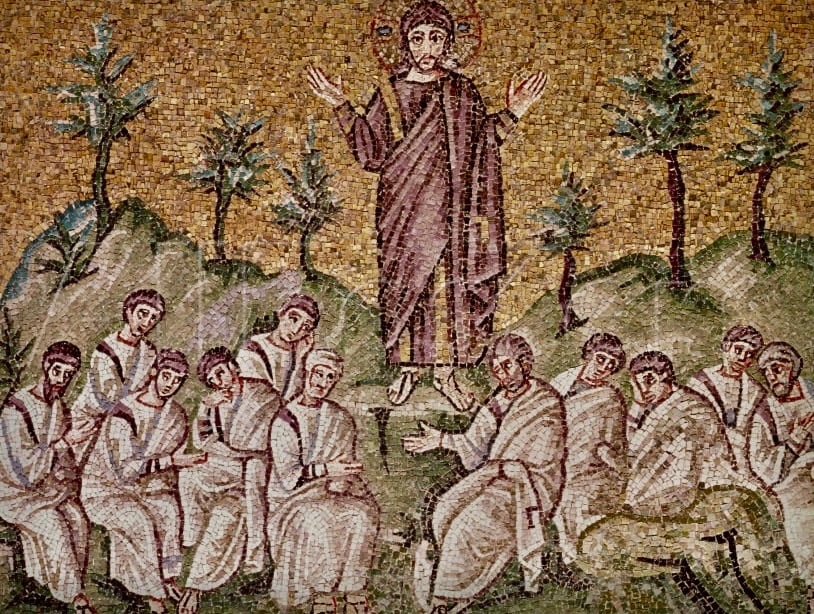
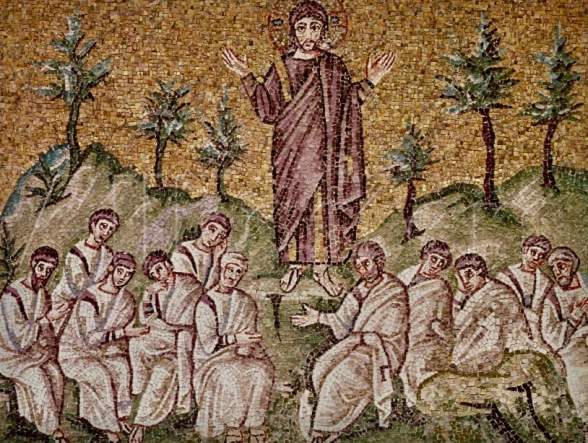
6th-century mosaic located in the Basilica of Sant’Apollinare Nuovo in Ravenna, Italy. From: https://www.psephizo.com/biblical-studies/how-do-we-make-sense-of-the-beatitudes/

The older brother

Click here to listen to this 21-minute message.

We all have, consciously or unconsciously, a hierarchy of people’s goodness to badness, of people’s worthiness of God’s loving attention or of salvation. Even if we believe in salvation through the work of Christ alone, we probably still can imagine people we think undeserving of eternal life.

This was the problem of the Pharisees in Jesus’ time. They were so focused on keeping God’s Law (see my related message on Jesus’ Law) that they could have nothing to do with people who were not righteous, people who were lower down on the hierarchy.

So when the Pharisees see Jesus hanging out with so called ‘sinners’ and tax collectors, they are horrified and mutter, “This man welcomes sinners and eats with them” (Luke 15:1-2). They regarded such behaviour as being absolutely at odds with being a Godly person.

This prompts Jesus to tell three parables, intended to reveal God’s soft heart for “sinners and tax collectors”, for the lost, and to challenge the Pharisees’ misalignment with the God they sincerely followed:

  1. The lost sheep. “Suppose one of you has a hundred sheep and loses one of them. Doesn’t he leave the ninety-nine in the open country and go after the lost sheep until he finds it?” (Luke 15:4-7) Here, Jesus speaks of the lost one in a hundred.
  2. The lost coin. “Suppose a woman has ten silver coins and loses one. Doesn’t she light a lamp, sweep the house and search carefully until she finds it?” (Luke 15:8-10) Here, Jesus speaks of the one in ten.
  3. The lost son. “[Suppose] there was a man who had two sons” (Luke 15:11-32). One of them gets lost. Here, Jesus speaks of the one in two. (Though in truth, both sons get lost.)

In this parable (commonly known as the parable of the prodigal son, ‘prodigal’ meaning financially wasteful) we meet a father and his two sons. The younger son asks for his inheritance up front, and then squanders it on wild living. Eventually he comes to his senses and, realising that his fathers servants live better than he is now living, returns to his father, acknowledges his sinfulness and asks to be hired as a servant. The father is overjoyed at the son’s return, hugs him, clothes him and throws a lavish party for him.

In most preaching about this parable, this is what we focus on. Rightly so, because it reveals the extravagantly loving heart of God, God’s willingness to reconcile with anyone who turns to God, God’s unconditional love. It exemplifies Jesus’ ministry, which is to find those who are disconnected from God, and welcome them back into fellowship with God. For example,

  1. In Jesus’ manifesto – his mission statement – he says (Luke 4:18-19):
       “The Spirit of the Lord is on me,
           because he has anointed me
           to proclaim good news to the poor.
       He has sent me to proclaim freedom for the prisoners
           and recovery of sight for the blind,
       to set the oppressed free,
           to proclaim the year of the Lord’s favor.”
  2. And in his reflection on his encounter with the tax collector Zacchaeus (the one who climbs a tree to see Jesus), Jesus concludes (Luke 19:10)
       “For the Son of Man came to seek and to save the lost.”

But actually, the narrative focus of the story is on the older son, whose attitude towards his wayward brother is the same as that of the Pharisees. Jesus wants the Pharisees (perhaps us also) to recognise themselves in the older son, whose attitude is so at odds with his father (who represents God, who in turn is represented by Jesus):

  1. The older son is angry, while his father is filled with compassion.
  2. He refuses to join in the feast the father is hosting, thereby distancing himself from his family.
  3. His father has to humiliate himself by leaving his guests to come out an plead with the older son.
  4. In his response to his father, the older son speaks with disrespect, saying “Look!” instead of “Father”.
  5. The son constructs his role in the family as one of slave, rather than son.
  6. He distances himself from his younger brother, referring to him as “this son of yours”.

This is exactly what the Pharisees did to Jesus (as the father in the story) in his engagement with sinners and tax collectors (as the younger son in the story). They said to Jesus, “This man welcomes sinners and eats with them”, just as the father in the story welcomed his younger son and threw a feast for him.

The father, however, recognises that this older son is also, in his own way, lost. He has lost his sense of fellowship with his father. He does not share his father’s values and outlook on the world. He has dissociated himself from his father’s family. But the father says:

  1. “My son”, even though the older son did not say, “My father”. He speaks with respect to his disrespectful son.
  2. He affirms that the older son is always with him (in relationship with him) and that everything that is the father’s is the son’s also, affirming his sonship.
  3. He refers to the younger son as “this brother of yours”, affirming the boys’ brotherhood.
  4. He reinforces the need to celebrate the return of the lost younger son, perhaps hinting that there would be a further celebration to celebrate the return of the lost older son.
  5. He concludes the narrative with the words: “He was lost and is found.”

As children of God, we (like the Pharisees) are urged to adopt the heart of God, as evidenced in the behaviour of the father in this parable, and to welcome and eat with so called ‘sinners’.

2019.03.31_Rembrandt

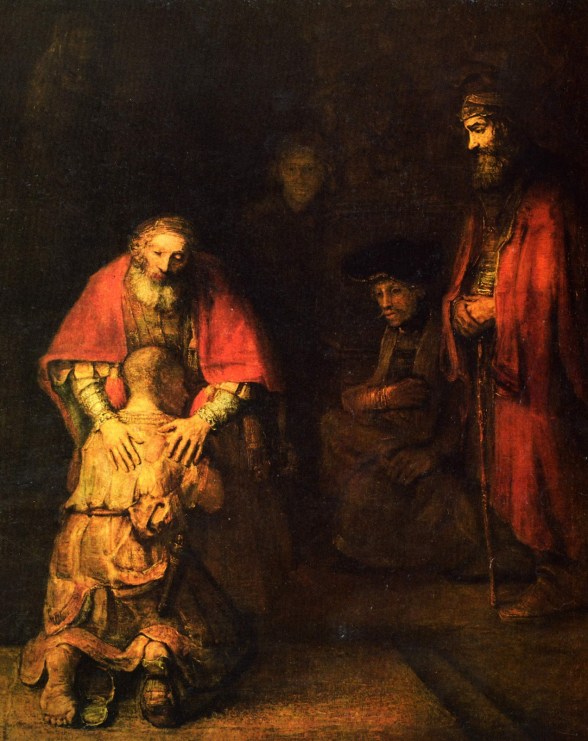
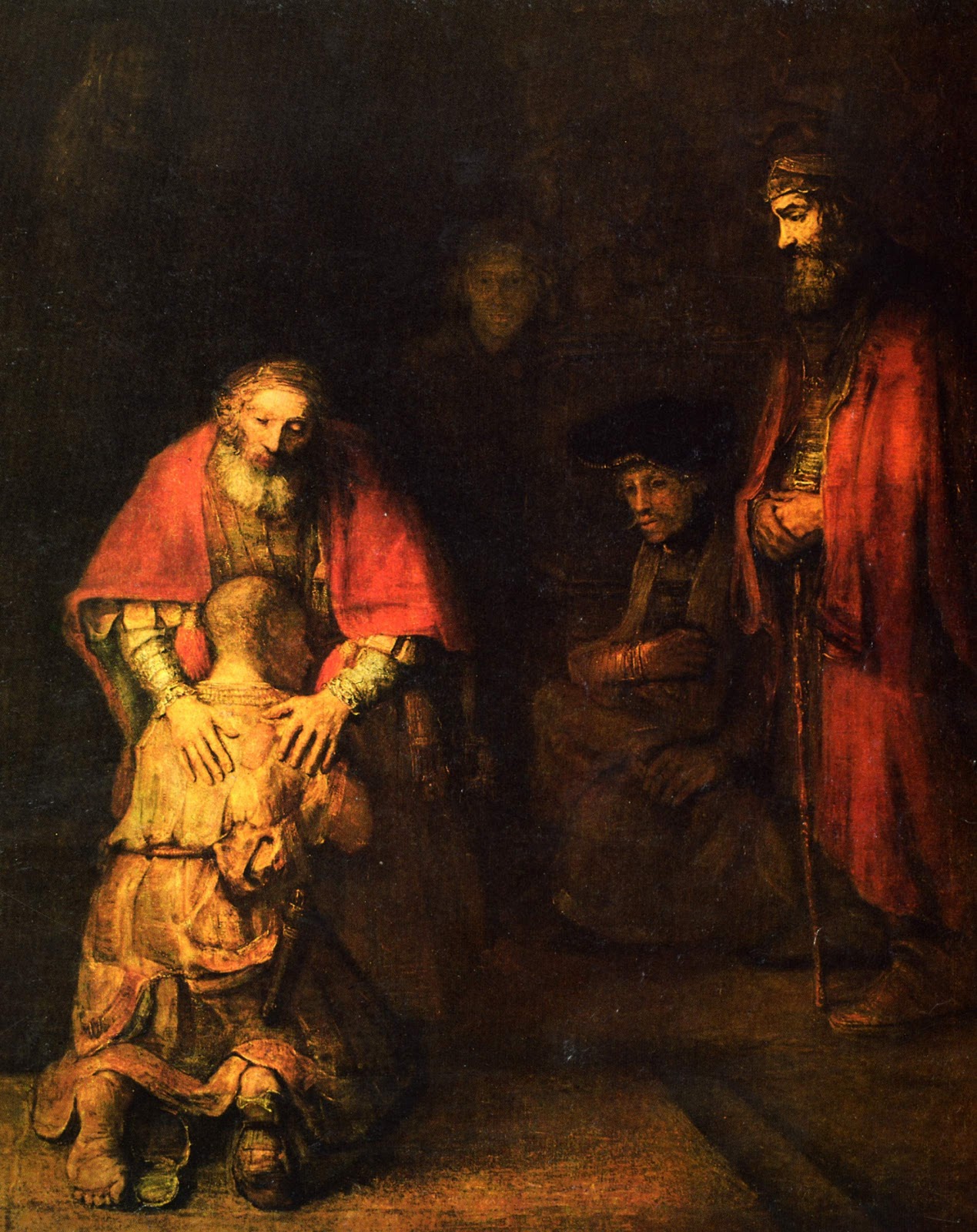
This painting by Rembrandt van Rijn is called ‘The Return of the Prodigal Son’ c.1662. The original hangs in the Hermitage in St. Petersburg. The older son is depicted on the right, in a red cloak, looking rather disapproving, and distanced from the father and younger son on the left.

Notice also the father’s hands – the one on the left is smaller and thinner than the one on the right. Most people think Rembrandt was endeavouring to depict both the fatherhood and motherhood of God.

Henri Nouwen has written a book about this narrative and painting called, ‘The return of the prodigal son’. You can read some of it here on Amazon. Read particularly pages 71 and following, about the older son. Or click here for a brief reflection on this painting.

Seeing from the Cross

Click here to listen to this 18-minute message.

Today is Good Friday – a poorly named day in my view. It should be Dark Friday. The Passion Week is transformed to good on Easter Sunday, but not before. There is nothing good about Friday. But my opinion is unlikely to change centuries of tradition!

Today, at my Anglican community church in Irene, South Africa, we participate in a three-hour service, from 12pm to 3pm – the hours that Jesus hung on the cross. It is a kind of vigil, like the women who kept watch as Jesus hung there. It is one of the best attended services at our church, and most people stay the full time. Today, we used the Seven Last Words of Christ to structure our service. The priest, deacon and lay ministers shared the preaching. I preached on the passage from John 19:25-27, where Jesus says “Woman, behold! Your son. … Behold! Your mother.” (my translation).

The central thing that stands out for me is that Jesus SEES his mother and his friend (thought to be John, the disciple). And seeing them and their need, he invites them to SEE each other (the Greek for ‘behold’, or ‘here’ in other translations, means ‘Look!’ or ‘See!’). So, in this sermon I suggest four layers of meaning:

  1. The passage foregrounds the humanity, dignity and worth of women, as central to the story. We need to stand against patriarchy, violence against women, the silencing and marginalisation of women, the exploitation of girl children.
  2. The passage speaks about Jesus’ commitment to family and to intimate relationships. We need to invest in these relationships, in the domestic, because this is of interest to God.
  3. The passage suggests the great potential of the church to recreate the world. We should examine our own churches, asking if we are really doing what God wants us to, are we being who God wants us to be?
  4. The passage advances God’s concern and love for the whole of humanity. God sees us, knows us, recognises us, loves us, champions us, cries for us. And we should also.

Wishing you a blessed and joyful Easter 2016.
Adrian

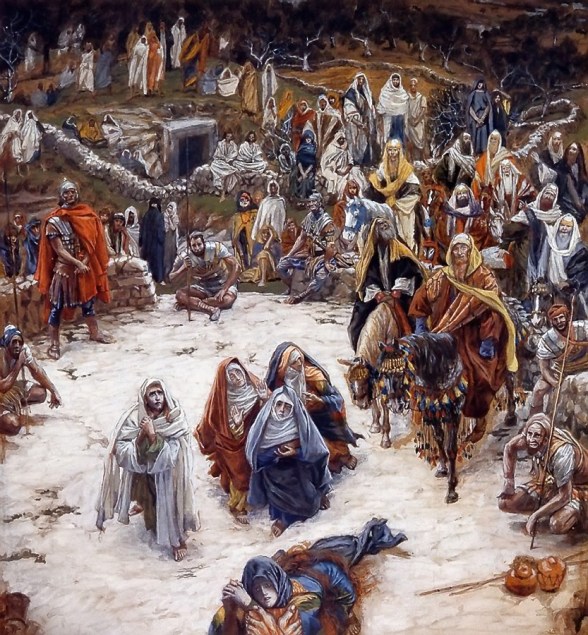
P.S. I struggled to find a picture that depicts what Jesus would have seen from the cross. The arts are almost entirely focused on Jesus on the cross – rightly so. But I found this one by James Tissot, a French painter, painted in c. 1890. For those receiving this by email, you won’t see the featured image for each of my sermons. Follow the link to my blog to see them.