Noah’s Ark foreshadows Christ’s Cross

Click here to listen to the audio recording of this 27-minute message. Or watch the video here on Facebook (the message starts 24 minutes into the recording). Or read the text summary below.

Our readings for today – the First Sunday in Lent – includes God’s Covenant with Noah after the great flood, in Genesis 9:8-17. Below I present this text from the interlinear bible, which endeavours to translate the Hebrew word-for-word into English:

8And God spoke to Noah, and to his sons with him, saying, 9“Behold, I, even I, am establishing my covenant with you, and with your seed after you, 10and with every living creature which is with you, among fowl, among cattle, among every animal of the earth with you, from all that go out from the ark, to every animal on earth. 11And I have made stand my covenant with you, and all flesh shall not be cut off again by the waters of a flood; nor shall there ever again be a flood to destroy the earth.”

12And God said, “This is a sign of the covenant, which I am about to make between me and you, and every living soul which is with you, for everlasting generations. 13I have set my bow in the cloud, and it shall be a sign of a covenant between me and the earth. 14And when I gather the clouds on the earth, then the bow shall be seen in the clouds. 15And I will remember my covenant which is between me and you, and every living soul in all flesh. And the waters shall not again become a flood to destroy all flesh. 16And the bow shall be in the clouds, and I shall see it, to remember the everlasting covenant between God and every living soul, in all flesh which is on the earth.”

17And God said to Noah: “This is the sign of the covenant which I have made stand between me and all flesh that is on the earth.”

It is worth taking careful note of the language used this passage, to gain an understanding of how radically inclusive God’s post-flood covenant with Noah was. See below the same text with coloured key words.

  1. In green, note the 8 uses of “you“: 5x “with you”, 1x “with your seed” and 2x “me and you”. God’s message to Noah is very directed towards him and particularly towards a partnership with him – the ‘with’ and the ‘and’.
  2. In yellow, note the 6 uses of “every“: 1x “every living creature”, 2x “every animal” and 3x “every living soul”. The Hebrew words behind the English all point towards living entities, whether human or animal – context may lean us towards one or other, but overall, the passage speaks equally about both people and animals.
  3. In blue, note the 5 uses of “all flesh“. In the Hebrew, ‘all flesh’ refers to the skin or flesh of any living being – again, people or animals, and also plants. The verb form of this Hebrew word means to be full of life, hence the skin (perhaps with its reddish colour) prompts us to think of living beings. But the Hebrew verb also means ‘good news’ and that’s a lovely link between this passage and the goodness of the Kingdom of God that Jesus preaches.
  4. In pink, note the 7 (yes 7!) mentions of the “earth“. In 5 of these, the reference is merely to people or animals “on the earth” – the earth is just a ground (soil) on which living things live. But in verses 11 and 13, we get two radical statements. In v11, God says that a flood will never again destroy the ‘earth’ – this is an expansion on God’s covenant not to destroy living things (animals and people) – now God also commits to protecting the earth itself. Moreover, in v13, God says that the rainbow “shall be a sign of a covenant between me and the earth”! Not only is the Noahic Covenant with Noah, people, animals AND plants, it is ALSO with the very earth itself. As if the earth is a living and sentient being! A great passage for those committed to ecospirituality.
  5. Finally, in lime, note the 5 uses of “between“. Two of these are “between me and you” emphasising a close partnering between God and Noah. The other three ‘between’s are between God and the earth, every living soul and all flesh. Here God shows his partnering with people, animals, plants and the planet (and perhaps by implication, the cosmos).

In short, this passage strongly emphasises a radical inclusivity by God towards the whole of God’s creation, encompassing not only all of humanity, not even also only of all animals, but also of the entire planet itself. This implies a universal covenant – a broad baobab tree with enough space for all created things to shelter under is branches. Humans, plus, plus, plus!

In this same passage, we also have 7 uses of the term “covenant”, which is why this passage is referred to the Noahic Covenant, following the devastating flood. A covenant is a binding agreement, and we get the heart of it in v11, “I have made stand [erected] my covenant with you, and all flesh shall not be cut off again by the waters of a flood; nor shall there ever again be a flood to destroy the earth.” The famous rainbow (mentioned three times as “bow”) is “a sign of the Covenant” – it is not the Covenant itself; just a symbol or sign that points to it (vv 12-13).

But what is most striking about this sign, is that it appears to be more for God’s benefit than for ours. God says in v16, “And the bow shall be in the clouds, and I shall see it, to remember the everlasting covenant between God and every living soul, in all flesh which is on the earth.” The bow is there for God to see, so that God will remember the covenant. It is hard to imagine God might forget about the covenant, so this is particularly intriguing, suggesting a strong commitment on God’s part.

It is reminiscent of the Passover blood that the Israelites painted on the doors of their homes. Exodus 12:13 has God saying, “When I see the blood, I will pass over you.” Here again is a sign that God sees that activates Covenant protection and blessing.
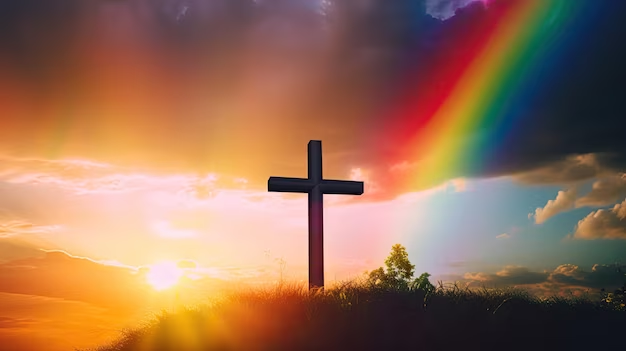
Image from https://img.freepik.com/premium-photo/cross-hill-with-rainbow-clouds-sunset_879736-1041.jpg

God’s covenant with Noah is universal – humans, plus, plus, plus. It foreshadows a far later Covenant, made in Christ.

This new covenant that we have through Jesus Christ is similarly radically inclusive and universal. Jesus died for the sins of the whole world, not just of some. Thus everyone can potentially be saved. And perhaps, if one adopts a universalist theology, God may just find a way to actually save every person. I don’t know, but I hope so!

Christ expands the Noahic covenant and completes it. His death and resurrection is God’s final Word on salvation. Christ incarnated, ministering, on the cross, resurrected and ascended is the new sign, replacing the rainbow. It fulfils the Noahic covenant.

We look forward in Lent towards remembering and walking through this new covenant that Jesus makes possible for the whole of creation.

A long story of God’s salvation

Click here to listen to the audio recording of today’s 17-minute message. Or watch the video on Facebook here (the message starts at about 25 minutes). Or read the short summary below.

Our Old Testament readings over Lent provide us with highlighted of the long story of God’s salvation of humanity. I thought that today we should look at all of these readings – the five Old Testament Sunday Lent readings, and today’s New Testament reading.

I summarise the development of God’s work for salvation as follows:

  1. God’s unconditional covenant with humanity
    • Genesis 9 (God’s rainbow covenant)
    • ‘Covenant’ is mentioned seven times
    • God promises never to destroy humanity with a flood
    • The rainbow reminds God of this covenant God has made with us
    • This covenant is entirely God’s doing and initiative, and unconditional for all humanity
  2. God’s everlasting covenant, plus circumcision
    • Genesis 17 (God’s covenant of circumcision)
    • ‘Covenant’ is mentioned 10 times
    • In three of these God says the covenant is everlasting
    • However, now the covenant has conditions:
    • Abraham must walk before God faithfully and blamelessly (v1), and
    • Males must be circumcised.
    • Males who are not circumcised fall outside God’s covenant (v14)
  3. God’s external law, which humanity must obey
    • Exodus 20 (God’s 10 commandments)
    • God now sets external laws by which we must abide
    • Now the responsibility for maintaining a right relationship with God is entirely humanity’s
    • Paul’s problem with this approach is that we inevitably break the law and thus fall out of favour with God
    • The solution of the Law alienates us from God
  4. Punishment for sin, but grace for salvation
    • Numbers 21 (God’s bronze snake)
    • But now we see a shift in God’s engagement with humanity
    • Still, law is important, and those who sin were bitten by poisonous snakes
    • But God instructs Moses to make a bronze snake which is lifted up
    • Those who look to this snake are saved/healed
    • This is a sign of grace – we look to God and God saves
    • The is a foreshadowing of the cross – we look up to Jesus on the cross, who saves
  5. God’s internal law; God’s choice to forgive
    • Jeremiah 31 (God’s law written on our hearts)
    • God says he is now setting out a new law that replaces the old – we see God shifting
    • This new law is written in our hearts – not on tablets or paper
    • And God chooses to forgive, out of God’s own initiative (v34b)
  6. Christ wins once-for-all salvation through faith
    • Romans 2-4 (God’s salvation by grace through faith)
    • Now, after Christ, salvation is by grace – it is won by Christ for us
    • We can add nothing to the salvation he has made possible
    • God chooses to forgive us, and indeed has already forgiven us and our descendants already – this is grace (a free gift)
    • We receive this grace through faith – we simply open our hearts and receive what is already available to us
    • We don’t earn our salvation – Christ has already done that – we merely receive it

There are three summary messages from today’s teaching:

  1. God has always been working for our salvation, since the creation – and continues to do so today
  2. God’s ways of working with humanity shift over time – God is not a stone – God is a person who adjusts their style of interacting with us
  3. Christ has fully accomplished our salvation – we can and need add nothing to it – we are invited merely to receive it
Featured image from https://davidjeremiah.blog/wp-content/uploads/2018/04/an-assurance-of-salvation-verse-to-know-by-heart.jpg

Who am I?

Click here to listen to this 23-minute message.

Today we ask the question, Who am I? Or more specifically, What is my identity as a Christian? This is the first of five themes in a series on stewardship, where we reflect on our role in taking care of God’s business in the world.

In this audio message, I make the following points:

  1. In John 15:1-10, the passage where Jesus says he is the vine and we are the branches, 11 times Jesus uses the term ‘remain’ (or ‘abide’ in the old Authorised Version): “Remain in me … and you will bear much fruit“. Here Jesus calls us to be rooted into him, to remain grafted into him. We recognise that without him, we can do nothing. So we depend on him.
  2. In the same passage, Jesus also speaks of remaining in us: “Remain in me as I remain in you“. This suggests an interdependence between God and us, in which God binds himself to humanity. We this most strongly evident in four moments in cosmic history: creation, covenant, incarnation and Pentecost. In each of these, God in some way limits himself or enters into agreement with humanity, binding himself and his work to us.
  3. Psalm 23 reminds us that God is both the source of our life (“The Lord is my shepherd, I lack nothing”) and its destination (“Surely your goodness and love will follow me all the days of my life, and I will dwell in the house of the Lord forever”). In John 14:6, Jesus similarly emphasises that he is the way and the truth and the life. In other words, he is everything – there is nothing in our lives that falls outside of our connection to Christ.
  4. Our interdependence with God is rooted in our relationship with God. Sometimes the church gives us rules or procedures or recipes we’re supposed to follow in our relationship with God. But this relationship is like any other relationship in our life. It is unique, personal and authentic. It is different for each of us, because, though God is the same person, each of us different, so his relationship to each of us different. God meets us right where we are. Whatever you find works for you in your relationship with God, do more of that.
  5. As much as our interdependence with God is rooted in our relationship with God, it is also rooted in our relationships with each other. God did not create a single person (Adam or Eve); God created a couple (two people in loving relationship with each other), and immediately mandated them to procreate and become a family. 1 Peter 2:9-10 similarly emphasises that we are a community of people in relationship with other people: “a chosen people, a royal priesthood, a holy nation, God’s special possession … the people of God”. So, we have to invest not only in ourselves and our relationship with God, but also in our relationships in the church (however you want to define that) and the work of the church.
  6. Finally, our readings today call for decisiveness. Moses, speaking just before the nation of Israel crosses into the promised land, calls them to a decision (Deuteronomy 30:19-20): “This day I … set before you life and death, blessings and curses. Now choose! Choose life! … For the Lord is your life”.

Image may contain: 1 person

This banner, hanging at St Stephen’s Anglican Church, Lyttleton, created by Eleanor Jappie.

Featured image from here.

Being God’s Beloved: Day 8: Chesed

Being God’s Beloved: Reflections on God’s Love.

We use words to describe and communicate experiences of life. These words are often inadequate to capture the whole of the experience. And when we try to translate them from one language to another, things get even more complicated.

One such word is the Hebrew word chesed. The 1535 Coverdale Bible translated it as ‘loving-kindness’. The NIV uses several English words or phrases, depending on the context, including love, unfailing love, great love, kindness, unfailing kindness, mercy, faithfulness and devotion. Chesed appears almost 250 times in the Old Testament. About three quarters of these occurrences refer to God’s chesed for humanity, while most of the remainder refer our chesed for one another.[1]

Chesed is most importantly a relational term. It is a pattern of interaction that takes places within established relationships. God’s love is made available to the whole of humanity – it is universal and all-embracing. But God’s chesed is a particular form of love that is exercised within established and intimate relationships between God and us. In other words, once we enter into a committed relationship with God, we experience an additional quality to God’s love, which is chesed.

Chesed may be best understood as a covenant love. Abraham entered into a covenant relationship with God in Genesis 17. At one level, the covenant is a contractual relationship between God and Abraham (and his descendants). But it is much deeper and whole-hearted than just a contract. It is a deep commitment of each to the other, much more like a marriage contract – an enduring and intimate investment in one another. With this mutual commitment comes chesed – loving-kindness, unfailing love. Chesed is the relational term that sums up the covenant.

God speaks about this in Isaiah 54:10, “‘Though the mountains be shaken and the hills be removed, yet my chesed (unfailing love)[2] for you will not be shaken nor my covenant of peace be removed,’ says the LORD, who has compassion on you.” And again a few verses later, God’s covenant and God’s chesed are paired, “I will make an everlasting covenant with you, my chesed (faithful love) promised to David” (Isaiah 55:3b).

Chesed is not merely a warm feeling of love towards a person with whom you have a committed relationship. Rather, it is a demonstration of that commitment in acts of kindness or mercy. It is love in action, based on commitment or loyalty. Neither is chesed simply random acts of kindness to strangers – the enduring and close relationship is central. We get some sense of this in Isaiah 63:7, “I will tell of the chesed (kindnesses) of the LORD, the deeds for which he is to be praised, according to all the LORD has done for us—yes, the many good things he has done for the house of Israel, according to his compassion and many chesed (kindnesses).” Compassion and kindness here have different meanings. Compassion is more about mercy and pity, with a significant emotional component, while kindnesses refer to acts of kindness rooted in God’s relationship with God’s people.

Because God is eternal and because God’s covenant is permanent, God’s chesed endures and persists for eternity. In Jeremiah 33:3, God says, “I have loved you with an everlasting love; I have drawn you with chesed (loving-kindness).” And in Psalm 89:28, God says, “I will maintain my chesed (love) to him forever, and my covenant with him will never fail.” Because of this assurance, the Old Testament writers repeatedly attest to God’s everlasting faithfulness: “But from everlasting to everlasting the LORD’S chesed (love) is with those who fear him, and his righteousness with their children’s children” (Psalm 103:17); “The LORD will fulfill his purpose  for me; your chesed (love), O LORD, endures forever—do not abandon the works of your hands” (Psalm 138:8); “Give thanks to the LORD, for he is good; his chesed (love) endures forever” (1 Chronicles 16:34).

This last phrase, “His chesed (love) endures forever”, appears numerous times in the Old Testament. It becomes a refrain in Psalm 118, which opens and closes with the whole phrase, “Give thanks to the LORD, for he is good; his chesed (love) endures forever”, and which repeats the refrain in verses 2, 3 and 4. Psalm 136 also opens with the whole phrase, and has the refrain in each of the Psalm’s 26 verses. Psalm 136 is a kind of Jewish Creed, in which all of God’s great acts to that time are recited, including God’s creation of the heavens and the earth, God’s liberation of Israel from Egypt and God’s giving to them the land of Israel. “His chesed (love) endures forever!”

God’s chesed is experienced particularly when we are in the midst of adversity. Psalm 94:18 says, “When I said, ‘My foot is slipping,’ your chesed (love), O LORD, supported me.” And Psalm 32:10 says, “Many are the woes of the wicked, but the LORD’S chesed (unfailing love) surrounds the man who trusts in him.” The sense here is that God’s chesed is grasped at while we are still in the adversity. Chesed does not necessarily remove the adversity or even the distress and anxiety that adversity evokes. Within each situation, we have to seek out again God’s chesed and rediscover what it means to be loved while we struggle with life. Chesed becomes a lifeline or an anchor onto which we hold for dear life. While we struggle someone may reassure us that God loves us, but actually that is something we have to find for ourselves.

God’s chesed is what we particularly cling to when our life is in danger. In Genesis 19, when the angels of the Lord rescue Lot and his family from Sodom, Lot says, “Your servant has found favour in your eyes, and you have shown great chesed (kindness) to me in sparing my life. But I can’t flee to the mountains; this disaster will overtake me, and I’ll die.” In the midst of this threat on his life, Lot experiences the angels’ deliverance as an act of chesed. In Psalm 119, especially, life and love are intimately tied up together: “Preserve my life according to your chesed (love), and I will obey the statutes of your mouth… Hear my voice in accordance with your chesed (love); preserve my life, O LORD, according to your laws… See how I love your precepts; preserve my life, O LORD, according to your chesed (love)” (119:88, 149 & 159).

God’s chesed gives us courage to approach God, even when we have messed up. Our sin – the myriad ways we fall short of God’s ideal for us – hinders our relationship with God. But our knowledge of God’s chesed is the mandate for us, nevertheless, to come close to God, to ask for mercy and forgiveness. Old Testament writers have a unique ability to remind God of God’s own values, and then to call on God to live according to these! It’s what we’d call chutzpah (Yiddish for audacity)! For example, Psalm 51 opens with these words, “Have mercy on me, O God, according to your chesed (unfailing love); according to your great compassion blot out my transgressions.” David, the author of this psalm, calls on God’s chesed and compassion to access God’s mercy and forgiveness. Psalm 6:4 similarly calls on chesed to access God’s deliverance: “Turn, O LORD, and deliver me; save me because of your chesed (unfailing love).”

Perhaps one of the more audacious examples is in Numbers 14:17-19, where Moses intercedes with God who is fed up with the grumbling of the Israelites during their time in the wilderness. He quotes back to God, God’s own words! And then, standing firm on God’s promised chesed asks for God’s forgiveness of the people. “Now may the Lord’s strength be displayed, just as you have declared: ‘The LORD is slow to anger, abounding in chesed (love) and forgiving sin and rebellion. Yet he does not leave the guilty unpunished; he punishes the children for the sin of the fathers to the third and fourth generation.’ In accordance with your great chesed (love), forgive the sin of these people, just as you have pardoned them from the time they left Egypt until now.” Reminded of his own words, God says, “I have forgiven them, as you asked.” We, like Moses, can have confidence to rest in God’s chesed, because God is committed to us.

God’s chesed is abundant. It is not meted out stingily. Psalm 33:5 affirms, “The earth is full of his chesed (unfailing love)” and Psalm 119:64 echoes, “The earth is filled with your chesed (love), O LORD.” The Psalms describe God’s love as reaching to the heavens – to the moon and back! “For great is your chesed (love), higher than the heavens; your faithfulness reaches to the skies” (Psalm 108:4). And God’s chesed reaches thousands of people (probably meaning everybody), “Know therefore that the LORD your God is God; he is the faithful God, keeping his covenant of chesed (love) to a thousand generations of those who love him and keep his commands” (Deuteronomy 7:9).

God’s lovingkindness – God’s chesed – is part of the relational package for all those who have entered into a covenant relationship with God. We can rely on God to be true to God’s character and promise, that God will keep his covenant of love with us. We can rest, peacefully, on God’s promise and God’s consistency. What God has said, God will do. It is one of the anchors of our life, not dependent on our feelings of relational security or self-worth. Not even dependent on the purity of our life. It is dependent on God’s consistent orientation towards us, an orientation of chesed.

But what if you are not in a covenant or committed relationship with God? What if you have not yet surrendered your life to Christ? While chesed is reserved for those in a covenant relationship, God still loves you and deeply wants to have a covenant relationship with you. This is God’s deep desire for each one of us – to have this sort of deep, intimate, loving relationship with you. All it requires from you is a decision to relinquish yourself to God – to surrender. Recognise your brokenness and the hollowness in yourself without God. Acknowledge your desire for and need for God. Thank God for being open to receive you into relationship. Thank God in particular for his Son Jesus Christ who has cancelled our sin and opened up the path to a wholehearted relationship with God. And commit yourself to God’s chesed. Welcome to God’s family! And to a lifelong experience of God’s chesed.

Meditation for the Day

Reflect on the meaning of chesed – God’s attitude of lovingkindness towards those with whom God has a covenant relationship. How would you relationship with God be different if you fully accepted God’s chesed?

Prayer for the Day

Loving God, remember your covenant of love to me. Let me never turn away from you. Let me never forget all your lovingkindnesses to me in the past. Let me always rest secure in your chesed.

Being_Gods_Beloved_square_3


[1] VanGemeren, W. (Ed.). (1997). New international dictionary of Old Testament theology and exegesis. Grand Rapids, MI: Zondervan. This is the primary source of information that informs today’s chapter. I have also made some use of the Brown, C. (Ed.). (1986). New international dictionary of New Testament theology and exegesis. Carlisle, UK: Paternoster.

[2] In all the quotations from the NIV Bible today, I am placing the NIV translation of chesed in brackets, so that you can see both the original use of chesed by the biblical writers and the varied translations of chesed into English by the NIV translators.