Christ, our centre

Click here to listen to the audio recording of this 21-minute message. Or watch the video here on Facebook (the message starts 35 minutes into the recording). Or read the text summary below.

Today is the fifth and last Sunday that we spend in John chapter 6. It has been a long and challenging 5 weeks. Next week, we go back to our journey through Mark’s gospel.

The setting of much of John 6, from after the feeding of the 5000 and Jesus walking on the water, is in a synagogue in Capernaum. In v59 we read, “Jesus said this while teaching the synagogue of Capernaum.” So, where did this teaching start? It started in v26, where, in the two verses before we read, that the crowds “got into the boats and went to Capernaum in search of Jesus. When they found him on the other side of the lake [in Capernaum], they asked him ‘Rabbi, when did you get here?'” and so the long teaching on the bread of life starts. John 6:25-71 all takes place in the synagogue at Capernaum.

This is not coincidental. While we can find Christ anywhere, he chooses to meet us in synagogues, in churches, in the midst of the people of God. We read this in John 18:20, where, before the high priest, Jesus says, “I always taught in the synagogues or at the temple, where all the Jews come together. I said nothing in secret.” Here is Jesus affirming that he consistently taught in the centre of the synagogues, in the midst of God’s people. And in Matthew 18:20, Jesus says, “For when two or three gather in my name, there I am with them” or ‘in the midst of them’. (I have to smile at the similarity between John 18:20 and Matthew 18:20!) And in most Anglican churches, we read the Gospel in the centre of the church, not from the front, because Christ, the Word, is central to the people of God. The Word is in the midst of us.

Christ is our centre, and we congregate around him.

But, Jesus’ word is hard. Last week, we chewed through a difficult passage about eating Jesus’ flesh and drinking his blood. His teaching is challenging and hard to understand. As a result, MANY of his disciples or followers fell away and left. They could not swallow his message. It was easier – so they thought – to move on and find an easier teaching elsewhere.

Jesus seems disappointed and sad at their leaving, because he turns to his 12 disciples, and says to them, rather than asking them, “You don’t want to leave too, do you.” He hopes and trusts that his people will remain with him.

Jesus’ himself says in v63, “The words I have spoken to you – they are full of the Spirit and and of life!” One thinks of God’s Word ringing out in Genesis 1, calling the universe into being through his word. And we think of John 1, “In the beginning was the Word, and the Word was with God, and the Word was God. He was with God in the beginning.” Christ does not merely speak words; he IS The Word!

And the 12 disciples know and understand this, because they have spent so much time sitting with Christ in their midst. And so Peter says, “Lord, to whom shall we go? YOU have the words of eternal life. We have come to believe and to know that you are the Holy One of God.” Jesus, as the Word of God that creates the world and as the Bread that comes down from heaven and gives life to the world, we feast on his word and bread. We hear the Gospel preached and we participate in the Eucharist. It is here, in this church community, that we find divine food, life and hope.

We must remain clustered around the centre, where Christ is. Let us not drift away to the edges, and then slip out into the darkness. We need to remain in the centre, where Christ, our light and life is. We need to remain in the centre and our church friends need to remain in the centre. Let us not drift away. And let us call back those who have. For Jesus has Spirit and Life – away from the centre, we are cold and lost.

https://i0.wp.com/www.shawnthebaptist.org/images/2018/01/JesusTeaching.jpg
It is significant that in many synagogues, the ‘pulpit’ from where the Torah is read, sung and preached and from where prayers are led, is in the centre of the synagogue, not in the front. https://qph.cf2.quoracdn.net/main-qimg-ea0d9bbe25c33626ee12b4dc33db5383-lq

Be grateful, be kind

Click here to listen to the audio recording of this 16-minute message. Or watch the video here on Facebook (the message starts 27 minutes into the recording). Or read the text summary below.

Our readings today urge us to be mindful – to think about what we think about, and about what we feel, say and do. We are invited to not simply react instinctively, but to consider how we react. Our thoughts and reactions impact ourselves and others, whether we are mindful or thoughtless, whether we are grateful or thankless, whether we are kind or harmful. We are urged to be grateful and kind.

In John 6:41-51, the people who had just had the blessing of being part of the Jesus’ feeding of the 5,000 (men, plus women and children) with fish and bread. You’d think they’d be grateful, but no, they were not. And then Jesus counsels them to not settle for bread that goes stale and moldy, but rather to seek after the Bread from heaven, that never spoils, but endures to eternal life (6:27). He even shares with them that God has sent him as the true bread from heaven and that he gives life to the world.

Still, they grumble and mutter. They remember him growing up in his family and cannot imagine that he could be the bread from heaven. “How can he now say, ‘I came down from heaven?'” Thankless they are! And Jesus chastises them: “Stop grumbling among yourselves!” One senses Jesus’ growing frustration, not only with how earth-bound they are (bread is more valuable to them than God the Son), but also with their unwillingness to see him for who he is.

And so he repeats “Very truly I tell you, the one who believes has eternal life.” And, “I am the bread of life.” And, “Your ancestors ate the manna in the wilderness, yet they died.” And, “But here is the bread that comes down from heaven, which anyone may eat and not die.” How much clearer can he be! You can hear his exasperation with these ungrateful and close-minded people. And so he repeats, “I am the living bread that came down from heaven. Whoever eats this bread will live forever.” And in case they still don’t get it (which they don’t!), he concludes, “This bread is my flesh! I will give it for the life of the world!”

And how do they respond? They “began to argue sharply among themselves.” Eish, the frustration of Jesus that we should be so mindless and so thankless. Here he is, offering us eternal life, right in our midst, and all we do is grumble, moan and argue.

Jesus calls us to a spirit of gratitude – to be grateful that the bread from heaven has come down into our midst, and to cast aside regular bread and instead feast on this heavenly bread that leads us to eternal life.

Paul, in the closing verses of Ephesians 4, similarly calls the Ephesians (whom he profoundly blessed in Ephesians 1 – you can catch my sermon on that here) to be kind to one another. Having been blessed with God’s greatest and most enduring and satisfying gifts (much as Jesus does in John 6), Paul calls us to be kind and considerate to each other. He calls us to set aside falsehood, anger, theft, laziness, unwholesome talk, grieving the Holy Spirit, bitterness, rage, anger, brawling, slander and malice. It’s quite a list!

And instead, Paul calls us to speak truthfully, not to let the sun go down without resolving our anger, to work, to do something useful, to share with those in need, to speak helpful words, to build other up according to their needs, to be kind, to be compassionate, to forgive others, to live a life of love, to follow God’s example.

Paul calls us to be kind – to be considerate, thoughtful, sensitive and helpful to other people, in just the same way that Jesus is with us – since Jesus loved us and gave himself up for us as a fragrant offering and sacrifice to God.

This message – be grateful, be kind – may seem twee and insincere and lefty. But it is core to Jesus’ message, and therefore core to the message of apostles, like Paul, and therefore core to my message as a pastor today, and should therefore be core to how you live your own life.

Of course, we fail. Some of you will have experience me being ungrateful and unkind. I and we can do better. Thankfully, though, we have a God who knows that we fail, and who has already been kind, loving and forgiving of us. We simply come back to him, say we’re sorry, ask for forgiveness, and pray for strength and grace to do better: to be grateful and to be kind. Amen.

Food and faith

Click here to listen to the audio recording of this 22-minute message. Or watch the video here on Facebook (the message starts 31 minutes into the recording). Or read the text summary below.

Jesus crosses the Sea of Galilee and then ascends the mountainside (v. 3) and sits down – it is on mountains that God often appears to people. Think of Moses and the burning bush, Moses receiving the Ten Commandments, Jesus transfigured before Peter, James and John. His ascent cues us that something important is going to happen – some revelation of the being or character of God.

John then tells us (v. 4) – seemingly for no reason – that the Jewish Passover Festival was near. Another translation (Bruner) has, “Now, the Passover, the festival of the Jewish people, was coming up.” The Passover, which takes place when the Jews are slaves in Egypt, includes the passing over of the Jewish households and their fleeing Egypt across the Red Sea. It is THE central narrative of the Jewish religion, in the same way that Christ’s death and resurrection are THE central narrative of the Christian religion. It speaks of deliverance, freedom, salvation, relief and hope. It speaks of God coming near to God’s people and answering the deep cries. So John mentions this to raise up in us a hopeful expectation of what God might do for us.

There are two layers to this story of the feeding of the five thousand: food and faith

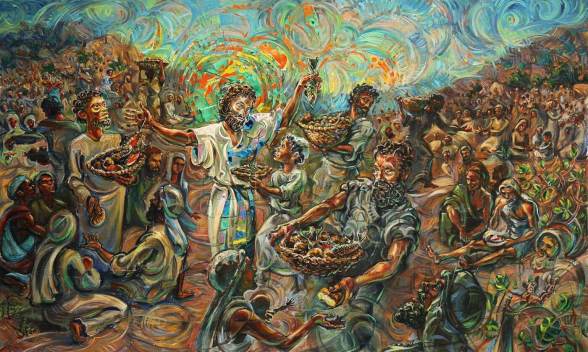
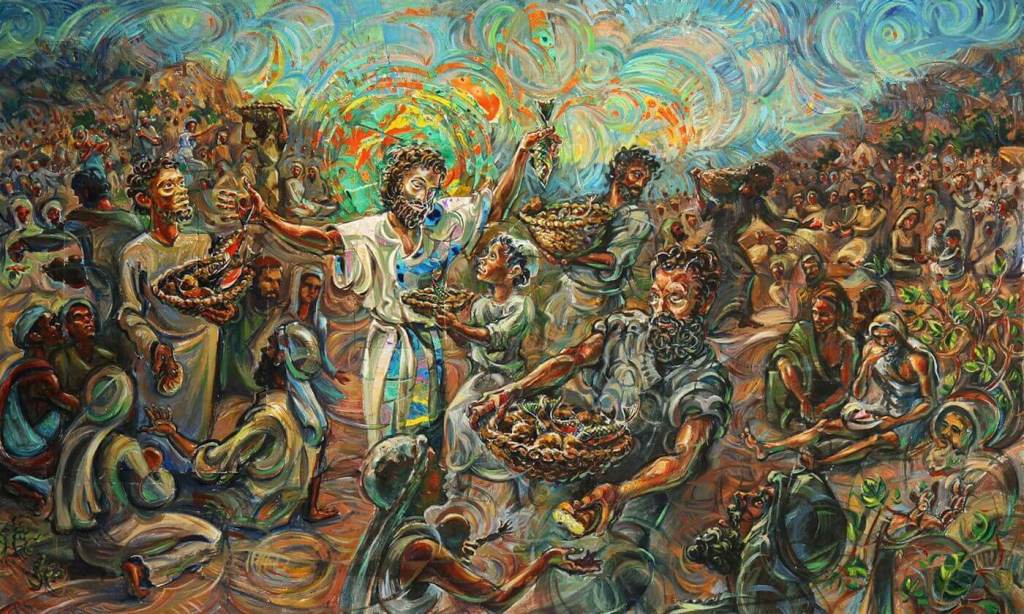
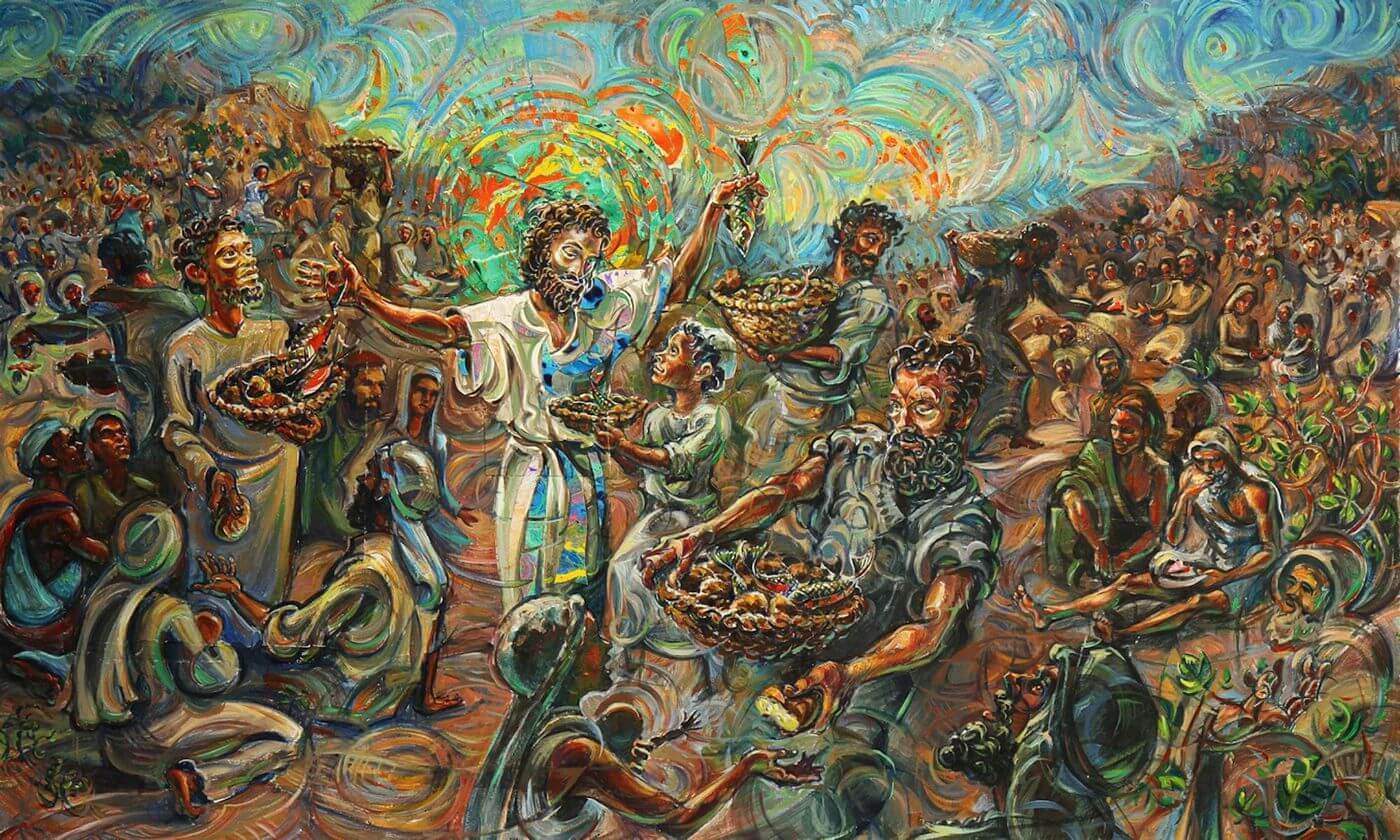
First, there is a practical layer – food. There are 5000 men there, presumably together with women and children. They are hungry and there is no place to get food. So Jesus creates enough food out of five small barley loaves and two small fish to feed them all, and to have 12 baskets of leftovers. This miracle, which may remind us of Jesus turning water into excellent wine at a wedding, a few chapters earlier, speaks to God’s concern for the basic needs of humanity. God desires us to have what we need to live. Basic needs for shelter, food, warmth, healthcare, education and safety are important to God. And Jesus provides for them. This is the first part of God’s revelation of himself in this story – God is concerned for your everyday needs and is willing and able to help you meet those needs, just as he helped free the Jews in slavery in Egypt.

Second, there is a spiritual layer – faith. Looking at the large crowds, the disciples are overwhelmed, and their mustard seeds of faith flee. Jesus knows that their faith is feeble, and so he asks Philip, “Where shall we buy bread for these people to eat?” His question leaves no wriggle room for Philip to say they must sort themselves out – it is clear that bread must be provided. The only question is where they will buy it. Philip’s faith collapses, as he says, “It would take more than half a year’s wages to buy enough bread for each one to have a bite!” Philip is unable to imagine that Jesus can do more than what is humanly possible. His feet are deeply embedded in the ground.

But then Andrew brings along a little boy who has five small barley loaves and two small fish and presents him to Jesus. It feels as if Andrew has some spark of faith that maybe something could be done with this little bit of padkos. But almost immediately, his faith also collapses, as he says, “but how far will they go among so many?”

Jesus takes control of the situation and issues instructions. The disciples trust and obey, and everyone ate as much as they wanted. Although Jesus will come to criticize the people for chasing after food, in this moment, they recognise him: “Surely this the Prophet who is to come into the world!” They want him to be king, but he just wants to reveal God to them.

And today’s reading ends with Jesus walking across the surface of the lake in a storm, several kilometers from the shore, and reminding them of who he is: “It is I. I am. Don’t be afraid.”

Featured image from https://www.tallengestore.com/cdn/shop/products/Jesus_Feeds_5000_-_Christian_Art_Painting_587f4577-c1f0-48ea-a738-38da1dc7cd19.jpg?v=1575281602

Bread of Heaven (Part 5)

Click here to listen to the audio recording of this 25-minute message. Or watch the video on Facebook here (the message starts at 30 minutes). Or read the text summary below.

We complete our five-part series on the Bread of Heaven, this week focusing on John 6:56-69. Over the past four weeks, Jesus has been consistently redirecting us to himself and presenting himself to us as the source of life. Among other things, he has show that:

  • He cares about us.
  • He feeds us, meets our physical needs, abundantly.
  • He redirects us from earthly things to heavenly spiritual things.
  • He directs us towards himself.
  • He invites us repeatedly into a relationship with him.
  • He says he is the bread of life, come down from heaven
  • He invites us to feast on him.
  • He offers us and the world eternal life.

Now the question is: How will you respond to all this?

There are two sets of responses in our reading: the response of the larger group of Jesus’ disciples and then the response of the 12 disciples, voiced by Peter.

The response of Jesus’ disciples

Today’s reading indicates that Jesus’ teachings are hard – who can accept them? What is it about Jesus’ teaching in John 6 that is hard to accept, offensive? In part, it is his claim that he came down from heaven (John 6:42) and in part that he invites us to eat his flesh and drink his blood (John 6:52). On the one hand, he is too heavenly and on the other hand he is too earthly and fleshy. He is too high and too low!

Jesus responds to the first point by asking how they will feel when they see him ascending back into heaven (John 6:61-62). If his claim to have come down from heaven is hard to accept, how much more witnessing him ascending back into heaven! And he respond to the second point by saying they should forget about earthly flesh and concentrate on spiritual flesh and words, which are full of Spirit and life (John 6:63).

But, recognising that his teachings are hard to understand, Jesus acknowledges that some do not believe and some who believe will fall away. It is our choice whether or not we believe in him. Yet, it is important for us also to know that God the Father enables our faith, enables us to believe and even to accept hard, difficult teachings. Indeed, three times in this chapter, Jesus emphasises that it is the Father who inspires and enables our belief:

  • The Father gives us to Christ (John 6:37).
  • The Father draws us to Christ (John 6:44).
  • The Father enables us to come to Christ (John 6:65).

God is sovereign. God does the drawing of our hearts towards Jesus. We rely and depend on God to enable and inspire our faith. And so we pray to him when our faith frays.

Nevertheless, many of Jesus disciples turn away and leave him. God does not force them to stay or force them to believe. We have free well to listen to God’s call and to follow him. God may give, draw and enable our faith, but he does not coerce – we still choose.

The response of Peter

Finally, Jesus turns to the 12 disciples – they are not among those who turned away and left. He asks them, “You do not want to leave too, do you?” (John 6:67). The phrasing of the Greek implies a ‘no’ answer. Jesus is hoping that they will not join the others who have turned away.

Peter’s reply is wonderful:

“Lord, to whom shall we go? You have the words of eternal life!” (John 6:68) Peter knows the options out there, and concludes that they are all wanting. Even if Jesus’ teaching is hard to fathom, he can think of no better options. And besides, despite the difficult of Jesus’ teachings, he recognises that these are words of eternal life. Not words about eternal life, but the words of eternal life! Jesus very words are Life itself! As Jesus said earlier (v63), “the words I have spoken are full of the Spirit and of life.”

“We have come to believe to know that you are the Holy One of God.” (John 6:69) Here Peter describes a process – the same process that we have been following these past five weeks: there is a process (“we have come”) of learning to trust Jesus and to entrust ourselves into Jesus (“to believe”) that leads to knowledge about who Jesus is and what he means to us (“and to know that you are the Holy One of God”). There is a process of trusting Jesus that leads to us knowing him.

All of this (this entire chapter 6 in John’s Gospel) has been about drawing us closer into a trusting relationship with Jesus, redirecting us from the things of the world to himself, and learning to trust that he himself, as the bread that has come down from heaven, is the source of all the nourishment that we need, of life, of Spirit.

Again, the question is: How will you respond to all this?

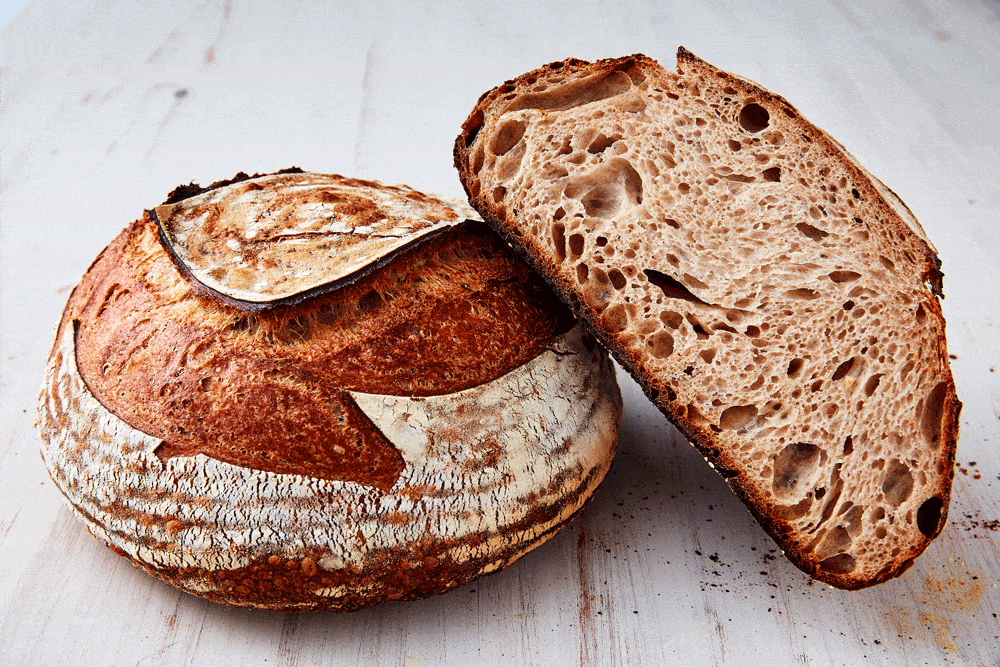
Featured image of sourdough bread from https://www.independent.com/events/how-to-make-sourdough-bread/

Bread of Heaven (Part 3)

Click here to listen to the audio recording of this 16-minute message. Or watch the video on Facebook here (the message starts at 26 minutes). Or read the text summary below.

We continue with our series on the Bread of Heaven, this week focusing on John 6:35-51. Last week (Part 2) we saw how Jesus persisted in redirecting people from worldly work and food to heavenly work and food, from our actions to Christ’s actions, from our small vision to God’s grand agenda, and from bread to Christ. Everything was focused on getting us to redirect ourselves towards Christ, to orientate ourselves towards him.

Our passage today continues that theme, as Jesus unpacks what it means to orientate ourselves to him and how he takes the leading in enabling us to do that. I’ll be extracting five word themes from the passage. We’ll see that Jesus is once again persistent in using the same phrases over and over to drive home his message.

Christ’s invitation – come to me

First, Jesus repeatedly uses language that speaks to us coming to him, believing in him, eating of him, looking to him. Eleven times in 14 verses he uses these terms. He issues us an invitation, an open and generous invitation, to come to him. It is the central message of today’s text – come to me!

35 Whoever comes to me will never go hungry
37 All those the Father gives me will come to me
37 whoever comes to me I will never drive away
44 No one can come to me unless the father draws them
45 Everyone who has heard the Father comes to me
35 whoever believes in me will never be thirsty
40 everyone who believes in him shall have eternal life
47 the one who believes has eternal life
50 anyone may eat and not die
50 Whoever eats this bread will live forever
40 everyone who looks to the Son shall have eternal life

God’s grace – the Father’s will

Our ability to come to Christ is, however, by God’s grace. It is through the will of Father, and not through our own efforts or initiative that we can come to God. Only by grace, through faith in Christ. Six times, Jesus emphasises that it is through the work of the Father that we can come.

37 All those the Father gives me will come to me
39 this is the will of him who sent me
40 For my Father’s will is that
44 the Father who sent me draws them
45 They will all be taught by God
45 heard the Father and learned from him

Christ’s initiative – Christ comes down

As much as our capacity to come to Christ is through the grace and will of God, Christ himself also assists in coming down to us. We don’t have to go far to find him – he has already come to us. In the three places where Jesus refers to his coming down from heaven, he uses three different tenses: I have come, I am coming right now, I came. This suggests that his coming is timeless: yesterday, today and tomorrow, Christ is coming down from heaven.

38 I have come down from heaven
50 here is the bread that is coming down right now from heaven
51 I am the living bread that came down from heaven

Christ’s inclusivity – each one and everyone

Jesus conveys his inclusivity in the way he refers to people in both the singular (9 times) and plural (8 times). It seems that he wants us to think of ourselves as being of special importance – just me, every single person, you the individual. And he also wants us to appreciate that he includes everyone, a radical inclusion that, in the last verse, encompasses the whole world!

35 whoever comes to me
35 whoever believes in me
38 whoever comes to me
39 I shall lose not one
44 No one can come to me
46 Not one has seen the Father
47 the one who believes has eternal life
50 any one may eat and not die
51 Whoever eats this bread will live forever

37 All those the Father gives
39 raise them up
40 my Father’s will is that everyone
40 raise them up
44 raise them up
45 They will all be taught by God
45 Everyone who has heard the Father
51 for the life of the world

Christ – the Bread of Life

And finally, Jesus repeatedly refers to himself as The Bread. Six times he calls himself the bread. In Parts 1 and 2 of our series, we encountered this only once – in the same verse that opens today’s reading. But here, he drives home that the bread we hunger after, the bread that sustains life, the bread that fills us up, is indeed Christ himself. If we are hungry and thirsty for something, Jesus is the one who satisfies us.

35 I am the bread of life
48 I am the bread of life
50 here is the bread that comes down from heaven
51 I am the living bread
51 Whoever eats this bread will live forever
51 This bread is my flesh

Today’s reading emphasises, repeatedly, that Jesus is the one we are after, that he is the one who, with the support of the Father, initiates the invitation for us to come to him and makes it easier by coming to us, so that each and everyone of us and all of us together can feast on the bread of life that has, is and continues to come down from heaven.

Come to Jesus!

Featured image of roti from https://www.cookhalaal.com/recipe/my-mothers-roti-recipe/

Bread of Heaven (Part 2)

Click here to listen to the audio recording of this 21-minute message. Or watch the video on Facebook here (the message starts at 30 minutes). Or read the text summary below.

We continue with our series on the Bread of Heaven, this week focusing on John 6:24-35. Last week (Part 1) we read about Jesus’ feeding of the 5000 men (plus children and women) with just five small barley loaves and 2 little fish. We recognised that there were two levels to the story – on the ground floor, this is a story about Jesus caring about people being hungry and doing something about it; on the first floor up, this story is an invitation to have faith in Jesus, that he is more than capable of taking care of our needs. This week (in Part 2 of our series), we add on a third floor, which is to faith in Jesus, who is the Bread from Heaven, the Bread of Life.

Today’s passage involves four interactions between the crowd (who had followed Jesus after his feeding them) and Jesus: they as a question and Jesus answers. With each Q&A, Jesus seeks to redirect the people from focusing on the things of this world, on things of the past and on ourselves, and to rather focus on him.

Redirection from worldly work and food to heavenly work and food

The crowds ask Jesus, “Rabbi, when did you get here?” Jesus is quite critical of them, saying they are just chasing miracles and food for their tummies. The then urges them, “Do not work for food that spoils, but rather work for food that endures to eternal life.” Note Jesus’ emphasis both on work and food, contrasting work and food that are temporal and can go off and have to be discarded, versus work and food that are enduring, even to eternity.

This reminds me of Jesus speaking to the Samaritan woman at the well, just two chapters earlier, where he said, “Everyone who drinks this water [from the well] will be thirsty again, but whoever drinks the water I give them will never thirst. Indeed, the water I give them will become in them a spring of water welling up to eternal life” (John 4:13-14).

Jesus is redirecting us from the things of this world – from food and water and even miracles – towards the things that are of eternal significance – towards faith, towards heaven and (we shall soon see) towards himself.

Redirection from our actions to Christ’s

The crowd seem to be getting with the programme, so they ask, “What must we do to do the works God requires?” This is a laudable question – they want to do the works of God, they want to meet God’s requirements, so they want to know what they should do. It is hard to fault them for wanting to do the work of God! But Jesus gives two redirections.

First, he shifts the focus from that they must do to what God does. The tells them what they must do by referring to the “work of God“, not ‘your work’. This is a huge hint towards the centrality of salvation through faith in Christ. Jesus says that the work we must do is in fact the work of God. This reminds me of Phil 2:12-13, where Paul writes, “[you] work out your salvation with fear and trembling, for it is God who works in you to will and to act in order to fulfil his good purpose.” He gives what sounds like a contradiction! You work out your salvation because it is God who is working in you…” We cannot do anything, except what God does in us. We are dependent on God for everything that we do.

Second, he shifts from “the works God requires” to the “work of God” – from plural to singular. The crowds were thinking in terms of the many things they needed to do as signs of faith, but Jesus says, ‘No! There is just one work of God. Just one thing is required. And that is to believe in the one God has sent’. That’s it: to believe, or have faith. Faith alone is what God requires. And this faith is almost a falling into Christ, like a relaxing into him, reclining into him, resting in him. It is hardly ‘work’ at all!

Jesus is redirecting us from a focus on the many things we think we need to do to satisfy God’s expectations, towards a simple (yet also hard) just trusting in God to enable our faith in Christ.

Redirection from a small vision to God’s grand agenda

The crowds now get cocky and impertinent, asking Jesus what sign he will given them to prove that they should deign to listen to him. They seem to have entirely forgotten that he just fed thousands of people from a small lunch box! They refer back to Moses, when they were wandering in the desert, centuries before, who gave them bread from heaven (manna).

But in Jesus’ response, he contradicts everything they have said (and in the process, declines to give them a ‘sign’):

  • It is not about Moses, but about my Father.
  • It is not what was given to them (in the distant past), but what the Father gives them right now.
  • It is not about bread from heaven (manna, which lasted only one day), but The True Bread from heaven.
  • It is not just for you, but for the whole world.

Jesus directs them from a rather small and long-gone longing for manna from Moses towards a far greater, more enduring and more inclusive bread that is True and from Heaven.

Redirection from bread to Christ

Finally, it seems they get it! Instead of referring to Jesus as “Rabbi” as in the start of this passage, they now refer to him as “Lord” (or “Sir”). And they now ask, “always give us this bread”. They recognise that everything they had been setting their eyes and hearts on was quite worthless. But this True Bread that Jesus was talking about now – that was bread worth having! This is like the Samaritan woman, who says “Lord, give me this water so that I won’t get thirsty and have to keep coming here to draw water.”

And Jesus replies,

I am the bread of life. Whoever comes to me will never go hungry, and whoever believes in me will never be thirsty.

Jesus has completely redirected them away from bread to himself. Jesus IS the bread of life. He does not give them the bread of life; he is the very bread itself! If we want bread, we want Christ.

Featured image of Turkish bread from https://www.youtube.com/watch?v=ORoIGnoakwU

Bread of Heaven (Part 1)

Click here to listen to the audio recording of this 22-minute message. Or watch the video on Facebook here (the message starts at about 31 minutes). Or read the text summary below.

Our reading this morning is from John 6:1-21. We will be spending five weeks on this chapter. I think that this is the most consecutive Sundays we spend on any chapter in the Bible. (I stand to be corrected.) This is because we receive here some of Jesus’ most profound and important teaching – about the Bread of Life, the Bread of Heaven. It starts with a story about ‘real bread’ and becomes a story about ‘Real Bread’ (Bruner’s commentary on John).

In the first 15 verses of John 6, we are introduced to bread. It sets the scene for the rest of the chapter. We can read this story at two levels: on the ground floor, it is a story about Jesus feeding 5000 men from five small barley loaves and two small fish – a story of compassion and care; on the first floor, it is a story about an invitation to faith – faith in Jesus, who is the Bread of Life.

The ground floor – a story about caring

Jesus is on the mountain side and he sees a large crowd heading his way. John writes “Jesus looked up and saw”. Jesus is always looking up and seeing. We get this again and again in the Gospel narratives. He has his eyes open and sees the needs of those around him. If you listen to my messages over the past month, you’ll hear it over and over. He sees. And he has compassion.

So he asks his disciples how they can arrange bread to feed the people. It is a huge ask, of course, with 5,000 men, plus children (we know there are children there, because soon we meet a ‘boy’ in v9) and women (if there are children, there are surely women). So, there were perhaps 15,000 or 20,000 people! Andrew brings a boy who has a little bit of food – not much more than a snack. Jesus gives thanks for the food and distributes it to the people. (One wonders what the boy thought about having his lunch annexed by the Andrew and Jesus!) Everyone eats their fill, so much so, that there are 12 large baskets (big baskets that could hold a man) of leftovers of the barley bread.

Many of us believe that Jesus performed a miracle, in which he multiplied that little bread into much bread. Others believe that when people saw Jesus’ (and perhaps also the boy’s) generosity and compassion, they were moved to share what they had with those who had less. And so, what we see is a social miracle about people moved to caring and sharing. Either way, this is a story about Jesus caring for others – caring for our everyday needs. As we often pray, ‘Give us this day our daily bread’. Bread is life in come communities. In others, it is maize meal porridge. In others, it is rice. Every society has a staple food that provides the foundation of life. Jesus cares about this and wants people to have food in their stomachs. And to have it abundantly.

The first floor – a story about faith

The feeding of the 5000 is an important miracle story in the Bible. It is the ONLY miracle, taking place between Jesus’ baptism and his entry into Jerusalem on Palm Sunday, that appears in ALL FOUR Gospels. There is no other miracle that appears across all four Gospels, except this one. And in John’s gospel, it introduces a lengthy chapter about the spiritual meaning of Real Bread. Still, even on the first floor, the real bread is just bread. But the interactions between Jesus and the others are an invitation to faith.

John tells us that the event takes place just before the Passover festival (v4). The Passover symbolised, as it still does, liberation and redemption from slavery in Egypt, God standing up for the people of God, God caring for God’s chosen ones. It is central to Jewish faith, like the cross is central to Christian faith. This cues us that this is a story about faith.

Seeing the large crowds, Jesus invited Philip to faith: “Where shall we buy bread for these people to eat?” For sure, this is a big ask – it is a big crowd. But Philip was there in John 2, when Jesus changed water into wine – a lot of wine, a lot of really good wine! Jesus invites Philip to have faith. A faith response might have been, “Lord, I can’t imagine where we could get or afford so much bread. But I know you can make a plan! If anyone can feed this many people, it is you!” That would be a faith response, particularly after witnessing the water into wine miracle. Instead, all Philip can see is the large crowd. He loses sight of Jesus. His faith fails him.

Andrew shows a little faith, however. He finds a boy with some food. He emphasises the smallness of what the boy has: “five small barley loaves and two small fish” (v8). And then his tiny bubble of faith pops: “But how far will they go among so many people?”

Yet, that is all Jesus needed: a tiny morsel of faith. He takes those small loaves and small fish and gives thanks for (literally ‘eucharists’) them and feeds 5000+ people. Jesus is not constrained by the size of our faith. Andrew’s faith is feeble, small and easily fizzles. But what is important is not so much our faith, as the one in whom we place our faith: Jesus is more than capable of calming our storms, feeding us, healing us, helping us. He is the Lord of lords and King of kings. He is God incarnate. He can do anything.

It is only in the collecting of the leftovers that the disciples and the people recognise a miracle has taken place. I think Jesus instructs the disciples to collect the leftovers so they can see and touch the miracle, much as Jesus does with Thomas in John 20 – “Put your finger here; see my hand”. As Thomas was invited by Jesus to see, touch and respond in faith, so were Philip and the other disciples invited to see, touch and respond in faith. And so are we. Particularly during times of turmoil, illness, loss, distress and hunger.

Postscript

Immediately after the story of the feeding of the 5000, we have John’s version of the story of Jesus walking on the water (see my sermon on this same story from Mark’s Gospel, a month ago). The disciples are alone in a boat on a lake in a storm and struggling to make headway. Jesus sees their plight and walks across the water to them. They are terrified to see him, but he says, ‘It is I; don’t be afraid“, and he climbs into the storm-rocked boat with them – he chooses to be in the boat in the storm with them – and immediately, they find they have reached the other side of the lake, where they were headed.

Jesus remains more than capable of riding out and calming the storms in our lives.

Featured image from https://www.kitchensanctuary.com/artisan-bread-recipe/

Pick your bakery

Click here to listen to the audio recording of this 8-minute message. Or watch the YouTube video below, or read the text summary after that.

In John 4:35, Jesus says “I am the bread of life. Whoever comes to me will never go hungry, and whoever believes in me will never be thirsty.” And later in the same chapter (v48-51), he says,

I am the bread of life. Your ancestors ate the manna in the wilderness, yet they died. But here is the bread that comes down from heaven, which anyone may eat and not die. I am the living bread that came down from heaven. Whoever eats this bread will live forever.

Earlier in John’s Gospel (4:13-14), Jesus says something similar to the Samaritan woman at the well:

Everyone who drinks this water [from the well] will be thirsty again, but whoever drinks the water I give them will never thirst. Indeed, the water I give them will become in them a spring of water welling up to eternal life.

When we are going through stressful, difficult times, or are feeling out of sorts, we have to choose what kind of bakery we go to, to get some bread to satisfy and calm ourselves.

Sometimes, we engage in things that are psychologically and socially healthy, like meditation, going for a walk or some other kind of exercise, meeting up with a friend or resting.

But oftentimes, we engage in things that are not psychosocially healthy and that can even have harmful consequences, like going on a shopping spree, drinking too much alcohol, watching pornography, lashing out physically or verbally at our loved ones, driving too fast, using drugs, skipping work and so on. These mechanisms provide temporary relief, but leave us hungry for more, and often create more problems than we had in the first place. They do not truly satisfy our hunger. Indeed, we might end up more hungry than before, and need more of this kind of bread next time.

Jesus invites us to come to his bakery when we are hungry for something to satisfy our souls. The bread he offers is healthy, wholesome, long lasting and satisfying.

When we reach these points of difficulty in life, we have the opportunity to make a choice – to pick our bakery. Do we go to the one on the corner where we can buy the soft white bread that lasts only a moment? Or do we choose to drive a distance to get the healthy bread that lasts a long time?

Or can we choose to turn to Jesus, the master baker, to get the bread that will last for eternity, bread from heaven?

Featured image from https://www.countrykitchenlisburn.com/bakery/