Click here to listen to the audio recording of this 22-minute message. Or watch the video here on Facebook (the message starts 31 minutes into the recording). Or read the text summary below.
Jesus crosses the Sea of Galilee and then ascends the mountainside (v. 3) and sits down – it is on mountains that God often appears to people. Think of Moses and the burning bush, Moses receiving the Ten Commandments, Jesus transfigured before Peter, James and John. His ascent cues us that something important is going to happen – some revelation of the being or character of God.
John then tells us (v. 4) – seemingly for no reason – that the Jewish Passover Festival was near. Another translation (Bruner) has, “Now, the Passover, the festival of the Jewish people, was coming up.” The Passover, which takes place when the Jews are slaves in Egypt, includes the passing over of the Jewish households and their fleeing Egypt across the Red Sea. It is THE central narrative of the Jewish religion, in the same way that Christ’s death and resurrection are THE central narrative of the Christian religion. It speaks of deliverance, freedom, salvation, relief and hope. It speaks of God coming near to God’s people and answering the deep cries. So John mentions this to raise up in us a hopeful expectation of what God might do for us.
There are two layers to this story of the feeding of the five thousand: food and faith
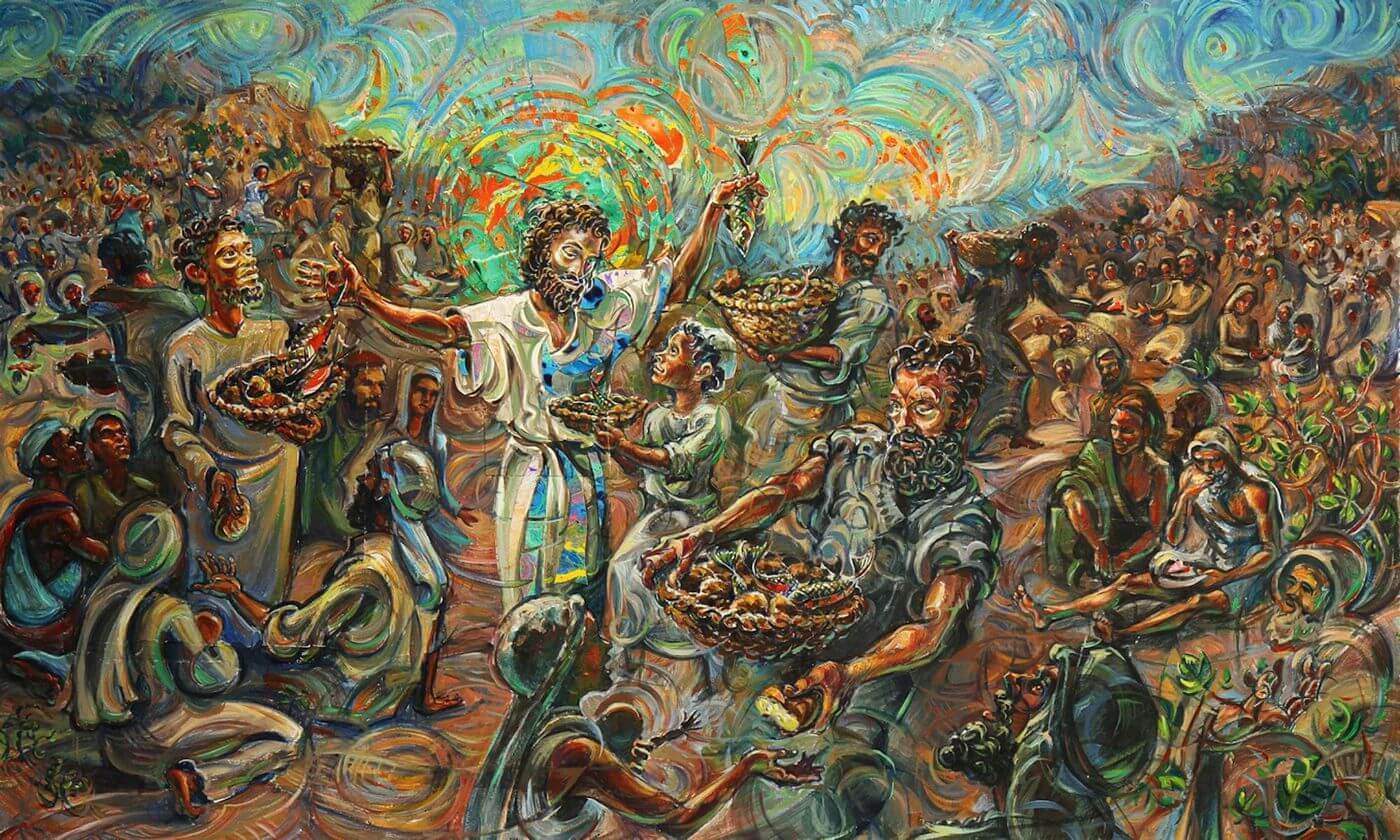
First, there is a practical layer – food. There are 5000 men there, presumably together with women and children. They are hungry and there is no place to get food. So Jesus creates enough food out of five small barley loaves and two small fish to feed them all, and to have 12 baskets of leftovers. This miracle, which may remind us of Jesus turning water into excellent wine at a wedding, a few chapters earlier, speaks to God’s concern for the basic needs of humanity. God desires us to have what we need to live. Basic needs for shelter, food, warmth, healthcare, education and safety are important to God. And Jesus provides for them. This is the first part of God’s revelation of himself in this story – God is concerned for your everyday needs and is willing and able to help you meet those needs, just as he helped free the Jews in slavery in Egypt.
Second, there is a spiritual layer – faith. Looking at the large crowds, the disciples are overwhelmed, and their mustard seeds of faith flee. Jesus knows that their faith is feeble, and so he asks Philip, “Where shall we buy bread for these people to eat?” His question leaves no wriggle room for Philip to say they must sort themselves out – it is clear that bread must be provided. The only question is where they will buy it. Philip’s faith collapses, as he says, “It would take more than half a year’s wages to buy enough bread for each one to have a bite!” Philip is unable to imagine that Jesus can do more than what is humanly possible. His feet are deeply embedded in the ground.
But then Andrew brings along a little boy who has five small barley loaves and two small fish and presents him to Jesus. It feels as if Andrew has some spark of faith that maybe something could be done with this little bit of padkos. But almost immediately, his faith also collapses, as he says, “but how far will they go among so many?”
Jesus takes control of the situation and issues instructions. The disciples trust and obey, and everyone ate as much as they wanted. Although Jesus will come to criticize the people for chasing after food, in this moment, they recognise him: “Surely this the Prophet who is to come into the world!” They want him to be king, but he just wants to reveal God to them.
And today’s reading ends with Jesus walking across the surface of the lake in a storm, several kilometers from the shore, and reminding them of who he is: “It is I. I am. Don’t be afraid.”
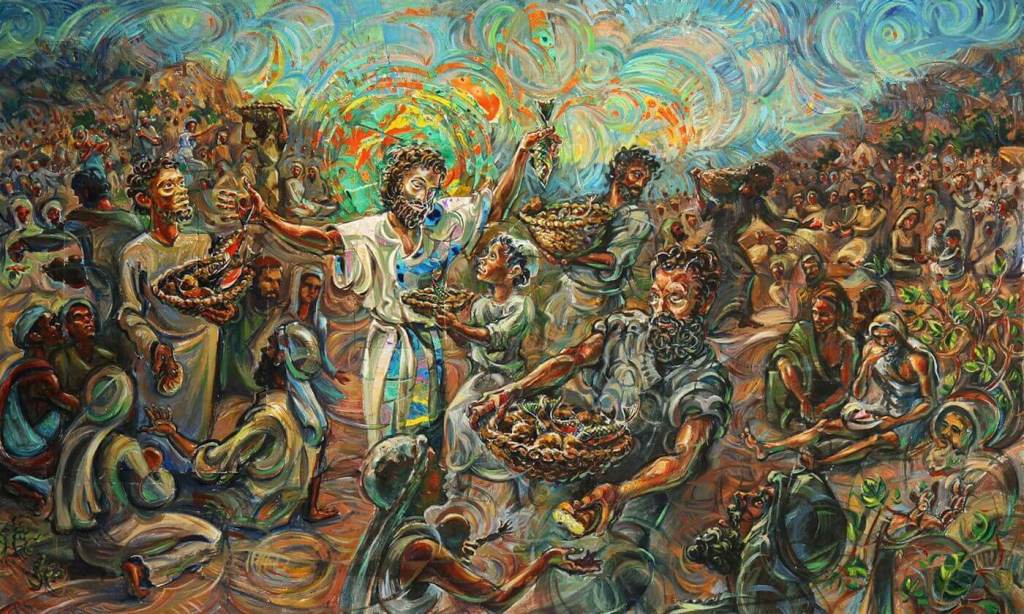
Featured image from https://www.tallengestore.com/cdn/shop/products/Jesus_Feeds_5000_-_Christian_Art_Painting_587f4577-c1f0-48ea-a738-38da1dc7cd19.jpg?v=1575281602


 Reflections of God's Love