Baptism of Christ

Click here to listen to the audio recording of this 17-minute message. Or watch the video here on Facebook (the message starts around 25 minutes into the recording) – for this sermon, the video is much better than just the audio – you need to see it. Or read the text summary below (photos included below).

Today we celebrate Christ’s baptism, which inaugurates his ministry. John the Baptist had been preaching a Gospel of repentance for the forgiveness of sin, made tangible through baptism. And Jesus came to him to be baptised, even though Jesus was without sin.

As Jesus comes up out of the water, the heavens open and the Spirit of God descends on Jesus in the form of a dove, and the voice of God is heard saying, “You are my Son, whom I love; with you I am well pleased.” This is the only place in the Bible where Father, Son and Holy Spirit are tangibly present at the same time. This is an expression of the Epiphany, which is the season we’re currently in – Epiphany being all about God’s revelation of God’s self to the world. And this scene is certainly a great revelation of the triune God!

We could also think about this moment as an incarnation not only of Christ himself, but of all three persons of the Trinity – Jesus is there in the flesh, the Holy Spirit comes in bodily form like a dove, and God’s voice is audible to human ears (sound waves moving through the air). Father, Son and Spirit all materialise in the human world in that brief moment. This conveys the sense that the triune God works together for the salvation of humankind.

In our service, I invited three people to create a tableaux of the Father, the Spirit and the Son, similar to the paintings of Jesus’ baptism (see picture below). They are standing with their arms outstretched in love. This is an image of the triune God: three persons working in perfect harmony to pour out God’s love and salvation on humanity.

This expression of the triune God is flooded with love. Today’s first testament reading from Isaiah 43:1-7 contains these words from God: I created you, I have redeemed you, I have summoned you by name, I will be with you, I love you, I am with you, I will bring you, I will gather you, I formed you, I made you. And in Luke 3:22, we hear God saying, “You are my son, whom I love; with you I am well pleased”. We hear in these words the great enduring love that God has for his son and for us. And this is expressed through the incarnation and through the epiphany. It reminds us that love is the central characteristic of God – the foundation on which God engages within the triune Godhead and on which God engages with us.

We are encouraged, therefore, to rest into the great and generous love that God lavishes on us, which we see so clearly in the baptism of Christ.

From back to front: Father, Spirit, Son – replicating the painting below of Jesus’ baptism
Juan Fernández Navarrete: The Baptism of Christ (c1567)

Up to life

You can watch the video of today’s Easter message here. The Gospel reading and sermon start at about 23 minutes into the recording and continue for about 19 minutes.

Today we celebrate Easter Sunday – the culmination of weeks of Lenten fasting and penitence, and a week of daily soul-searching services. On Good Friday, we watched our Lord’s life slip away on the cross and experienced darkness fall over the earth as the Light and Life of God was snuffed out. And then we waited, through Friday and Saturday – wondering, what might happen, how might this all turn out.

It is relatively easy for us, because we are so familiar with the outcome of the story. But for those first believers – such as Mary and the other women in Mark 16:1-8 – it must have been surreal and terrifying. The unthinkable had happened. No wonder Mark relates the confusion of the first women to arrive at Jesus’ grave, and their fear and silence after encountering what they thought was a young man (but probably an angel).

For us, though, we now understand and appreciate the resurrection of Christ as the fruit of Christ’s triumph over death, of God’s generous and complete forgiveness of sins of all humanity, of a profound and utter reconciliation with God, and the restoration of Christ as the light of the world. God gifts back to humanity the very one that humanity sought to extinguish, as a sign of their joint unconditional and extravagant love for humankind, and indeed the whole cosmos.

Alleluia! Christ is risen indeed!!

In Romans 6:3-11 we gain further insights from Paul into the ways in which our salvation follows the same path as Christ’s death and resurrection. In our baptism, we die to self in a watery grave; only to be raised again to new life in Christ, a life filled with Holy Spirit. In our service today we baptise little Onyedikachuckwu Christian Okafor – a visible sign of God’s salvation – and renew our own baptismal vows, said originally on our behalf as infants, and today renewed freely by ourselves.

Lord, you have nourished us with your Easter sacrament. Fill us with your Spirit and make us one in peace and love. We ask this through Jesus Chris our Lord. Amen.

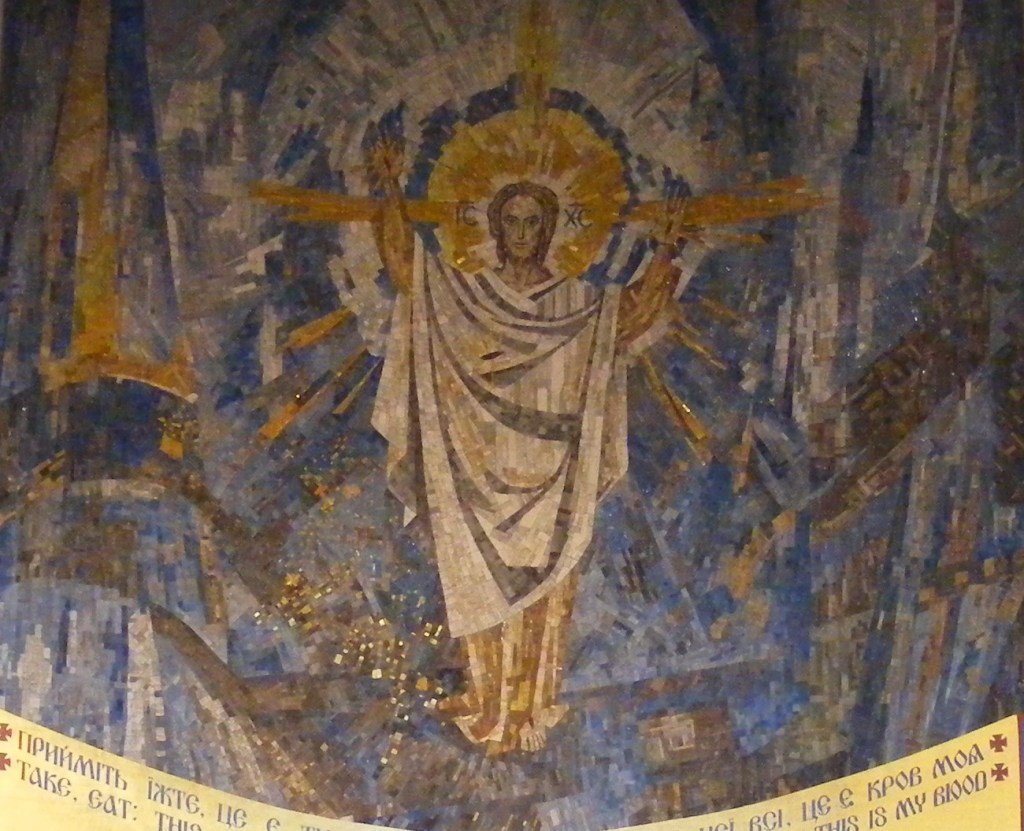
Mosaic from St. Basil’s Ukrainian Catholic Church in Edmonton at https://royaldoors.net/?p=3751

Jesus’ Anointing

Click here to listen to this 16-minute message.

We continue through the season of Epiphany in my church, which is the season in which we reflect on the manifestation or appearance of God in the world. This is particularly so in his Son Jesus Christ, who is the great shining forth of God’s presence in the incarnation of Christ, the Son of God, the second person of the Trinity.

Today we focus on the baptism of Jesus by John. In Matthew and Mark’s accounts of the baptism, God the Father speaks and God the Holy Spirit descends as John baptises Jesus and as Jesus comes up out of the water. But in Luke’s version of the baptism (Luke 3:15-22), things look quite different and it is less about his baptism and more about his anointing.

John is removed from the scene a few verses earlier, Jesus’ baptism is mentioned only in passing as background, and the appearance of God happens as Jesus prays. Moreover, the language used (passive voice and infinitive clauses – people were being baptised, Jesus was baptised, heaven was opened, a voice came from heaven)) creates a sense of time being suspended. It is as if the globe stops spinning and all falls silent, as the heavens are torn open, the Spirit descends in bodily form and the voice of God is heard. It is a moment of mystery. It is an epiphany!

Luke accentuates this by echoing imagery and language from the prophetic literature and the Psalms of the First Testament, e.g.

  • Ezekiel 1.1 and 2:1-3:1, where the heavens open, Ezekiel is filled with the Holy Spirit and God appears, reaching out of the heavens towards Ezekiel, and commissions him for ministry.
  • Psalm 2:7, where God says “you are my son”.
  • Isaiah 42:1, where God speaks of his chosen servant, who he fills with Spirit, to bring justice to the world.

These passages reinforce what follows Jesus’ baptism in Luke: Jesus goes out in the desert for 40 days (Luke 4:1-13) and then into the synagogue, where he proclaims his manifesto – “The Spirit of the Lord is on me, because he has anointed me to preach good news to the poor” (Luke 4:14-30).

How wonderful it would be if we ourselves experienced such an epiphany! Sadly, for most of us, God speaks quietly and subtly, not in such dramatic ways. Yes, let us not doubt that God does call us, manifest himself to us, anoint us with Holy Spirit and commission us for service. We are as much called into God’s work as Jesus was.


Featured image from: https://www.desiringgod.org/interviews/why-was-jesus-baptized