True North

Click here to listen to the audio of this 13-minute message. Or watch the YouTube video below, or read the text summary that follows.

John 15:18-19 reads,

“If the world hates you, keep in mind that it hated me first. If you belonged to the world, it would love you as its own. As it is, you do not belong to the world, but I have chosen you out of the world. That is why the world hates you.”

Jesus acknowledges that sometimes the world will hate us for our faith and teaches two things about this:

  1. He comforts us by sharing that the world hated him first, so we’re in good company, we’re not alone, we’re not the first.
  2. He explains that the world hates us because we don’t belong to the world, we don’t conform. The word ‘belong’ is what he uses in John 17:16, where he says “They are not of the world, even as I am not of it.” The Greek for ‘belong’ or ‘of’ is ‘up out of’, like a plant or a tree grows up and out of the ground. Jesus is saying that we do not come up out of the world, and that this can lead to tension with the world – that the world hates us when we speak the Truth of God.

Our capacity to speak the Truth of God requires us to have a kind of spiritual and moral compass that shows us the Truth of God. A compass that helps us discern the mind of God.

The verse just before our passage (John 15:17) reads:

This is my command: Love one another.

And this verse is the tail end of a longer passage about the vine and branches, in which Jesus calls us to ‘remain’ rooted in him and in his love (John 15:1-17). So our understanding of the world hating us is the context of loving others and remaining in the love of Christ and thus of God. This love – the command to love – is the frame around our experience of being hated by the world.

On the basis of that, I suggest two learnings about our relationship with the world and its possible hatred of us:

First, Jesus calls us to be thoughtful about HOW we speak to the world. Our words need to be saturated in the love of God. In truth, the Church has often been – and continues today often to be – hateful in the way it speaks to the world. Even if what Christians and the church says is True, it is often said in a hateful, unloving, judgemental, diminishing way. This is the not the way of Christ. Jesus was challenging and direct, but he was never hateful in the way he spoke. We need to model our way of engaging the world on Jesus.

Second, WHAT we speak out on is also important. It is not only about how we speak, but also about what we speak. Let’s return to the metaphor of the compass. A compass points to the magnetic north, but this is not the True north. In fact, they are about 500km apart – similar, but not the same. We need to ensure that our words point to the True north, not the some off-centre north.

How do we know what to speak up for and what to speak out against? How do we know what is True? Again, we must look to Jesus. In Jesus’ ministry, he almost always spoke up for sinners and marginalised people, and out against those in power. We seldom hear Jesus speaking out against sinners and marginalised peoples. And the people Jesus usually speaks out against are the powerful – the powerful of the world and of politics and the powerful of the church.

Christians today have tended to invert this, speaking up for the rich and powerful, and against those who sin and those who are marginalised. They have lost their True North. They are not following in the way of Christ. They are not remaining in Christ and not adhering to his command to love one another.

We must go back to the Gospels and model our lives on Christ, in the ways he spoke truth to power, on the issues that he spoke up for and on the issues he spoke out against.

Jesus is our True North.

2020.06.03_Ny+kompass

Featured image from https://www.euro-academy.com/euroacademy-blog/2018/2/18/pujof0xh909ihjovyuusrkvzsym4pl

Barrier-breaking Spirit

Click here to listen to the audio of this 10-minute message. Or watch the YouTube video below or read the text summary after that.

Pentecost occurs 50 days after Easter and 10 days after Jesus’ ascension. Acts 2:1-12 tells us that the disciples were meeting together in one place. “Suddenly”, writes Luke, “a sound like the blowing of a violent wind came from heaven and filled the whole house where they were sitting. They saw what seemed to be tongues of fire that separated and came to rest on each of them. All of them were filled with the Holy Spirit.”

This remarkable story give us two of the three key images we have of Holy Spirit: Wind, Fire and the Dove (from Jesus’ baptism).

Filled with the Spirit, the disciples begin to speak in different languages. Now Jerusalem, as the spiritual hub for Jewish people, was full of Jewish people from all over the place, speaking many different languages. They were initially drawn by the commotion – presumably the sound of the violent wind, like a tornado in a room.

But then they were “bewildered” and “amazed” and “perplexed” because “each one heard their own language being spoken”. Of all the things that Holy Spirit could have done to inaugurate her ministry among humankind, she chose to enable the disciples to speak the Gospel message in languages that the disciples did not know, so that a racially and culturally diverse group of people could hear the Gospel in words that they could understand. This tells us that:

Central to the ministry of Holy Spirit is to break down barriers

Indeed, Holy Spirit is just continuing the ministry of Jesus. Jesus himself was constantly breaking down the barriers that divide people:

  • His incarnation, when the boundary between divine and human was traversed
  • His speaking with the Samaritan woman – breaking boundaries of ethnicity, religion and gender
  • His healing of woman who bleeding – breaking purity and gender boundaries
  • His healing of the Centurion’s daughter – breaking racial, class and power boundaries
  • His touching of the dead boy and raising him to life – breaking purity laws
  • His salvation of the whole world – breaking the power of sin and death

Paul’s letters are filled with similar references to the barrier-breaking work of Christ and thus also of his followers:

  • Galatians 3:28 tells us, “There is neither Jew nor Gentile, neither slave nor free, nor is there male and female, for you are all one in Christ Jesus.” These are the classical sociological categories of race, class and gender. Jesus breaks them all.
  • Ephesians 2:14 tells us, “For he [Jesus] himself is our peace, who has made the two groups [Jew and Gentile] one and has destroyed the barrier, the dividing wall of hostility”.
  • Ephesians 1:10 tells us that God’s ultimate will is “to bring unity to all things in heaven and on earth under Christ”.
  • And Colossians 1:20 tells us that God was pleased “through him [Christ] to reconcile to himself all things, whether things on earth or things in heaven, by making peace through his blood, shed on the cross”.

Just as Jesus’ ministry involved boundary-breaking, so too, Holy Spirit’s ministry is about boundary-breaking. And she continues this work as her first Act at Pentecost. And the rest of the Acts of the Apostles is a working out of what boundary-breaking ministry is all about.

If you are a follower of Christ – even if your faith feels thin and weak, even if you don’t feel gifted or confident – Holy Spirit lives in you. She has taken up residence in you. And she wants to continue to do this barrier-breaking ministry through you, so that all people and the whole of creation can be reconciled under Christ.

ARTWORK WITH BIBLE BY KELLY

Pentecost image found in the Cathedral Basilica of St. Louis, from http://thedialog.org/catechetical-corner/living-our-faith-pentecost-filled-with-the-spirit/

To be one

Click here to listen to the audio of this 26-minute message . Or watch the YouTube video below, or read the text summary that follows. (This is a longer than usual message, because the topic is rather difficult. I hope you will not be deterred by its length.)

John 17 presents Jesus’ “High Priestly Prayer”, which takes place just before Jesus’ arrest and execution. In it Jesus prays for himself, for his disciples, and then for all believers who are to come, including you and me. It is a beautiful prayer that reveals to us the heart of Jesus – well worth reading.

In this message, I focus on just four verses (11b, 20-23):

Holy Father, protect them [my disciples] by the power of your name, the name you gave me, so that they may be one as we are one … My prayer is not for them alone. I pray also for those who will believe in me through their message, that all of them may be one, Father, just as you are in me and I am in you. May they also be in us so that the world may believe that you have sent me. I have given them the glory that you gave me, that they may be one as we are one—I in them and you in me—so that they may be brought to complete unity. Then the world will know that you sent me and have loved them even as you have loved me.

A few thoughts on this passage:

  • Four times Jesus speaks about the oneness and unity of Christians. This can be regarded as the central theme of his prayer in John 17.
  • Verse 21 emphasises that our relationship with God (the vertical relationship) is primary and is the foundation of church unity (the horizontal relationship).
  • Verse 22 refers to “the glory that you gave me”. Scholars have long debated what this ‘glory’ refers to. There is good reason to think Jesus is here referring (again) to the Holy Spirit, who occupied much of the previous chapters.
  • Verses 21 and 23 refer to the world: that they may believe/know that God sent Jesus. The unity of Christians is not an end in itself, but the ground that produces the fruit of the world seeing God at work, thus of evangelism.
  • Verse 23 says that God loves the world as much as God loves the Son. This is a profound revelation of God’s extravagant love for the world, reminding us of John 3:16.

Despite Jesus’ marvellous vision and prayer for the unity of the Church, the sad reality is that the church is anything but unified. Denominations fracture and split; independent churches spring up constantly; even local parishes are disunified and in conflict. It does not appear that we are one as God the Father and the God the Son are one. A few thoughts on this:

  • Churches may diverge due to different practices, particularly around worship. Most Christians think about how Sunday services run and whether they like how we do things – whether we raise our hands, whether we have an organ or band, whether we use a set liturgy, whether the choir is up front or at the back, how long the sermons are, etc.
  • Given that Jesus emphasises our vertical relationship with God, and given that each relationship is different because each person is different, it seems to me that worship practices are not that important. It is probably better to attend a church where your relationship with God grows than to attend a church whose practices leave you cold.
  • Churches may diverge due to different doctrine. Some Christians may not worry or think too much about doctrine, but for many, doctrine – what we believe – is important. Churches split over their understanding of the role of Holy Spirit, over the gender of God, over the Trinity, over our sequencing of the end times.
  • We should think about and hold to certain beliefs – understanding of Truth was important in Jesus’ teachings, throughout the scriptures and to the early church. It should be important to us also. However, we should have the humility to recognise that our understanding Truth is flawed, limited, incomplete and quite possibly wrong. God knows the Truth; what we know as ‘truth’ is mere limited understanding, like peaking into a palace through a keyhole – we see just fragments of the riches within.
  • Currently the church is fracturing around our understanding of the place of LGBTQI+ people within the life of the church. In my own denomination – the Anglican communion – we have churches that see diverse human sexualities as anathema and others who see sexuality as unregulated by God. People’s feelings about sexuality run very deep and lead to pain exclusions of and judgmentalism towards LGBTQI+ people.
  • While many today have very strong feelings about these issues, Jesus did not. He had very strong feelings about love, about inclusion and about reaching out to those on the margins of society. He never talked about sexual orientation; but he talked incessantly about love. It is heartbreaking that the church should so forget how to love one another, when this is the central teaching of our Lord.

Many Christians are distressed at the proliferation of different churches. I’m not. In 1 Corinthians 12, Paul writes about the Body of Christ, the Church, and emphasises the diversity of the body and that diversity is good and necessary for the functioning of the whole. He gives particular emphasis to cherishing those parts of the body that people may regard as immodest, unpresentable, shameful. Paul stresses that in God’s eyes, these parts are as much necessary and beloved as those parts that people are happy to show off. Every part of the Body of Christ is necessary. Paul is emphasising how to maintain a sense of unity in the church together with all its diversity.

Let us not worry about the different churches, no matter how different they may be to us. Let us rather be sure to regard them as our sisters, our brothers, beloved by Christ and part of our own body.

2020.05.24-gless12

Featured image from https://ssnet.org/lessons/18d/less12.html

Holy Spirit – Our true friend

Click here to listen to the audio of this 16-minute message. Or watch the YouTube below, or read the summary text thereafter.

Our reading for today (John 14:16-20) prepares us to celebrate Pentecost in two weeks’ time. Jesus teaches about Holy Spirit who will come and continue his work among us. We learn several important things about Holy Spirit from this brief passage, including:

  1. The Greek word ‘paraclete’ is directly translated as ‘the one called alongside’ or ‘the one called to come alongside’
  2. ‘Paraclete’ is translated in various ways: comforter, counsellor, advocate, encourager, etc.
  3. Frederick Dale Bruner (in his commentary on John) and Eugene Peterson (in his Bible translation, ‘The Message‘) translate paraclete as ‘friend’ or ‘true friend‘. A friend is one who draws alongside us, who comforts and encourages us, who challenges us, and who stands up (or advocates) for us when people trash-talk us.
  4. Jesus describes this true friend as a gift from God to us.
  5. Jesus describes Holy Spirit as another friend. By implication, Jesus is the disciples current friend; Holy Spirit will come as another friend. There is continuity between Jesus and Holy Spirit.
  6. Holy Spirit is a person, not a force or a thing. I try to give practical expression to this in my spiritual life in three main ways:
    • I drop the definite article ‘the’ from ‘the Holy Spirit’. Instead, I speak and think about ‘Holy Spirit’ as a name, like Jesus is a name. We don’t refer to Jesus as ‘the Jesus’ because Jesus is his name; we say ‘the Messiah’ because Messiah is a title of description. I use ‘Holy Spirit’ as a name, since we have no other name for him.
    • I use personal pronouns and avoid ever referring to Holy Spirit as ‘it’ or using ‘which’. These are impersonal, depersonalised words. I try to use the same words I use when speaking about Jesus or God the Father.
    • I refer to Holy Spirit as ‘she’. Not because I think of her as a woman, as female or as feminine. But because God is no more male than God is female. God transcends or incorporates all genders. Since we can’t refer (easily) to the Father or the Son with female pronouns, I choose to use female pronouns for Holy Spirit. If we could evolve the English language to be less gendered, we’d use gender-inclusive or gender-neutral language for God. (I appreciate that many will not appreciate or agree with me. That’s fine. We will learn a lot more about Holy Spirit on That Day.)
  7. We, unlike those who do not believe, can both see and know Holy Spirit. For everyone else, Spirit is invisible and unknowable. But for us who believe, she can be both seen and known. She dwells within each of us as individuals. And she takes up residence among us collectively, as communities of faith. We are united by Spirit, even when we are physically apart.

As we journey closer to Pentecost on 31 May 2020, let become increasingly mindful or receptive to the presence of Holy Spirit in our personal and collective lives and celebrate this precious gift that God has given us.

2020.05.17_HolySpirit_Hahlbohm

Featured image: ‘Holy Spirit’ by Danny Hahlbohm, http://www.inspired-art.com/gallery_9_10/Holy_Spirit.html


Jesus at the centre

Click here to listen the audio of this 13-minute message. Or watch the YouTube video of the message below, or read the text summary after that.

John 14:6-11 is located immediately after the Last Supper and the washing of the disciples’ feet, as well as Jesus’ prediction of Judas’ and Peter’s betrayals. John 14 starts a four-chapter long sermon – Jesus’ final words to his disciples before his death.

In the opening of this section, Jesus presents himself as at the centre of our faith. He says to Peter, “You [already] believe in God [the Father]; [I now invite you to] believe also in me” (John 14:1). To believe in the Father is to believe in the Son. He goes on famously to say, “I am the way and the truth and the life. No one comes to the Father except through me” (John 14:6). Jesus places himself at the centre of our relationship with God the Father. It is through him that we encounter God. Jesus is the centre.

But lest we think that Jesus is setting himself up as the mediator between us and God, he goes even further, audaciously, to say that he and the Father are one. “If you really know me, you will not know my Father as well … Anyone who has seen me has seen the Father … Don’t you believe that I am in the Father and that the Father is is in me? … I am in the Father and the Father is in me” (John 14:7-11). And just a few chapters earlier, Jesus had said, “I and the Father are one” (John 10:30).

Jesus is not merely a path to God. He is God. He is God the Son. He is locked into the Father and the Father is locked into him. In the very following passage (John 14:15-27), Jesus speaks about Holy Spirit, the third person of the Trinity, who will come to continue the work of the Father and the Son, once the Son has returned to the Father. When we relate to Jesus, we are relating to God, because Jesus is God.

Ultimately, sensing that Philip and the other disciples are grappling to grasp these complex and elusive concepts, Jesus says, “At least believe on the evidence of the works themselves” (John 14:11): You have heard me teaching. You have seen me heal people, raise the dead, feed thousands. You have witnessed me reaching out to women, tax collectors, lepers, prostitutes, menstruating women, disabled people, Samaritans and Gentiles. You have heard me speak truth to power and challenge rigid interpretations of the law. You have heard me proclaim a new Law that supersedes the Law of Moses.

What you are seeing is God at work among you!

Jesus must be at the centre of our personal and collective faith. The things of the church are helpful and perhaps even important. Jesus does not do away with them. But they must not be at the centre.

Jesus – the person Jesus – is the only one worthy of being at the centre.

He is our friend, our brother, our teacher, our healer, our saviour, our Lord, our very God.

2020.05.10_6059765012_d7fafb9504_b

Featured image is the ‘glory window’ of the Thanksgiving Chapel in Dallas, Texas.

Being Church – Being Loved

Click here to listen to the audio of this 13-minute message. Or watch the YouTube recording below, or read the text after that.

In 1 Thessalonians 2:17-20, we read about Paul’s deep love for the church at Thessalonica, which he had planted, but which he was unable to visit. Much as we are as a result of COVID, Paul was physically separated from his church, and he was really missing them. Paul expresses intense emotions about his parish – he felt ‘orphaned’, he felt ‘separated’, he felt ‘intense longing’ to see them and he ‘made every effort’ to visit.

Paul says that Satan was blocking his way from visiting. Today we should consider that Satan is blocking our ability to meet together, through the agency of the Coronavirus. This virus – a tiny thing – is blocking our ability to meet together.

But, says, Paul, he is separated ‘in person, not in thought’, that is, physically, but not psychologically, socially, emotionally or spiritually. We can and do remain connected to each other, through our relational bonds and through our common fellowship with Christ.

Throughout this passage, Paul shows the heart of a pastor, who loves his parish and longs to be present with them. And so, while we are physically separated from each other, let us remember that we have a pastor called Jesus Christ, who loves us and is in fact present among us through Holy Spirit, and that we are in fact connected with each other through the love of God.

Featured photo from St Stephens Anglican Church, Lyttleton, South Africa

Seeing Jesus

John 12:21 tells us about a group of Greek seekers who come to Philip saying, “Sir, we would like to see Jesus”. And so begins a story of one person introducing another person to Jesus, in a chain of people seeking to see Jesus.

Click here to listen to the audio of this 5-minute message. Or watch the video below.


Light of the world

Click here to listen to this 15-minute message.

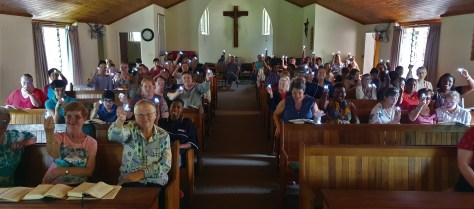
(This message was preached at Irene Homes, a residential care facility for women with intellectual disabilities. They are an engaging and participating congregation. I was moving around a bit, so the volume varies as I move away from the recorder. Also, at about 13 minutes, we spent a few minutes passing out battery-operated candles; I’ve edited this out, which explains the slight jump a few second after 13 minutes.)

Jesus says of all of us who follow him (Matthew 5:13-16):

You all are the very salt of the earth!

You all are the very light of the world!

He states this as a present fact – you are, not you should be or you will be or you ought to be or one day you might be. No! He states is as Truth: You are! In our lived experience, however, we’re probably often not salt and light. So, Jesus here appears to be declaring a Truth that is to come as a present reality, much as he does when he says “The Kingdom of God is here”. It is a ‘now, but not quite yet’ statement. A prophetic Word, that encourages us to live up to the image Christ already has about us.

What does it mean to be salt and light?

Salt has many uses (primarily flavouring and preserving), but Jesus emphasises the saltiness of salt. If I presented a white powder to you that did not taste salty, you’d be reluctant to call it ‘salt’. Saltiness is the essential characteristic of salt; without saltiness, salt is not salt. So what are the essential characteristics of a follower of Christ, without which we can hardly call ourselves Christians? The most immediate answer is the qualities Jesus has just presented in the Beatitudes (Matthew 5:3-10), which open the Sermon on the Mount (Matthew 5-7), which speak about being poor in spirit, mourning, meek, hungering and thirsting after righteousness, merciful, pure in heart, peacemaking and being persecuted because of being righteous. These qualities of Christian living – love, mercy, inclusivity, justice, reconciliation – are the distinctive qualities of a Christ-follower. They are the saltiness of a Christian.

Light also has many uses, but Jesus emphasises that light enables things to be seen. It is not the essential characteristic of light he highlights, but rather the purpose to which it is put, viz. so that people can see us putting into practice these distinctive qualities of a Christ-follower, so that people will praise God in heaven. He thus speaks about how silly it would be to place a light under a bowl, or to put it in a corner on the ground rather than up on a stand. When we do that, you can’t see the light; it is wasted.

When Jesus says, “You are the salt/light”, he uses a plural ‘you’, thus “You all…” or “Y’all”. Our individual distinctive qualities and our individual light may be insufficient to be seen from far or to make much impact. But our collective qualities and our collective light, like a city on a hill with many lights burning from many windows, can be seen from far and make a real difference in the world.

Just imagine if every Christian truly put into practice the distinctive qualities of a Christ-follower set out in the Beatitudes! What a remarkable place the world would be!!

2020.02.09_Light

The ladies of Irene Homes being the light of the world!

Look! The Lamb of God

Click here to listen to this 23-minute message.

This message is a call for us to see and look at Jesus, the Lamb of God. And to point him out others. This was the mission of John the Baptist, and it as much ours today.

We are still in the period of Epiphany, where we focus on the manifestation or revealing of Jesus Christ as the Son of God, as God’s Chosen One. Our reading for this Sunday is John 1:29-37:

29 The next day John saw Jesus coming toward him and said, “Look, the Lamb of God, who takes away the sin of the world! 30 This is the one I meant when I said, ‘A man who comes after me has surpassed me because he was before me.’ 31 I myself did not know him, but the reason I came baptizing with water was that he might be revealed to Israel.”

32 Then John gave this testimony: “I saw the Spirit come down from heaven as a dove and remain on him. 33 And I myself did not know him, but the one who sent me to baptize with water told me, ‘The man on whom you see the Spirit come down and remain is the one who will baptize with the Holy Spirit.’ 34 I have seen and I testify that this is God’s Chosen One [or Son].”

35 The next day John was there again with two of his disciples. 36 When he saw Jesus passing by, he said, “Look, the Lamb of God!” 37 When the two disciples heard him say this, they followed Jesus.

Bruner, who has written a wonderful (1200 page) commentary on John, translates some of these verses differently, emphasising the use of present and continuous tenses in the original Greek, notably:

29 The next day John sees Jesus coming toward him, and he says, “Look! The Lamb of the God, the One who is taking away the sin of the world!

36 And John looked intently at Jesus as Jesus is walking by and he says, “Look! The Lamb of God!” 

I focus on these two verses in this message, as I have felt God speaking to me particularly insistently this week about verse 29. And I make five points:

  1. John sees Jesus coming and walking towards him. Jesus is always coming towards us, even if we are moving away from him. His trajectory is always in our direction.
  2. Look! John twice says, “Look!”. I like Bruner’s addition of the exclamation mark, as it emphasises that this is a call, an imperative. John wants us to stop drifting through life blindly. Or from being so focused on other things that we don’t notice Christ coming towards us. So he calls out, in excitement, perhaps even in alarm, “Look! Look out!”
  3. Jesus is taking away the sin of the world. This is a pretty packed little sentence:
    • John speaks about ‘sin‘, not ‘sins’. It is the condition of being sinful that Jesus takes away, rather than the individual sinful acts that we do.
    • John says that Jesus ‘is taking‘, emphasising that this is a continuous activity, that has already begun, is presently happening and will continue to happen in the future. While Jesus’ death on and resurrection from the cross are surely pivotal in salvation, God has been saving humanity through the Son from the time of the fall, throughout the First Testament, through Jesus’ incarnation, life and ministry, through his death, resurrection and ascension, by the outpouring of Holy Spirit, and continuing to today and into the future. The Son of God has been and continues to be in the business of taking away sin.
    • It is the sin ‘of the world‘ (the ‘cosmos’) that Jesus takes away, not just the sin of those who repent, those who believe, those who are members of certain churches or religions, those who adhere to certain church rules or doctrine. Scripture abounds with verses that reinforce that salvation is for and of the whole world (the cosmos). It is a radical inclusion of the entire created order – the cosmos!
  4. Salvation is thus possible for all, but we have to take hold of it. That’s why John keeps saying, “Look!”, and why we are told in verse 37 that John’s disciples leave John to follow Jesus. Jesus is the Lamb of God who is taking away the sin of the world. In the Eucharist or Mass, we celebrate and re-member this great work of God the Son.
  5. And finally, we, like John and his disciples, and like Jesus’ disciples (about whose calling we learn in the rest of John 1), are invited to continue John’s ministry of pointing people to Jesus. We remind people that Christ is coming towards them. We call them to ‘Look!’ We point them not to our denomination, our pastors, our worship, ourselves; but towards Christ himself. And we show through our lives, our inclusivity, our radical love and our walking towards others that he is indeed taking away the sins of the world .

2020.01.19-Lamb of God

Featured image: Saint John the Baptist Bearing Witness, by Annibale Carracci, ca. 1600, downloaded from: https://www.metmuseum.org/art/collection/search/438813

Beleaguered

Click here to listen to this 24-minute message.

Probably all of us go through times, at least now and then, when we feel beleaguered (click here for a definition of this word).

Jesus certainly did. The closer he got to the cross, the more the leaders of his time circled him, plotted against him, slandered him, entrapped him. By the time Judas became willing to betray him, Jesus had scores of vultures circling him. Our reading for today, from Luke 21:5-19, comes at just this time in his life. In it, Jesus speaks about the future – both the near future of the time of the destruction of the Jewish (second) temple, which would take place about 40 years later in AD70, and the distant eschatological future of the End Times, when Jesus prepares to return. In both times, followers of Christ will suffer persecution. They will be beleaguered.

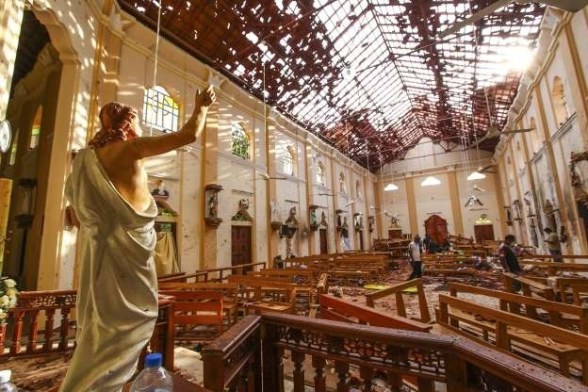
Even though we are probably not living in the End Times, we as Christians may already have experience of being beleaguered. Sometimes we become beleaguered in our workplace, when we stand up for Kingdom values: integrity, honesty, fairness, justice, inclusion and vulnerability. Or in families, someone who converts from the family’s faith into the Christian faith may be ostracized, even expelled and cut off. Churches are attacked and people at workshop are killed, as in Sri Lanka on Easter Day 2019. Even within the church, people can become beleaguered by leaders who are threatened by their vision, their Spirit-filledness, their willingness to ask for change and their desire for greater inclusion. Much as the church ought to be a place of sanctuary and community, it can become a place of persecution and exclusion.

In Luke 21:5-19, Jesus presents four words of advice – words of wisdom – for those of us in such situations.

  1. Know that God knows. Sometimes, when we are under such pressure, we feel alone and abandoned. But Jesus emphasizes that God knows and is mindful of our situation. In v9 he says, “When you hear of wars and uprisings, do not be frightened. These things must happen first, but the end will not come right away.” In other words, since God knows what is still to come, such as the destruction of the Temple, God also knows your situation. God knows. God cares. God is present. God is in control. Psalm 121 reminds us that “he who watches over you will not slumber; indeed, he who watches over Israel will neither slumber nor sleep.”
  2. Persecution is an opportunity for witness. He says in v13, “And so you will bear testimony to me.” While we are being persecuted and beleaguered, witness might not be uppermost on our minds, but Jesus says that this is the time to embody Kingdom values. But our capacity to witness is not something we do alone – no! He emphasizes that we need not stress about what we will say as witnesses (v14), because “I will give you words and wisdom that none of your adversaries will be able to resist or contradict.” We see such inspiration particularly in the life and death of St Stephen, in Acts 6 and 7.
  3. God protects his own. With God at our side, we have God’s protection: “But not a hair of your head will perish” (v18). Jesus appears to contradict himself here, because just two verses earlier he said, “they will put some of you to death“. We get some clarity about this from another passage that also speaks about the hair on our head, Luke 12:4-7, where he says, “The very hairs of your head are all numbered.” This follows a passage in which Jesus distinguishes between the death of the body and a more permanent death (which he there refers to as being thrown into hell). Jesus wants us to understand that to die does not mean to perish. Our bodies may suffer and even die, but we do not perish – those who are in Christ continue to live in the presence of God. (See my previous sermon on this passage in Luke 12.) So, yes, may may suffer when we are beleaguered and persecuted, but God protects us when it counts most.
  4. We are called to endure. Jesus concludes this passage saying, “Stand firm, and you will win life.” We are called to stand firm, to endure, to persevere, to be resolute, to hold the faith and (in South African idiom) to vasbyt (literally, to bite tightly). Paul says something similar in Ephesians 6:13, “Therefore put on the full armor of God, so that when the day of evil comes, you may be able to stand your ground, and after you have done everything, to stand.” This endurance is more than just standing still; it is about continuing to do God’s work. In Luke 8:15, in the parable about the seeds the fell on different types of ground, Jesus says, “But the seed on good soil stands for those with a noble and good heart, who hear the word, retain it, and by persevering produce a crop.”

Jesus never promises us an easy life, despite what many pastors and churches preach. Indeed, if anything, Jesus promises us that life will be difficult. But he provides us with the reassurance that God knows what we are going through and is present and in control, and that God will protect us, and ultimately whatever happens we will fall into his arms. He calls us to use these opportunities to witness to his values and Kingdom, and he calls us to stand firm and to produce good fruits, not matter what is going on around us.

If you are in such beleaguered circumstances, please know that I do not aim to diminish your suffering – not at all. Rather, I hope to encourage you with the words of Jesus, who suffered much, that God is right there with you and holding you through it all.


2019.11.17_Beleaguered churchFeatured photo of St. Sebastian’s Church in Negombo, Sri Lanka, which was bombed on Easter Day, 21 April 2019. May the souls of those who died rest in peace in God’s loving embrace. From https://ie.gofundme.com/f/victims-of-st-sebastian-church-negombo-sri-lanka