Click here to listen to the audio recording of this 30-minute message. Or watch the video here on Facebook (the message starts 24 minutes into the recording). Or read the text summary below.
We are journeying through Stewardship Month, when we reflect on what God has entrusted to us and how we give back to God from what he has blessed us. Two weeks ago, we focused on the Old Testament principle of tithing (10%) and not withholding from God what is God’s (Leviticus 27:30-34). The tithe is no longer obligatory, under God’s grace, but it remains a good benchmark or point of departure for our giving. Then last Sunday, Rev Ronald focused on the parable of the rich man who hoarded his wealth for his future (Luke 12:13-21). He was called a ‘fool’ by God, for thinking that he had control over his future. Our true security lies in our relationship with God. We are stewards of God’s riches, and we reap what we sow.
On this third week, we focus on New Testament principles of sacrificial giving – a development on the Old Testament principle of tithing. First, Psalm 89 draws our focus to the fact that everything is made by God, comes from God and belongs to God. The psalmist says (v11), “The heavens are yours, and yours also the earth; you founded the world and all that is in it.” We may feel that our possessions are ours, that our salaries are ours, that the assets that we’ve accumulated are ours. But the Psalmist reminds us, as we see throughout the scriptures, that everything belongs to God. This is our first principle (albeit from the First Testament) – everything is God’s, it is just on loan to us.
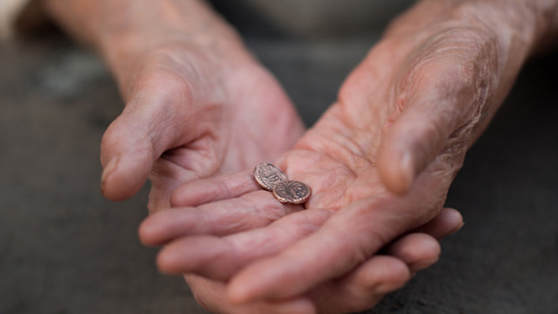
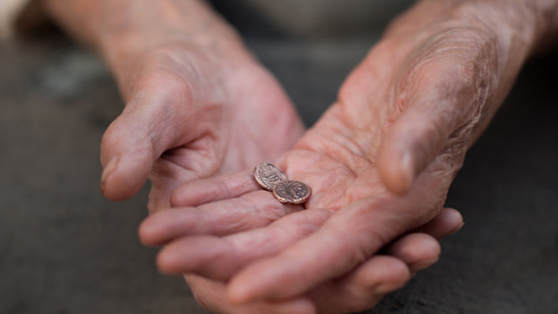
Second, in Luke 21:1-4, Jesus reflects on witnessing an older woman who put a tiny amount of money into the temple offering. Even though her gift was very small, he praised her for giving generously out of the little she had. This echoes the principle of tithing – it is less about the absolute amount that we give and more about the percentage of what we give. This is the second New Testament – give a percentage of your income to God.
The third principle is this: to give to the collective. Acts 4:32-37 tells us about the early church, just after Pentecost. Because they saw what God had done for them, they gave of their wealth to the church. Some even sold land or houses, and gave the proceeds to the church, so that there was enough cash in the church to cover costs and give to those in need. We think of this as an early form of Christian socialism – that you put your giving into the church collective, as a form of redistribution of wealth, the third principle.
The fourth principle comes from 2 Corinthians 8:1-15. Paul cites the church in Macedonia as an example of sacrificial giving. It would be great is St Stephen’s could stand as such an example – and in fact, in previous years we have done just that, such as financially supporting the building of St Timothy’s in the Reeds, and helping all the parishes in our Archdeaconry with finances in 2021, after COVID-19 impacted parishes severely.
Paul notes that the church was going through a “very severe trial” (v2), but even they were generous in their giving. This giving was based on both “their overwhelming joy and their extreme poverty”. Now the joy bit makes sense, right? But the extreme poverty seems out of sync – if we fact extreme poverty, we should give less, right? But in fact the Macedonian church gave more! Paul links back to our second principle – “they gave as much as they were able” (v3) but also highlights that they gave “even beyond their ability”. This is how the Old Testament principle of tithing 10% is transformed into giving even ‘more than we are able’. Paul also notes that they did this “entirely on their own” (v3). Indeed, they even “urgently pleaded” for the “privilege of sharing” (v4).
Paul uses the Macedonian church as an example for the Corinthian church and invites the Corinthians to act like the Macedonians (v7). Now it is important to remember that this was not a command, but rather an invitation (v8). Our giving must come from the sincerity of our love – he complements the Corinthians for being not only the first to give, but also to be the first “to have the desire to do so” (v10). We are not commanded, but invited. He writes, “If the willingness [to give] is there, [then] the gift is acceptable, according to what one has, not according to what one does not have” (v12). So, the fourth principle is giving willingly according to our means.
So here we have four principles that should guide the decisions that we make for 2025 regarding our financial giving:
- Everything we have belongs to God.
- We should focus on the percentage of our possessions we give, not the actual amount.
- We should prioritise giving to the local church.
- We should give willingly and eagerly and joyfully, according to our means.
Featured image from: https://www.reenactingtheway.com/uploads/1/5/2/9/15291334/published/the-widow-mite-hands.jpg?1543297730
 Reflections of God's Love