Food and faith

Click here to listen to the audio recording of this 22-minute message. Or watch the video here on Facebook (the message starts 31 minutes into the recording). Or read the text summary below.

Jesus crosses the Sea of Galilee and then ascends the mountainside (v. 3) and sits down – it is on mountains that God often appears to people. Think of Moses and the burning bush, Moses receiving the Ten Commandments, Jesus transfigured before Peter, James and John. His ascent cues us that something important is going to happen – some revelation of the being or character of God.

John then tells us (v. 4) – seemingly for no reason – that the Jewish Passover Festival was near. Another translation (Bruner) has, “Now, the Passover, the festival of the Jewish people, was coming up.” The Passover, which takes place when the Jews are slaves in Egypt, includes the passing over of the Jewish households and their fleeing Egypt across the Red Sea. It is THE central narrative of the Jewish religion, in the same way that Christ’s death and resurrection are THE central narrative of the Christian religion. It speaks of deliverance, freedom, salvation, relief and hope. It speaks of God coming near to God’s people and answering the deep cries. So John mentions this to raise up in us a hopeful expectation of what God might do for us.

There are two layers to this story of the feeding of the five thousand: food and faith

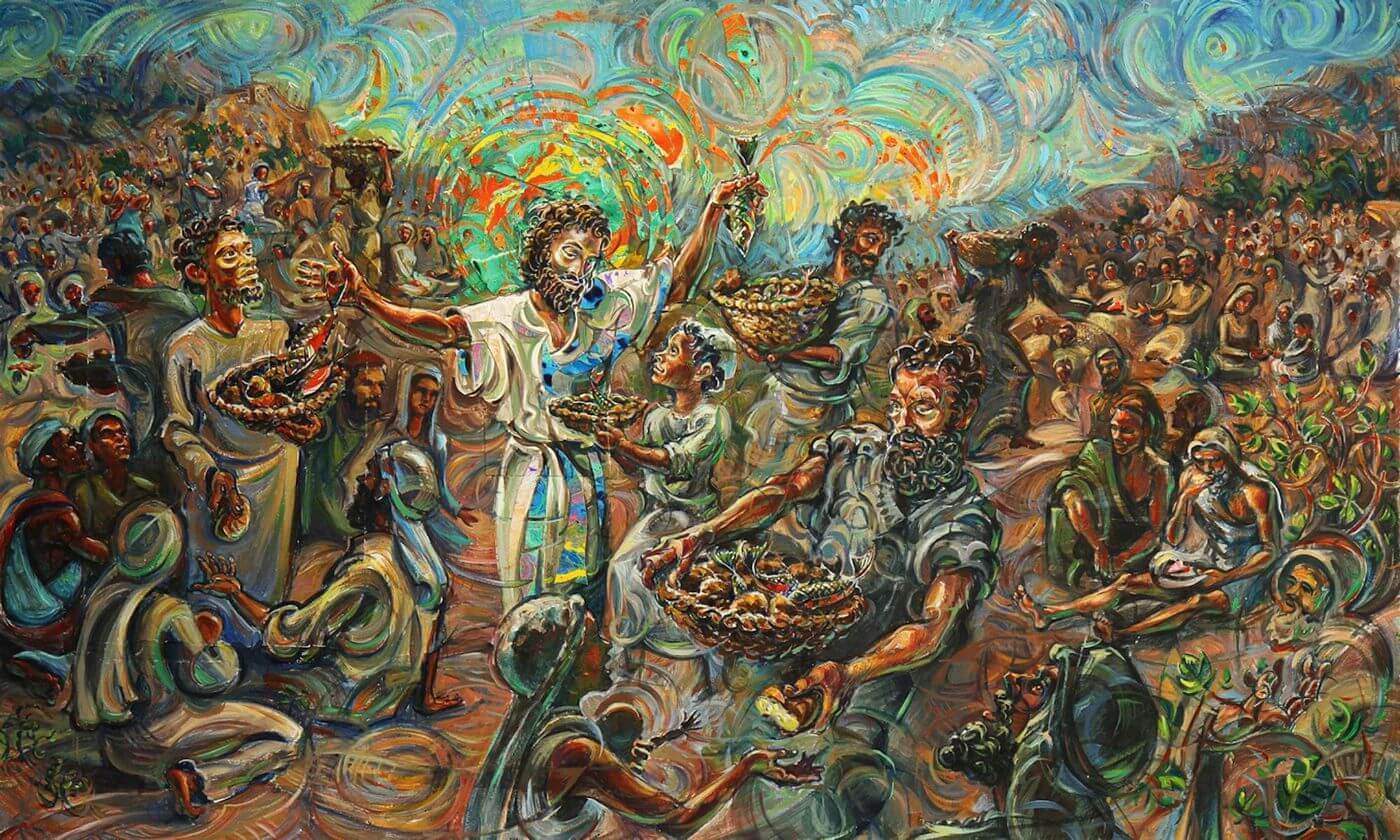
First, there is a practical layer – food. There are 5000 men there, presumably together with women and children. They are hungry and there is no place to get food. So Jesus creates enough food out of five small barley loaves and two small fish to feed them all, and to have 12 baskets of leftovers. This miracle, which may remind us of Jesus turning water into excellent wine at a wedding, a few chapters earlier, speaks to God’s concern for the basic needs of humanity. God desires us to have what we need to live. Basic needs for shelter, food, warmth, healthcare, education and safety are important to God. And Jesus provides for them. This is the first part of God’s revelation of himself in this story – God is concerned for your everyday needs and is willing and able to help you meet those needs, just as he helped free the Jews in slavery in Egypt.

Second, there is a spiritual layer – faith. Looking at the large crowds, the disciples are overwhelmed, and their mustard seeds of faith flee. Jesus knows that their faith is feeble, and so he asks Philip, “Where shall we buy bread for these people to eat?” His question leaves no wriggle room for Philip to say they must sort themselves out – it is clear that bread must be provided. The only question is where they will buy it. Philip’s faith collapses, as he says, “It would take more than half a year’s wages to buy enough bread for each one to have a bite!” Philip is unable to imagine that Jesus can do more than what is humanly possible. His feet are deeply embedded in the ground.

But then Andrew brings along a little boy who has five small barley loaves and two small fish and presents him to Jesus. It feels as if Andrew has some spark of faith that maybe something could be done with this little bit of padkos. But almost immediately, his faith also collapses, as he says, “but how far will they go among so many?”

Jesus takes control of the situation and issues instructions. The disciples trust and obey, and everyone ate as much as they wanted. Although Jesus will come to criticize the people for chasing after food, in this moment, they recognise him: “Surely this the Prophet who is to come into the world!” They want him to be king, but he just wants to reveal God to them.

And today’s reading ends with Jesus walking across the surface of the lake in a storm, several kilometers from the shore, and reminding them of who he is: “It is I. I am. Don’t be afraid.”
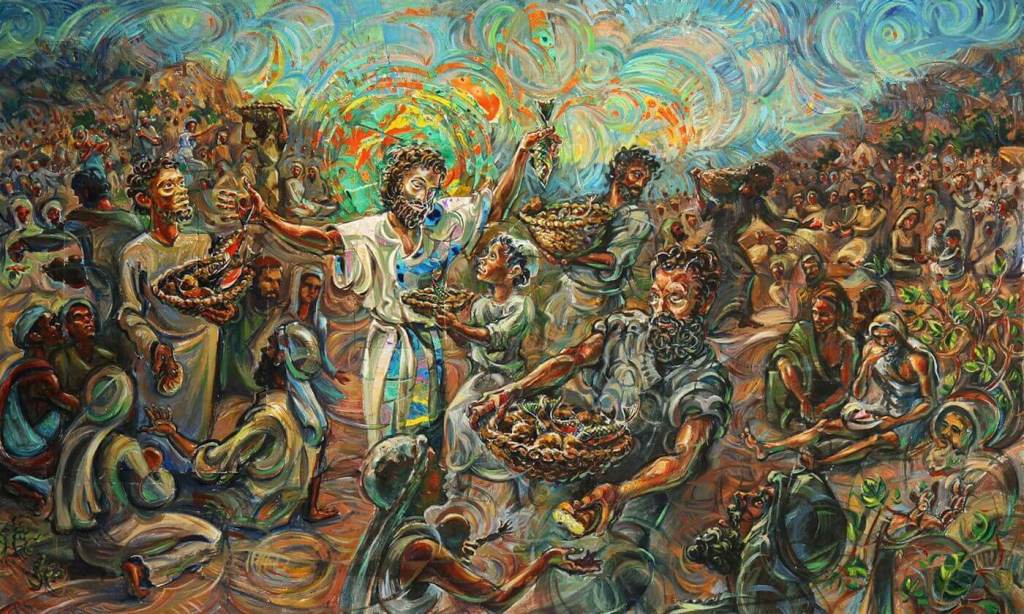
Featured image from https://www.tallengestore.com/cdn/shop/products/Jesus_Feeds_5000_-_Christian_Art_Painting_587f4577-c1f0-48ea-a738-38da1dc7cd19.jpg?v=1575281602

Chosen

Click here to listen to the audio recording of this 16-minute message. Or watch the video here on Facebook (the message starts 32 minutes into the recording). Or read the text summary below.

Our First Testament readings today (2 Samuel 7 and Psalm 89) speak of the chosenness of King David and by extension of the Jewish people, the people of Israel. God affirms that he gives a place of safety to the people of Israel and that David’s throne and kingdom are forever.

Two days ago (19 July 2024), the UN’s International Court of Justice, declared Israel’s occupation of the West Bank, East Jerusalem and the Gaza Strip as illegal and called on Israel it withdraw its occupation and all settlers living there and to pay reparations for the harm done to Palestinian people. Prime Minister Benjamin Netanyahu responded: “The Jewish people are not occupiers in their own land — not in our eternal capital Jerusalem, not in the land of our ancestors in Judea and Samaria. No false decision in The Hague will distort this historical truth, just as the legality of Israeli settlement in all the territories of our homeland cannot be contested.”

Netanyahu’s response harks back to these First Testament promises, though neglects several other important First Testament principles. First, a crucial First Testament theology and principle is hospitality. God is hospitable – inviting humanity to share in God’s work in the world and coming to meet with God’s people and journey with them. God expects Israel to be hospitable to other peoples. Deuteronomy is explicit that foreigners should be treated as if they were Israel’s own. There should be no discrimination.

Second, God uses other nations to discipline Israel through the First Testament. The people Israel turn away from God towards other gods; God sends enemy forces to disrupt Israel; Israel repents and turns back to God; peace between God and Israel is restored. This is a pattern repeated over and over in the historical books of the First Testament.

If Israel’s First Testament status as ‘chosen’ is still valid, surely all the other aspects of its relationship with God should be valid also.

Of course, there are many different views on Israel and Palestine. The situation is complex and feelings are hot!

And then, as we move into the Second Testament, there is a shift again. There is Jesus’ radical inclusivity, which I’ve spoken about frequently. Paul, in Ephesians 2, writes about the exclusion from Gentiles from Israel, but how Christ has destroyed the dividing wall of hostility between Jews and Gentiles, and made us one person, through Christ’s body on the cross. There is now peace for us all. And in Galatians 3, Paul says that in Christ there is neither Jew nor Gentile, slave nor free, male nor female. For we are all one in Christ Jesus. God’s desire is for a united humanity, centred on Christ.

But the world is a messed-up place. Such conflicts all over – not just in the Middle East, but between Democrats and Republicans in the USA, ethnic groups in many countries in Africa, Muslims and Hindus in India, Europeans and refugees in Europe, and the list goes on. We are a fractured race, seriously out of step with God’s desire for humanity.

We can probably do little to nothing to solve the challenges in the Middle East and elsewhere, but there are some things we can do to contribute to a shift in the world. First, we can ensure that we are inclusive and diverse, that we treat every person as God’s creation, much loved and blessed, and ensure that racism, sexism and other -isms are wiped out of our interactions. Second, we can pray, and pray some more, because prayers for unity and harmony and mutual respect and love are fully aligned with God’s vision for humanity and so this surely must be a prayer that God will answer.

King David Playing the Harp (1622) by Gerard van Honthorst

Sanctuary

Click here to listen to the audio recording of this 14-minute message. Or watch the video here on Facebook (the message starts 26 minutes into the recording). Or read the text summary below.

This message is a reflection on Psalm 48

1 Great is the Lord, and most worthy of praise,
in the city of our God, his holy mountain.

2 Beautiful in its loftiness,
the joy of the whole earth,
like the heights of Zaphon is Mount Zion,
the city of the Great King.
3 God is in her citadels;
he has shown himself to be her fortress.

4 When the kings joined forces,
when they advanced together,
5 they saw her and were astounded;
they fled in terror.
6 Trembling seized them there,
pain like that of a woman in labor.
7 You destroyed them like ships of Tarshish
shattered by an east wind.

8 As we have heard,
so we have seen
in the city of the Lord Almighty,
in the city of our God:
God makes her secure
forever.

9 Within your temple, O God,
we meditate on your unfailing love.
10 Like your name, O God,
your praise reaches to the ends of the earth;
your right hand is filled with righteousness.
11 Mount Zion rejoices,
the villages of Judah are glad
because of your judgments.

12 Walk about Zion, go around her,
count her towers,
13 consider well her ramparts,
view her citadels,
that you may tell of them
to the next generation.

14 For this God is our God for ever and ever;
he will be our guide even to the end.

________________________________________________________________________

Psalm 48 centres on Zion – God’s sanctuary, the temple, the City of our God, the Holy Mountain, the fortress. I will refer to Zion as God’s sanctuary from here on.

God’s sanctuary is inhabited by God, the Lord, the Lord Almighty, the Great King.

God’s sanctuary is a feminine space – the feminine pronoun ‘her’ is used eight times to emphasise the feminine character of the sanctuary. It is something like a womb – a safe, protective, nourishing and nurturing space. The enemies of God experienced pain like that of a woman in labour, but for those who dwell in the sanctuary, it is a womb.

God’s sanctuary is a place of refuge and safety – a sanctuary.

In God’s sanctuary, there is beauty, joy, security, meditation, unfailing love, God’s right hand, righteousness, rejoicing, gladness, our guide, God, for ever and ever.

God’s sanctuary is the place we are invited to enter: Walk about Zion, go around her, count her towers, consider well her ramparts, view her citadels.

God’s sanctuary is where we can retreat when things get on top of us, when we feel pressured or burdened, when we are worried or distressed, when we’re afraid, when we need replenishing, when our faith founders, when life’s adversities are too much, when we are alone. The sanctuary is God’s place, God’s grace.

Music to listen to while reading Psalm 48

Featured image of a labyrinth in a forest from: https://www.thedailyworld.com/life/creating-a-sanctuary-breathing-peace-into-this-challenged-world/