Click here to listen to the audio recording of this 22-minute message. Or watch the video here on Facebook (the message starts 24 minutes into the recording). Or read the text summary below.
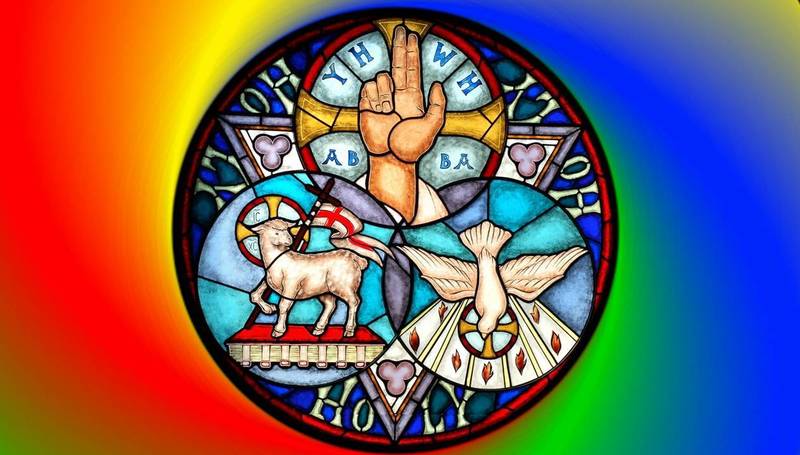
The Trinity (the three-in-one God) is a central belief for Christians, even though the term is not in the Bible and there are few explicit statements about a three-in-one God in the Bible. But there are hints and clues all over the place, e.g., in today’s readings with have:
- God referring to God’s self as “us” in Isaiah 6:8,
- Paul referring to God the Father, the Spirit and Christ as three distinct divine persons in Romans 8:12-17; and
- Jesus speaking about the Spirit and God as two distinct divine persons in John 3:1-17.
Jews and Muslims share with us Christians the First Testament, and so it can be argued (though not all will agree) that we all worship the same God, whether by the name of Jehovah, Allah or God our Father. And all recognise Jesus as a significant person, though Jews see him as a Rabbi and Muslims as a Prophet, while we see him as God the Son. They do not recognise God as three-in-one; indeed, it sounds to them like we have three Gods. For Jews and Muslims, God is a single, male ruler – a King. They follow a pattern of a single line of authority, similar to how the military is structured. There is only One God.
For Christians, by contrast, God is plural, diverse and relational. But this plurality in the Godhead, however we might understand it, is characterised by harmony and concord. There is no conflict, competition or divergence in the triune Godhead. This is a very different conception of God.
Do we understand God’s three-in-oneness? Can we rationalise it and explain it? No, not really. It is hard enough to understand a single human being; how much harder is it to explain God, let alone a triune God! We can, should and do think about the Trinity – we theologise and theorise how God be both three and one. But ultimately, we do not find fully satisfying explanations and understandings. We often come up with analogies to explain God’s three-in-oneness: states of water, an egg, a clover, family, etc. But all of these lead us into one or other heresy about the nature of God.
We are well advised to discard all these analogies and simply gaze upon the mystery of the Godhead. We should apprehend God, not analyse or dissect God. All we can really conclude with any confidence is that God is inherently relational – there are relationships within the centre of the Godhead; relationships characterised by immense, enduring and steadfast love. Let us hold to this beautiful mystery.
So, God is not a monarch, but a cooperative, and that leads me to think about words starting with co- and com-
- Collaborate, co-operate, co-lead, co-ordinate, collective, correlate, coincide, colleague, collegial, co-worker
- Community, communal, in common, companion, compassion, comradery
These co-/com- words emphasise the relational quality that is central to the being of God. And because these are central to who God is, they are central to the world that God has created. And they are central to how we live our lives. Everything that God does is relational and we are part of this relational mix. Our readings today provide important examples of this:
- In Isaiah 6, God is surrounded by seraphim – heavenly beings, keeping God company. And God send Isaiah to go out as God’s spokesperson – God collaborates with Isaiah, as partners.
- In Romans 8, we learn that we are adopted by God, heirs and sons of God, co-heirs (siblings) with Christ, and that we share in Christ’s suffering and also in Christ’s glory – there is a close sibling-like relationship between us and the Son of God.
- In John 3, we learn that the Son came to save not just individuals, but indeed the whole world – God is interested in the human collective, not only in human individuals.
The key implication for us worshiping a triune, collective God is to develop collective thinking and behaving. Relationships are primary to God and primary to us.
Featured image from https://www.stpaulscalgary.ca/podcasts/media/2020-06-07-trinity-sunday


 Reflections of God's Love