Mary’s example (Advent 4)

Click here to listen to the audio recording of this 18-minute message. Or watch the video here on Facebook (the message starts about 28 minutes into the recording). Or read the text summary below.

Mary, the mother of Jesus, had a difficult start to her pregnancy – she was young (probably about 13) and unmarried (only betrothed). Many of us may have become parents in less than ideal circumstances, and so we can feel with her the challenges she faced, when the angel Gabriel comes and informs her that she will become the mother of Son of God (Luke 1:26-38).

In reflecting on this well-known passage, three things stand out for me afresh:

First, Mary had a community of people around her, who loved and supported her. First, Joseph, the man (probably a boy, really, aged perhaps 14 or 15) who she was engaged to. He could so easily have spurned her, but instead, he remains steadfast at her side and protects her from judgmental neighbours. He was accepting, loving and faithful in ways that are quite extraordinary. Although we know little about Joseph, he sounds like a great father.

In addition, Mary’s aunt, Elizabeth, and her husband Zechariah. They were very old and Elizabeth had not borne a child. They too were vital sources of support for Mary, and in the following passage we read about Mary’s visit to Elizabeth.

This human community of support is important for all of us. We all need people in our orbit who care, love, accept, cherish, nourish, empower, advocate, challenge and enable. We need this at home, and we need it in the church.

Second, Mary did not go from ‘zero to hero’ in one leap. She was ‘greatly troubled’ by Gabriel’s message, so much so that the angel had to reassure her: Do not be afraid, Mary. And after Gabriel’s pitch to her, Mary asks questions of Gabriel, “How will this be since I am a virgin?” Gabriel is fully willing to engage her uncertainty, her fear, her incredulity and her questions.

This is in contrast to Gabriel’s response to Zechariah, who in v18 says something similar to Gabriel: “How can I be sure of this? I am an old man and my white is well on in years.” Zechariah’s words are not unlike Mary’s, but Gabriel responds strongly, asserting his authority, and silencing Zechariah until after John’s birth.

After some discussion with Gabriel, Mary come to a place of acceptance, or rather of acquiescence, “I am the Lord’s servant. May your word to me be fulfilled.” I have selected the word ‘acquiescence’ because I think it best captures Mary’s initial response. Acquiescence can be defined as “the reluctant acceptance of something without protest.” It is almost a resignation, similar to the Arabic “Inshallah”, which means “if God wills”, and implies that if God wills, it will happen whether we want it to or not. We surrender to God’s will.

We need also to learn to hear God’s voice speaking into our lives, to engage with God about God’s will, and to make decisions to acquiesce to God’s will. In other words, to trust in God.

Third, this passage shows forth a long-held principle (dating back to Genesis 1) of God choosing to partner with humans. Almost always there is a co-working between God and people to accomplish God’s aims. In this passage (v31), we get a series of things Mary will do: You will conceive. You will give birth to a son. You are to call him Jesus. And (v32-33), we get a series of things God will do: Jesus will be great, Jesus will be called the Son of the Most High, God will give him the throne of his father David, Jesus will reign over Jacob’s descendants for ever, Jesus’ kingdom will never end.

This plan that Gabriel brings to Mary involves a partnership between Mary and God. Without the partnership, the plan is impossible. And so it is with much of God’s work in the world – God chooses to limit God’s self by working with imperfect and limited human beings. This is God’s modus operandi.

In conclusion, let us follow Mary’s example, and that of Joseph, Elizabeth and Zechariah, and partnering with each other and with God, to accomplish those things that God desires in this world.

The Annunciation, fresco by Fra Angelico, 1438–45, San Marco, Florence

The Prophet (Advent 3)

Click here to listen to the audio recording of this 18-minute message. Or watch the video here on Facebook (the message starts about 25 minutes into the recording). Or read the text summary below.

John the Baptist is arguably the second most important person in the New Testament – second only to Jesus. He was the last of the First Covenant prophets – prophesying about the coming Messiah. Once Jesus arrived, John’s ministry, and that of all the prophets in the First Testament, had reached fulfillment.

Curiously, in John 1:6-35, John the Baptist (or the writer of the Gospel according to the John) repeatedly speaks to who John is NOT, rather than to who John IS. In total, there are five negative declarations in this passage, suggesting a humility on the part of John and a clear understanding of his role, as the forerunner and preparer for the Messiah. John is not the light (8), not the Messiah (20), not Elijah (21), not the Prophet (21) (even though that is really what he is), and not worthy to untie the sandals of the Messiah (27). Strong negative statements about who he is NOT.

Alongside these are three affirmations of who John IS, only one of which he voices himself: he is a witness to testify concerning the light (7), he is a witness to the light (8) and he is the voice of one calling in the wilderness, ‘Make straight the way for the Lord’ (23), even though this last is John quoting Isaiah. John makes not independent statements of himself in his own words.

John’s negations and lack of affirmations about his pivotal role and place in the Christian story suggest great humility and that the focus of all his efforts is on Jesus, the Messiah, the promised Son of God. His life purpose is to point to Christ.

This is confirmed in John’s testimony about Jesus, which includes him sharing that he himself did not recognise Jesus (31), but that he saw the Spirit of God descend upon him and remain on him (33).

And so John points us to Jesus: “Look, the Lamb of God, who takes away the sin of the world! This is the one I meant…” (29) and the next day, “Look, the Lamb of God!” (35). This is the role of the Prophet – to witness to his experience of Jesus and to point us to Jesus. He is the pointer.

Our role, as Christians today, at the end of 2023, is to take up John’s prophetic role, by pointing to Jesus, as John did. Through our lives, our actions, our words and our values, we are (for better or worse) God’s prophets, pointing the way to Christ.

How do we do this? Our readings provide suggestions:

Isaiah 61 suggests we do so by sharing good news to the poor, binding up the broken hearted, proclaiming freedom to captives, comforting those who mourn, providing for those who grieve, restoring places long devastated, standing up for justice, and standing against robbery and wrong doing. All of these prophetic actions are located in the world – they all speak to the social justice that characterises the Kingdom of God.

Mary’s song in Luke 1:46-55 echoes some of Isaiah’s sentiments: extending mercy, lifting up the humble, and filling the hungry with good things. But Mary’s vision of her son, the Messiah, also includes some strong prophetic words: scattering the proud and sending the rich away empty.

And 1 Thessalonians 5:16-22 focuses on more obviously ‘spiritual’ actions: to rejoice always, pray continually, give thanks in all circumstances, hold to the good and reject evil.

It is all of these actions – standing up for social justice, speaking out against injustice and evil, and ensuring a robust spiritual life – that serve as a prophetic voice in the world today. This is perhaps the most important thing for us as Christians to be doing in the world – pointing the way to the Messiah.

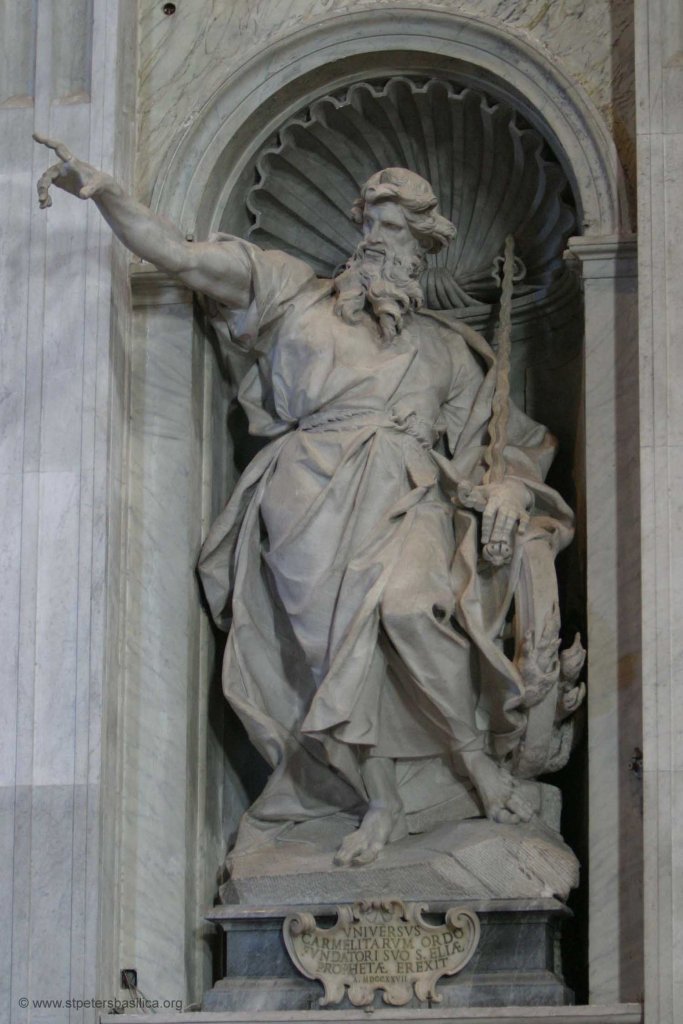
Statue of Elijah pointing, by Agostino Cornacchini (1727) at St Peter’s Basilica, Vatican City

Repentance & Restoration (Advent 2)

Click here to listen to the audio recording of this 21-minute message. Or watch the video here on Facebook (the message starts about 35 minutes into the recording). Or read the text summary below.

Today (Sunday 10 December) is the Second Sunday in Advent, a season in which we remember and celebrate Christ’s first coming into the work and prepare ourselves for his second coming into the world.

Two key themes emerge from our readings: repentance and redemption.

Central to our preparation for Christ’s coming is repentance of sin:

  • Mark 1 speaks of John’s ministry of a call to prepare for Christ’s coming, to a baptism of repentance of sin, and to confession,
  • Isaiah 40 speaks of the sins of the people of Israel,
  • Psalm 85 refers to our iniquity and sin, and warns us of God’s wrath and anger, and
  • 2 Peter 3 calls us to repentance and warns of the possibility of us perishing.

Repentance is an important part of our lives as followers of Christ. The Greek word for repentance means to turn around – a 180 degree about turn. In repentance, we turn away from sin and towards God. It is a reorientation of ourselves in relation to God and sin. This is the most important work we can do during Advent, as we prepare for Christ.

Repentance leads to restoration. Through repentance, we are stored into our fellowship with God and experience the blessings of God in our lives:

  • Mark 1 speaks of John’s baptism of repentance leading to God’s forgiveness of our sins,
  • Isaiah 40 uses the most wonderful language, starting with “comfort, comfort my people”, tenderly, our hard service is complete, sin is paid for, valleys will be raised up and mountains made low, rough ground becomes levels and rugged places a plain, we all (humans) will see God’s glory and restoration, and God will tenderly gather, carry and lead us,
  • Psalm 85 says that God will restore us again and revive is again, That we will be together in righteousness and peace, that righteousness and peace will kiss, that faithfulness will spring up while righteousness will look down, and that God will give us what is good, and
  • 2 Peter 3 speaks of God’s patience with us, of a new heaven and earth, of us becoming spotless, blameless and at peace with God, and that God’s patience means our salvation.

These wonderful words of restoration are the fruit of repentance. As we turn 180 degrees away from sin and towards God, something most of us have to do daily (even hourly or minutely!), God forgives and restores. This is the great gift of God’s son – Jesus comes into our world to forgive and restore.